What is an account aggregator?
An account aggregator (AA) is an RBI-regulated entity that enables individuals and businesses to securely and digitally share their financial information from one financial institution to another — only with explicit consent.
It acts as a secure intermediary (often described as a “data pipe”) between
- Institutions that hold your financial data (banks, mutual funds, insurance companies, etc.)
- Institutions that need your data to offer services (lenders, wealth managers, insurers, etc.)
Important points:
- An account aggregator does not store your financial data.
- This system cannot read or process your data.
- It only transfers encrypted data from one party to another after permission is granted.
Simply, instead of uploading bank statements, salary slips, or investment proofs every time you apply for a loan or financial product, you can simply give consent through an Account Aggregator. The required data are shared digitally and securely in real time.
How Does an Account Aggregator Work?
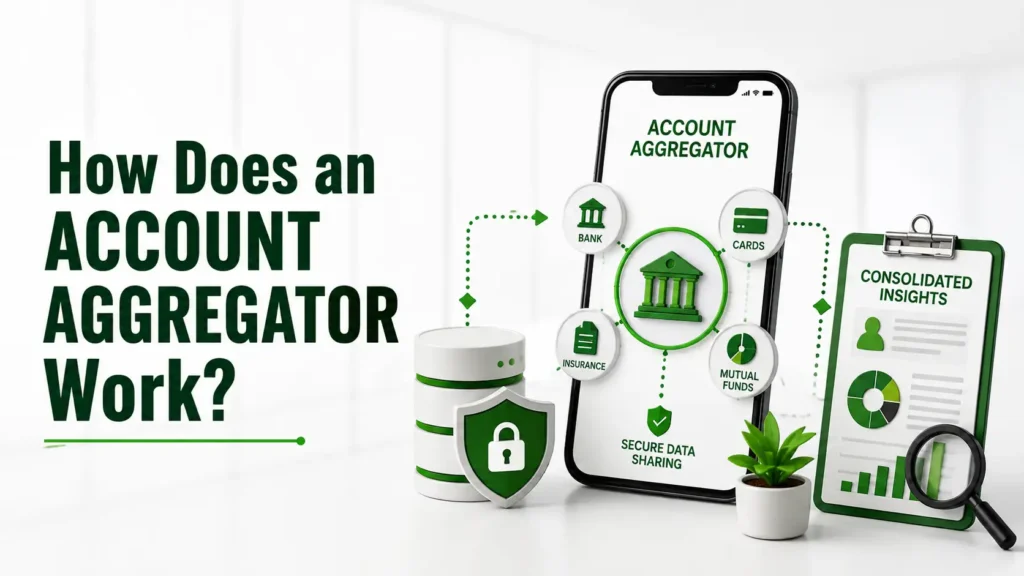
Here is the step-by-step process.
- You register with an RBI-licensed Account Aggregator of your choice.
- You link your financial accounts (bank accounts, mutual funds, insurance policies, etc.).
- When a financial service provider (for example, a bank offering a loan) needs your data, it sends a request through an Account Aggregator.
- The Account Aggregator requests your consent. You decide:
- What data can be shared
- With whom
- For how long
- Once approved, the account aggregator fetches the encrypted data from the relevant institutions and securely delivers them to the requesting party.
- You can revoke your consent at any time.
The entire process is digital, consent-based, and conducted in real-time.
Key Participants in the Account Aggregator Ecosystem
| Participant | Full Form | Role |
|---|---|---|
| FIP | Financial Information Provider | Institutions that hold your data (Banks, NBFCs, Mutual Funds, Insurance companies, Pension funds, etc.) |
| AA | Account Aggregator | Consent manager and secure data transfer intermediary |
| FIU | Financial Information User | Institutions that use your data to provide services (Lenders, Wealth platforms, Insurers, etc.) |
| TSP | Technology Service Provider | Technology partners supporting the ecosystem |
| Certifiers | – | Bodies that verify technical standards (e.g., Sahamati) |
Key Features of Account Aggregators
- Consent-based sharing: No data is moved without explicit permission.
- No data storage — Account Aggregators do not retain financial information.
- End-to-end encryption: Data remain encrypted throughout the transfer.
- Real-time access: Latest financial information is shared instantly.
- Selective and time-bound sharing — You control exactly what is shared and for how long it is shared.
- Multi-institution connectivity — Data can be fetched from multiple banks, mutual funds, and other institutions simultaneously.
- Revocable consent — You can withdraw permission at any time.
Read Also: Home Loan vs Loan Against Property
Benefits of Using Account Aggregators
For Customers:
- Almost zero paperwork (no need to upload bank statements repeatedly)
- Faster loan and credit approvals
- Single view of all financial accounts in one place
- Better financial planning and decision-making
- Full control over personal financial data
- Improved access to credit for people with limited formal documents
For Lenders and Financial Institutions:
- Faster and more accurate credit assessment
- Access to verified, real-time data
- Reduced operational costs and errors
- Better risk evaluation
- Support for financial inclusion
Security and Privacy
Account Aggregators are designed with strong privacy and security principles.
- They do not store customer financial data.
- They cannot read or use the transferred data.
- All data transfers are encrypted.
- Explicit consent is mandatory for every sharing request made.
- Users can manage and revoke consents easily.
- The entire framework operates under strict guidelines.
This consent-based and data-blind architecture makes Account Aggregators significantly more secure than traditional methods of sharing financial documents.
Regulatory Framework
Account Aggregators are regulated by the Reserve Bank of India under the NBFC-Account Aggregator guidelines. The framework was designed through inter-regulatory coordination involving the RBI, SEBI, IRDAI, and PFRDA.
In June 2026, the RBI recognised Sahamati as the Self-Regulatory Organisation (SRO) for the Account Aggregator ecosystem. This has strengthened governance, standards, and trust across the network.
Read Also: Best SIP Plan 2026
Current Status of Account Aggregator in India (2026)
As of mid-2026, the Account Aggregator ecosystem has grown substantially.
- 17 operational Account Aggregators
- Over 170 Financial Information Providers (FIPs)
- More than 1,000 Financial Information Users (FIUs)
- Hundreds of millions of linked accounts and consent requests fulfilled
- Widespread use in lending, with expanding adoption in insurance, wealth management, personal finance management, and capital markets
The framework is also gradually expanding to include additional data sources, such as GST, and discussions around other datasets, further increasing its utility.
How to Use an Account Aggregator
- Choose an RBI-licensed Account Aggregator app.
- Complete registration and KYC processes.
- Link your bank, investment, and other financial accounts to your credit card.
- When applying for a loan or financial product, consent is given through the AA app when requested.
- Monitor and manage your consent from the AA dashboard.
Registration is voluntary and usually free for customers.
Conclusion
Account Aggregators represent a major step forward in India’s open finance journey. By enabling secure, consent-based, and real-time sharing of financial data, they reduce friction in accessing credit and other financial services while placing customers firmly in control of their information.
As adoption continues to grow across lending, wealth, insurance, and personal finance use cases, Account Aggregators are becoming a foundational layer of India’s digital financial ecosystem, much like UPI did for payments.
Using an account aggregator can make the process faster, simpler, and more transparent if you are applying for a loan or managing multiple financial accounts.