What is an Index Fund?
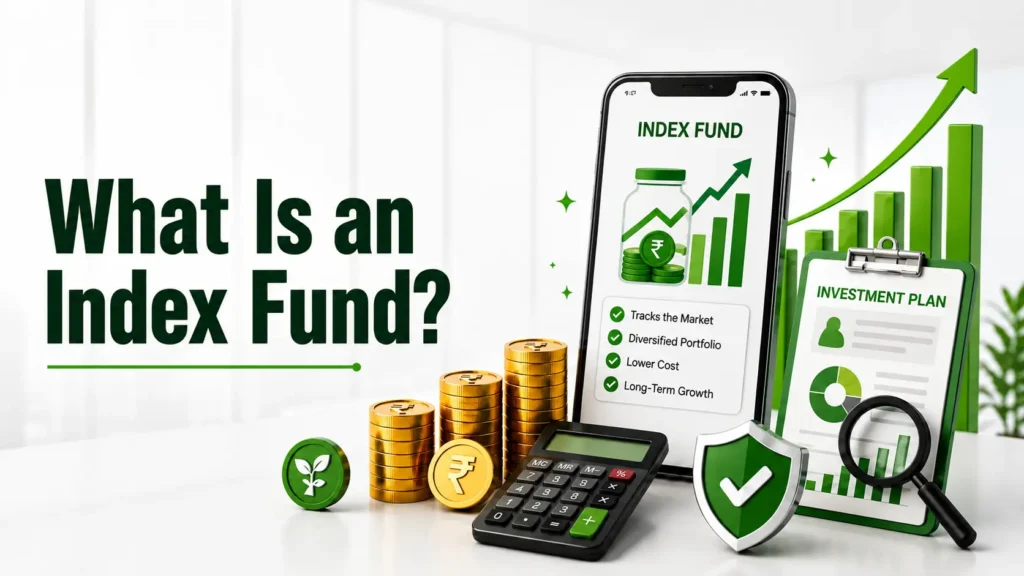
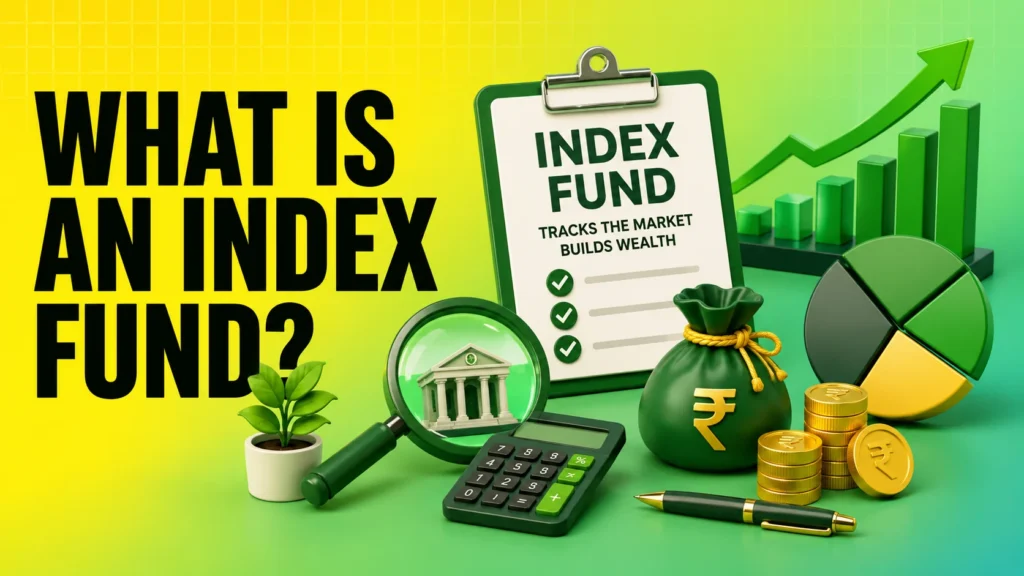
An index fund is a type of mutual fund (or exchange-traded fund) that aims to replicate the performance of a specific market index, such as the Nifty 50 or Sensex in India or the S&P 500 internationally.
Instead of a fund manager actively selecting stocks to try and beat the market, the fund simply holds the same stocks that make up the index in the same proportion. The goal is not to outperform the index but to closely match its returns (minus small costs).
You cannot invest directly in a market index. Index funds provide an easy and indirect way to do so. This passive approach differentiates them from traditional actively managed mutual funds.
Read Also: Best SIP Plan 2026
How Do Index Funds Work?
Index funds follow a passive investment strategy.
- This fund tracks a predetermined index.
- It invests in all (or a representative sample) of the securities that form the index, with the same weightage.
- When the index composition changes (a company is added or removed), the fund automatically adjusts its holdings.
- There is minimal buying and selling of stocks, which keeps the costs low.
- The fund returns closely follow the index returns, reduced by the expense ratio and any tracking difference.
Because there is no active stock selection or frequent trading, these funds require less human intervention and research. The slight difference between the fund’s performance and the index is known as tracking error. Lower tracking errors are generally better.
Types of Index Funds
Index funds are available across different categories.
- Broad Market Index Funds: Track major indices, such as Nifty 50 or Sensex, and provide diversified exposure to the overall market.
- Market Capitalization Weighted Funds: Give higher weight to larger companies (most common type).
- Equal-weight index funds: Give the same weight to every stock in the index, irrespective of its size.
- Sectoral or Thematic Index Funds: Focus on specific sectors, such as banking, technology, or healthcare.
- International Index Funds: Track global indices (subject to SEBI investment limits).
- Debt index funds: Track fixed-income or bond indices.
- Smart Beta/Factor-based Funds: Follow indices built on factors such as value, quality, or low volatility.
- Newer variants (as of 2026): REIT-oriented and other specialized passive funds are also emerging.
Benefits of Investing in Index Funds
- Low Cost: Expense ratios are significantly lower than those of actively managed funds because there is no need for extensive research teams or frequent trading. Recent SEBI regulations (effective April 2026) have further improved cost transparency and capped certain charges for index funds and ETFs.
- Broad Diversification: One fund gives exposure to dozens or hundreds of stocks across sectors, thereby reducing the impact of any single company’s poor performance.
- Simplicity and Transparency: Investors always know what the fund holds because it mirrors a public index.
- Consistent Market-Linked Returns: Over long term, they capture the overall growth of the market without the risk of underperforming due to poor stock selection.
- Tax Efficiency: Lower portfolio turnover generally leads to fewer taxable events than active funds.
- Ideal for Long-Term Investing: Suitable for wealth creation over 5–10 years or more with a “set it and forget it” approach.
Limitations and Risks of Index Funds
- They do not outperform the market. Their returns closely match the index (minus costs).
- Full market downside risk remains; if the index falls, the fund will also fall.
- Tracking errors can cause small deviations from index performance.
- Limited flexibility to react to sudden market changes or avoid underperforming stocks.
- There is no control over the individual stocks held in the portfolio.
Similar to any equity investment, index funds carry market risk and are best suited for investors with a medium-to long-term horizon.
Index Funds vs Actively Managed Funds and ETFs
| Aspect | Index Funds | Actively Managed Funds | ETFs |
|---|---|---|---|
| Strategy | Passive (track index) | Active (try to beat market) | Passive (track index) |
| Cost | Very low | Higher | Usually lowest |
| SIP Facility | Available | Available | Limited or not available |
| Demat Account | Not required | Not required | Required |
| Trading | End-of-day NAV | End-of-day NAV | Real-time on exchange |
| Potential to Outperform | No | Yes (but not guaranteed) | No |
Index funds are often preferred by investors who want simplicity and low costs, whereas ETFs suit investors who are comfortable with demat accounts and real-time trading.
Taxation of Index Funds in India (as of 2026)
Equity-oriented index funds (those with at least 65% investment in domestic equities) are taxed the same as equity mutual funds.
- Short-term capital gains (holding period of 12 months or less): Taxed at 20%.
- Long-term capital gains (holding period of more than 12 months): Gains up to ₹1.25 lakh in a financial year are exempt. Gains above ₹1.25 lakh are taxed at 12.5%.
These rates have been applicable since the changes introduced in the Union Budget 2024 and are in force. Debt index funds and certain specialized funds (such as some international or REIT-oriented funds) follow different tax rules.
Always check the latest tax treatment for a specific fund before investing, as classification can affect taxation.
Read Also: Difference Between SIP and Mutual Fund
How to Invest in Index Funds in India

- Decide which index you want to track (e.g., Nifty 50, Nifty Next 50, Sensex).
- Compare available funds based on parameters such as expense ratio, tracking error, and assets under management (AUM).
- Choose between Direct and Regular plans (direct plans have lower costs).
- Invest through:
- Mutual fund websites or apps of Asset Management Companies
- Online investment platforms
- Your bank’s digital platforms
- SIP (Systematic Investment Plan) or lump sum
- Complete KYC if not already done and start investing.
You can invest in index funds in the mutual fund form without a demat account.
Who Should Invest in Index Funds
Index funds are suitable for the following:
- First-time and beginner investors
- Long-term investors focused on wealth creation
- Busy professionals who prefer a hands-off approach
- Investors who believe in the long-term growth of the overall market
- Those looking for low-cost diversification
They work best when held for five years or more.
Key Things to Consider Before Investing
- Look for low expense ratios and low tracking errors.
- Prefer funds with reasonable AUM for better liquidity and stability.
- Match the index with your risk appetite and investment objectives.
- Stay invested through market cycles rather than reacting to short-term volatility.
- Review the fund’s portfolio and performance periodically, but avoid frequent changes.
Conclusion
Index funds offer a straightforward, cost-effective, and transparent method of investing in the stock market. By tracking a market index, they remove the complexity of stock selection while providing broad diversification and long-term market-linked returns.
With improving cost structures under recent SEBI regulations and the growing popularity of passive investing in India, index funds continue to be a strong core holding for many investor portfolios in 2026.
As with any investment, align index funds with your financial goals, risk tolerance, and time horizons. Consider consulting a financial advisor if you need to make investment decisions.