What Is an Index Fund?
An Index Fund is a type of mutual fund that aims to replicate the performance of a specific market index instead of trying to outperform it.
Rather than selecting individual stocks based on research, an Index Fund invests in the same companies that make up its benchmark index and generally in similar proportions. If the benchmark changes, the fund adjusts its portfolio accordingly.
For example, an Index Fund tracking the Nifty 50 invests in companies included in the Nifty 50 Index. Likewise, a Sensex Index Fund follows the composition of the Sensex.
Because the investment strategy is rule-based and passive, Index Funds usually require less active management.
Key Features of an Index Fund
- Tracks a specific market index
- Uses a passive investment strategy
- Generally has a lower expense ratio
- Offers broad diversification
- Suitable for long-term wealth creation
- Portfolio changes mainly when the benchmark index changes
What Is a Mutual Fund?
A Mutual Fund is an investment vehicle that pools money from multiple investors and invests it in a diversified portfolio of financial assets such as stocks, bonds, or money market instruments.
Most mutual funds are managed by professional fund managers who research companies, analyze market trends, and make investment decisions on behalf of investors. Their objective is often to generate better risk-adjusted returns than the benchmark index.
Depending on their investment strategy, mutual funds are available in several categories, including:
- Equity Mutual Funds
- Debt Mutual Funds
- Hybrid Mutual Funds
- ELSS (Tax-Saving) Funds
- Sectoral and Thematic Funds
- International Funds
Each category serves a different investment objective, making it important to choose a fund that aligns with your financial goals
Index Fund vs Mutual Fund: Quick Comparison
| Feature | Index Fund | Mutual Fund |
|---|---|---|
| Investment Style | Passive | Usually Active |
| Objective | Track a market index | Attempt to outperform the market |
| Portfolio Management | Rule-based | Managed by a fund manager |
| Expense Ratio | Generally Lower | Usually Higher |
| Portfolio Changes | Based on index changes | Based on investment decisions |
| Risk Level | Follows market performance | Depends on the fund strategy |
| Suitable For | Long-term and passive investors | Investors seeking active management |
Index Fund vs Mutual Fund: Key Differences

Understanding the differences between these two investment options can help you choose the one that best fits your financial objectives.
1. Investment Strategy
The biggest difference lies in how the portfolio is managed.
An Index Fund follows a passive investment strategy. It simply tracks a benchmark index and does not attempt to outperform the market.
An actively managed Mutual Fund, on the other hand, relies on the expertise of a fund manager who selects investments based on market research, company analysis, and investment opportunities.
2. Fund Management
In an Index Fund, the fund manager’s role is mainly to ensure that the fund closely mirrors the benchmark index.
In a Mutual Fund, the fund manager actively decides which securities to buy, hold, or sell with the objective of improving returns or managing risk.
This difference in management style is one of the primary reasons the two investment options have different costs and performance expectations.
3. Expense Ratio
The expense ratio represents the annual cost of managing a fund.
Since Index Funds require limited active management, they generally have lower operating expenses.
Actively managed Mutual Funds often involve higher research, trading, and portfolio management costs, which may result in a higher expense ratio.
Although the difference may seem small, expenses can affect long-term investment returns over time.
4. Investment Objective
An Index Fund aims to match the performance of its benchmark as closely as possible.
An actively managed Mutual Fund seeks to outperform its benchmark through stock selection and active portfolio management.
Neither objective is inherently better—the right choice depends on an investor’s expectations and investment strategy.
5. Transparency
Index Funds are generally considered more transparent because investors know exactly which benchmark they follow.
Actively managed Mutual Funds may change their holdings based on market conditions and investment decisions, making their portfolios more dynamic.
Index Fund vs Mutual Fund: Which Offers Better Returns?
One of the most common questions investors ask is:
“Which provides higher returns—an Index Fund or a Mutual Fund?”
The truth is that there is no guaranteed winner.
An Index Fund aims to match the performance of its benchmark index. If the benchmark grows over time, the fund is expected to deliver similar returns after accounting for expenses and tracking differences.
An actively managed Mutual Fund follows a different approach. Fund managers research companies, evaluate market trends, and build portfolios with the goal of outperforming the benchmark.
While some actively managed funds have outperformed their benchmarks over certain periods, others have underperformed. Investment performance depends on several factors, including market conditions, the fund manager’s strategy, portfolio allocation, and investment discipline.
Read Also: What Is Expense Ratio?
Understanding Investment Risk
Every investment carries some level of risk. The important question is not whether an investment has risk, but whether the level of risk matches your financial profileRisk in Index Funds
Since an Index Fund tracks a market index, its performance moves with the market.
If the benchmark index rises, the fund generally appreciates in value. If the market declines, the investment may also lose value.
However, because most benchmark indices include multiple companies across different sectors, Index Funds usually offer built-in diversification that helps reduce company-specific risk.
Risk in Mutual Funds
Risk in Mutual Funds depends on the type of fund and its investment strategy.
For example:
- Large-cap funds generally invest in well-established companies and may experience relatively lower volatility.
- Mid-cap and small-cap funds can offer higher growth potential but often involve greater market fluctuations.
- Sectoral and thematic funds focus on specific industries and may carry higher concentration risk.
Because actively managed funds rely on investment decisions made by fund managers, their performance may vary depending on market conditions and portfolio management.
Advantages of Index Funds
- Lower expense ratios
- Simple and transparent investment approach
- Broad diversification
- Easy to understand for beginners
- Suitable for long-term investing
- Less dependence on individual stock selection
Limitations of Index Funds
- Designed to match the market, not outperform it
- Returns depend entirely on benchmark performance
- Investors cannot benefit from active stock selection during favorable market opportunities
Advantages of Mutual Funds
- Professionally managed portfolios
- Wide variety of investment categories
- Potential to outperform benchmark indices
- Goal-based investment options
- Greater flexibility in portfolio management
Limitations of Mutual Funds
- Higher expense ratios in many actively managed funds
- Performance depends on fund management decisions
- Not every fund consistently beats its benchmark
- Requires careful fund selection before investing
Common Mistakes to Avoid Index Fund and Mutual Fund
Selecting the right investment isn’t just about comparing returns. Many investors make decisions based on short-term trends or incomplete information, which can affect their long-term financial goals.
Here are some common mistakes to avoid.
1. Chasing Past Performance
Many investors choose a fund simply because it delivered impressive returns in the past.
However, past performance does not guarantee future results. Markets change, economic conditions evolve, and investment strategies may perform differently over time.
Instead of focusing only on historical returns, consider factors such as investment objective, risk level, consistency, and costs.
2. Ignoring the Expense Ratio
Even a small difference in the expense ratio can have a noticeable impact on long-term wealth creation.
When comparing similar funds, it’s important to understand how management costs may affect your overall investment returns over time.
3. Investing Without Understanding Your Risk Tolerance
Every investor has a different financial situation and investment objective.
Choosing a fund that doesn’t match your risk tolerance can lead to unnecessary stress during market volatility and may result in poor investment decisions.
4. Focusing Only on Short-Term Market Movements
Equity investments naturally experience periods of growth and decline.
Making investment decisions based solely on short-term market fluctuations may prevent you from achieving long-term financial goals.
A disciplined investment approach is often more effective than reacting to temporary market movements.
5. Not Diversifying Your Portfolio
Putting all your money into a single investment category may increase overall portfolio risk.
Diversification across different asset classes and investment products can help reduce concentration risk and improve long-term portfolio stability.
Final Verdict
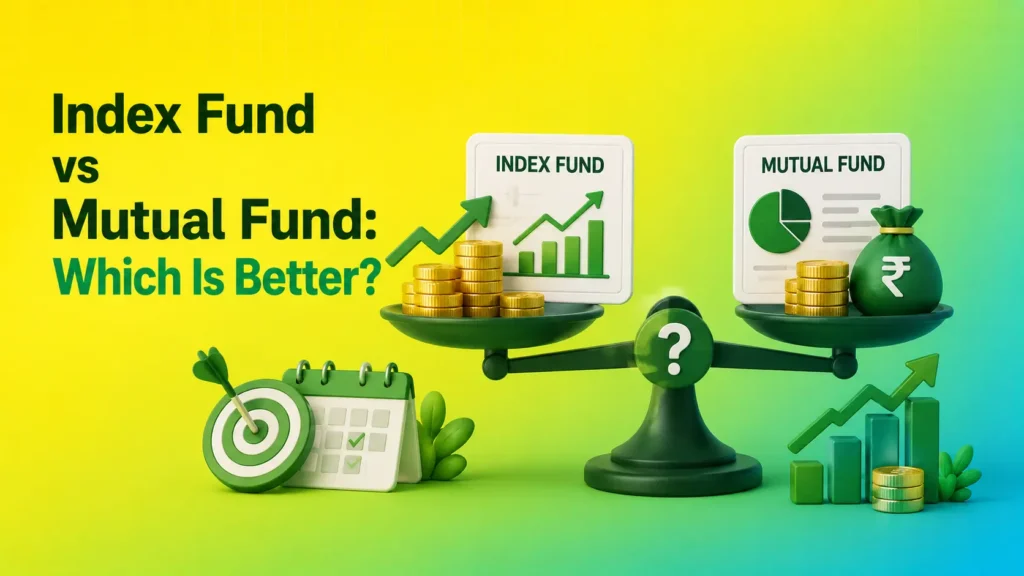
When comparing Index Fund vs Mutual Fund, there is no one-size-fits-all answer.
If your priority is low investment costs, broad market exposure, and long-term passive investing, an Index Fund may be a suitable option.
If you prefer professional portfolio management and are comfortable with the possibility of higher costs in exchange for potential outperformance, an actively managed Mutual Fund may better align with your investment strategy.
Rather than asking which investment is universally better, ask which one is more appropriate for your personal financial goals.
The best investment decision is one that supports your long-term objectives, matches your risk tolerance, and fits your overall financial plan.