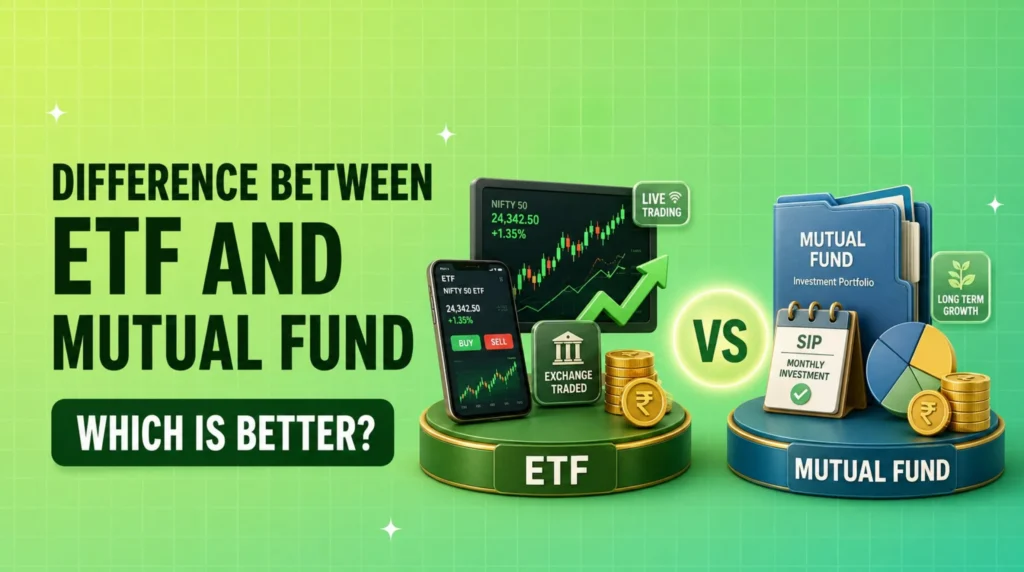
Many beginners want to invest in the stock market but do not want to pick individual stocks. That is where ETFs and mutual funds become useful. Both options allow investors to invest in a group of stocks, bonds, or other assets through a single investment product.
However, many people get confused about the difference between ETF and mutual fund. At first, both may look similar because they offer diversification and professional fund structure. But the way they are bought, sold, priced, managed, and used by investors is different.
For Indian investors, understanding this difference is important before starting investment. If you want simple investment, SIP convenience, and professional fund management, mutual funds may feel easier. But if you want stock-like trading, low cost, and market price flexibility, ETFs can be useful.
In this guide, we will understand ETF vs mutual fund in simple words, their benefits, risks, differences, and which one may be better for beginners.
What is an ETF?
ETF stands for Exchange-Traded Fund. It is a type of investment fund that usually tracks an index, sector, commodity, or asset basket. For example, an ETF may track Nifty 50, Sensex, banking sector, gold, or government bonds.
The main feature of an ETF is that it is traded on the stock exchange, just like shares. This means investors can buy and sell ETF units during market hours through a Demat and trading account.
For example, if you buy a Nifty 50 ETF, you are indirectly getting exposure to the companies included in the Nifty 50 index. You do not need to buy all 50 stocks separately. One ETF unit gives you exposure to the overall basket.
ETFs are generally popular among investors who want low-cost, transparent, and market-linked investment options.
What is a Mutual Fund?
A mutual fund is an investment scheme where money from many investors is collected and invested in stocks, bonds, money market instruments, or other assets. A professional fund manager manages this money according to the fund’s objective.
For example, an equity mutual fund may invest mainly in shares. A debt mutual fund may invest in bonds and fixed-income instruments. A hybrid mutual fund may invest in both equity and debt.
Mutual funds can be actively managed or passively managed. In actively managed funds, the fund manager selects investments with the goal of beating the benchmark. In passive funds, the fund simply tracks an index.
Mutual funds are usually bought and sold through an Asset Management Company, investment platform, bank, broker, or app. They are not traded like stocks during market hours. Most mutual fund transactions happen at the day-end NAV.
Difference Between ETF and Mutual Fund: Quick Comparison
| Basis | ETF | Mutual Fund |
|---|---|---|
| Full Form | Exchange-Traded Fund | Mutual Fund |
| Buying Method | Bought and sold on stock exchange | Bought from AMC, broker, app, or platform |
| Pricing | Market price changes during trading hours | NAV is calculated at end of the day |
| Demat Account | Usually required | Not always required |
| SIP Convenience | Possible but less simple than mutual funds | Easy SIP facility available |
| Cost | Usually lower expense ratio | Can be higher, especially active funds |
| Trading Style | Like stocks | Like fund units |
| Management | Mostly passive | Active and passive both |
| Best For | Investors who understand market orders and Demat | Beginners who want simple investing |
| Liquidity | Depends on trading volume | AMC handles redemption |
How ETFs and Mutual Funds Work
ETFs work like a combination of mutual funds and stocks. Like mutual funds, they hold a basket of assets. But like stocks, they trade on the exchange. Their price can move during the trading day based on demand, supply, and underlying asset value.
For example, if a Nifty ETF tracks the Nifty 50 index, its value will move with the index. But because it trades on the exchange, the buying and selling price may slightly differ from its actual NAV.
Mutual funds work differently. When you invest in a mutual fund, your money is pooled with money from other investors. The fund manager invests that money based on the scheme objective. At the end of each business day, the fund’s NAV is calculated.
If you invest in a mutual fund today before the cut-off time, you usually get units based on that day’s NAV. You do not trade it live like a stock.
This is one of the biggest differences between ETF and mutual fund.
Key Differences Between ETF and Mutual Fund
Trading Method
ETFs are traded on the stock exchange. You need to place a buy or sell order through your trading account, just like buying a share. You can buy or sell during market hours.
Mutual funds are not traded like shares. You invest through an AMC, broker, investment app, bank, or mutual fund platform. The transaction happens based on NAV, not live market price.
So, if you want real-time buying and selling, ETFs offer that flexibility. If you want a simple investment process without watching market price, mutual funds are easier.
Pricing System
ETF prices keep changing throughout market hours. The price depends on market movement, demand, supply, and the value of the underlying assets.
Mutual funds are priced based on NAV. NAV means Net Asset Value. It is calculated at the end of the trading day. Investors get units based on the applicable NAV.
This means ETF investors may buy at different prices during the same day, while mutual fund investors usually get the NAV declared at the end of the day.
For beginners, mutual fund pricing is simpler. For active investors, ETF pricing gives more control.
Investment Cost
ETFs usually have lower expense ratios, especially because many ETFs are passively managed. They simply track an index or asset basket, so fund management costs can be lower.
Mutual funds can have higher costs, especially actively managed equity funds. The fund manager and research team actively select stocks, which can increase the expense ratio.
However, ETF investors should also consider brokerage charges, Demat account charges, bid-ask spread, and other trading-related costs. So, low expense ratio alone should not be the only decision factor.
Mutual funds may have expense ratios too, but for regular SIP investors, the process is usually more convenient.
Liquidity
ETF liquidity depends on trading volume on the stock exchange. If an ETF has high trading volume, buying and selling becomes easier. If trading volume is low, you may face a wider difference between buying and selling price.
Mutual fund liquidity depends on the redemption process of the fund house. When you redeem mutual fund units, the AMC processes your request as per fund rules. The money usually comes to your bank account within the applicable settlement period.
For highly traded ETFs, liquidity can be good. But for low-volume ETFs, investors should be careful.
Fund Management
Most ETFs are passively managed. They aim to track an index, commodity, or sector. The goal is not usually to beat the market, but to replicate the performance of the benchmark.
Mutual funds can be active or passive. In active mutual funds, a fund manager tries to select better stocks and beat the benchmark. In passive mutual funds, the fund tracks an index.
This is an important difference between ETF and mutual fund. ETFs are more suitable for investors who believe in passive investing, while mutual funds offer both active and passive choices.
SIP Availability
Mutual funds are very popular for SIP investing. SIP stands for Systematic Investment Plan. It allows you to invest a fixed amount regularly, such as monthly.
For example, you can start a SIP of ₹500, ₹1000, or ₹5000 in a mutual fund, depending on the scheme. The amount is automatically deducted from your bank account.
ETFs can also be bought regularly, but the process is not always as smooth as mutual fund SIPs. You may need to place orders manually or use broker-based options if available. Also, ETF prices change during market hours, so exact unit purchase may vary.
For beginners, mutual fund SIP is usually easier to understand and manage.
Demat Account Requirement
To invest in ETFs, you generally need a Demat account and trading account because ETFs are bought and sold on the stock exchange.
For mutual funds, a Demat account is not always required. You can invest directly through AMC websites, mutual fund platforms, banks, brokers, or investment apps.
This makes mutual funds more accessible for beginners who do not want to open or manage a trading account.
However, if you already invest in stocks and have a Demat account, ETFs can be easy to access.
Risk and Return
Both ETFs and mutual funds carry market risk. If the underlying assets fall in value, your investment value can also fall.
ETF returns depend on the performance of the index, sector, commodity, or asset it tracks. For example, a Nifty ETF will broadly move with Nifty 50.
Mutual fund returns depend on the fund type and management style. An actively managed mutual fund may perform better or worse than its benchmark. A passive mutual fund will usually try to track the index.
In simple words, ETFs are not risk-free, and mutual funds are not guaranteed-return products. Both require proper understanding, time horizon, and risk tolerance.
Benefits of ETFs
ETFs offer several benefits for investors who understand market-based investing.
One major benefit is low cost. Since many ETFs are passively managed, their expense ratio is generally lower compared to many active mutual funds. This can help long-term investors reduce investment costs.
Another benefit is trading flexibility. ETFs can be bought and sold during market hours. Investors can use limit orders and choose their buying price more actively.
ETFs also provide diversification. A single ETF can give exposure to many stocks, bonds, or commodities. For example, a Nifty ETF gives exposure to the Nifty index instead of one company.
ETFs are also transparent. Investors can usually see what index or asset the ETF is tracking.
Benefits of Mutual Funds
Mutual funds are popular because they are simple and beginner-friendly.
The biggest benefit is convenience. Investors can start SIPs easily and invest regularly without tracking market prices every day. This is useful for salaried people and beginners.
Mutual funds also offer many choices. You can invest in equity funds, debt funds, hybrid funds, index funds, ELSS funds, liquid funds, and more.
Another benefit is professional fund management. In active mutual funds, experienced fund managers select investments based on research and market strategy.
Mutual funds are also accessible without a Demat account in many cases. This makes the investment process easier for first-time investors.
ETF vs Mutual Fund: Which Is Better for Beginners?
For most beginners, mutual funds are usually easier to start with because they offer simple SIP options, easy investment platforms, and no need to understand stock exchange trading.
A beginner can start with a mutual fund SIP, choose a suitable fund category, and invest monthly. The process is simple and less stressful.
ETFs may be better for investors who already understand market orders, Demat accounts, bid-ask spread, and stock exchange trading. ETFs can be cost-effective, but they require slightly more involvement.
So, if you are a complete beginner, mutual funds may be more convenient. If you already use a trading account and want low-cost passive exposure, ETFs can be a good option.
Who Should Invest in ETFs?
ETFs may be suitable for investors who want low-cost investing and are comfortable using a Demat and trading account.
They are also useful for investors who prefer passive investing. If you want to track an index like Nifty 50 or Sensex without selecting individual stocks, an ETF can help.
ETFs can also be useful for investors who want intraday liquidity and price control. Since ETFs trade during market hours, you can decide when to buy or sell.
However, ETFs are better for people who understand market price, trading volume, bid-ask spread, and brokerage charges.
Who Should Invest in Mutual Funds?
Mutual funds may be suitable for investors who want simple and regular investing.
If you are a salaried person and want to invest monthly through SIP, mutual funds are convenient. You can automate your investment and build wealth over time.
Mutual funds are also suitable for investors who want professional fund management. If you do not want to choose stocks or track market movements daily, mutual funds can help.
Beginners, students, working professionals, and long-term investors often find mutual funds easier to manage.
Common Mistakes to Avoid Before Investing
One common mistake is choosing ETFs only because they have low expense ratios. You should also check liquidity, tracking error, brokerage, and whether the ETF fits your goal.
Another mistake is investing in mutual funds without understanding the fund category. Equity funds, debt funds, hybrid funds, and sector funds have different risk levels.
Many beginners also ignore time horizon. If you need money in the short term, equity ETFs or equity mutual funds may not be suitable due to market volatility.
Some investors invest only by looking at past returns. Past performance does not guarantee future returns. Always check risk, cost, consistency, fund objective, and your personal financial goal.
Another mistake is stopping SIPs during market corrections. Long-term investing needs patience and discipline.
Final Verdict
The difference between ETF and mutual fund is mainly in how they are traded, priced, managed, and used by investors.
ETFs are traded on the stock exchange like shares. They usually offer low cost, transparency, and trading flexibility. But they generally require a Demat account and some understanding of market trading.
Mutual funds are easier for regular investors because they offer simple SIP options, professional fund management, and easy access through multiple platforms. They are often more beginner-friendly.
So, which is better?
If you want simplicity, SIP convenience, and professional management, mutual funds may be better. If you want low-cost passive investing and are comfortable with stock exchange trading, ETFs can be useful.
The best choice depends on your goal, risk tolerance, investment knowledge, and time horizon.
FAQs
What is the main difference between ETF and mutual fund?
The main difference between ETF and mutual fund is that ETFs are traded on the stock exchange like shares, while mutual funds are bought and sold based on NAV through AMC, broker, or investment platforms.
Is ETF better than mutual fund?
ETF can be better for investors who want low-cost passive investing and trading flexibility. Mutual funds can be better for beginners who want easy SIP investment and professional fund management.
Can I do SIP in ETF?
ETF investing can be done regularly, but traditional SIP convenience is usually easier in mutual funds. In ETFs, you generally need a Demat and trading account to buy units.
Do ETFs need a Demat account?
Lorem ipsum dolor sit amet, consectetur adipiscing elit. Ut elit tellus, luctus nec ullamcorper mattis, pulvinar dapibus leo.
Which is better for beginners: ETF or mutual fund?
For most beginners, mutual funds are easier because they offer simple SIP options, easy investment process, and no need to trade on the stock exchange directly.