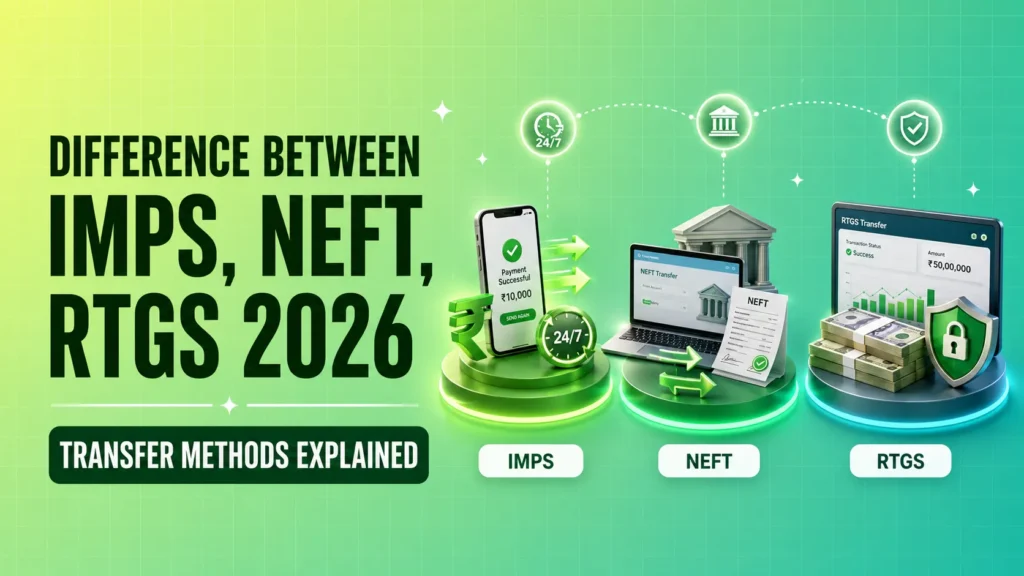
Have you ever opened your bank app to send money and seen options like IMPS, NEFT, and RTGS, and felt confused about which one to choose?
Choosing the wrong option can lead to payment delays or sometimes extra charges. That’s why understanding the basic difference between these three is very important. And if you want to manage your finances even better, start by learning how to do financial planning — because choosing the right payment method is also a part of smart financial planning.
What are IMPS, NEFT, and RTGS?
IMPS, NEFT, and RTGS are popular online money transfer systems in India used to send money from one bank account to another.
All three serve the same purpose, but they differ in speed, transaction limits, and usage. These systems mainly work through bank accounts — if you don’t know the difference between a Saving Account and a Current Account, make sure to read that first before choosing any transfer method.
What is IMPS?
IMPS stands for Immediate Payment Service. As the name suggests, money is transferred instantly, usually within seconds.
It is available 24×7 and is best for small and urgent payments. If you need to send money immediately, IMPS is the fastest option.
What is NEFT?
NEFT stands for National Electronic Funds Transfer. It is a traditional system where transactions are processed in batches.
This means the money is not transferred instantly and may take some time. However, it is a reliable and safe option for normal and routine payments. NEFT is commonly used for monthly transactions like rent or salary. If you want to track your income and expenses better, explore our personal finance blogs for useful tips.
What is RTGS?
RTGS stands for Real-Time Gross Settlement. This system is designed mainly for large-value transactions.
Money is transferred in real time, but the minimum transfer amount is ₹2 lakh. It is mostly used for business and high-value payments. Large transactions often involve loans as well — if you have recently taken a retail loan or any big loan, RTGS will be the most suitable transfer option for you.
Where You Actually Use Them
- If you need to send ₹2,000 urgently to a friend → IMPS is the best option because the money is transferred instantly.
- If you are sending monthly rent or salary where there is no urgency → NEFT is a safe and simple choice.
- If you are making a large payment like ₹5 lakh for property or a car → RTGS is the most suitable option. For such big purchases, people often take a Gold Loan or Personal Loan — both have different advantages depending on your situation.
Simple Difference Table
| Feature | IMPS | NEFT | RTGS |
|---|---|---|---|
|
Speed
|
Instant |
Slow (batch)
|
Instant |
|
Minimum Amount |
₹1 |
₹1 |
₹2 lakh
|
|
Best Use
|
Urgent payments
|
Normal payments
|
Large transactions
|
|
Availability
|
24×7 |
24×7 |
24×7 |
Final Conclusion
IMPS, NEFT, and RTGS all serve different purposes. If you need fast payment, IMPS is best. For normal transactions, NEFT is suitable. And for large amounts, RTGS is the perfect choice.
A smart user is one who chooses the right method based on the situation, saving both time and effort while ensuring smooth transactions. And a truly smart user does not just transfer money — they also invest it wisely. If you want to start investing, check out our guide on the best personal finance websites in India.
FAQs
Q1. Which is the fastest among IMPS, NEFT, and RTGS?
IMPS and RTGS are both fast, but IMPS is more commonly used for small and instant payments.
Q2. How much time does NEFT take to transfer money?
NEFT transactions usually take between 30 minutes to a few hours because they are processed in batches.
Q3. What is the minimum amount for RTGS?
The minimum transfer amount for RTGS is ₹2 lakh.
Q4. Are all three systems available 24×7?
Yes, IMPS, NEFT, and RTGS are all available 24×7 nowadays.
Q5. Which is best for daily use?
IMPS is best for small and instant daily payments, while NEFT can also be used for normal routine transactions. And if you use a credit card for daily transactions, make sure you are aware of the important credit card rule changes in 2026.