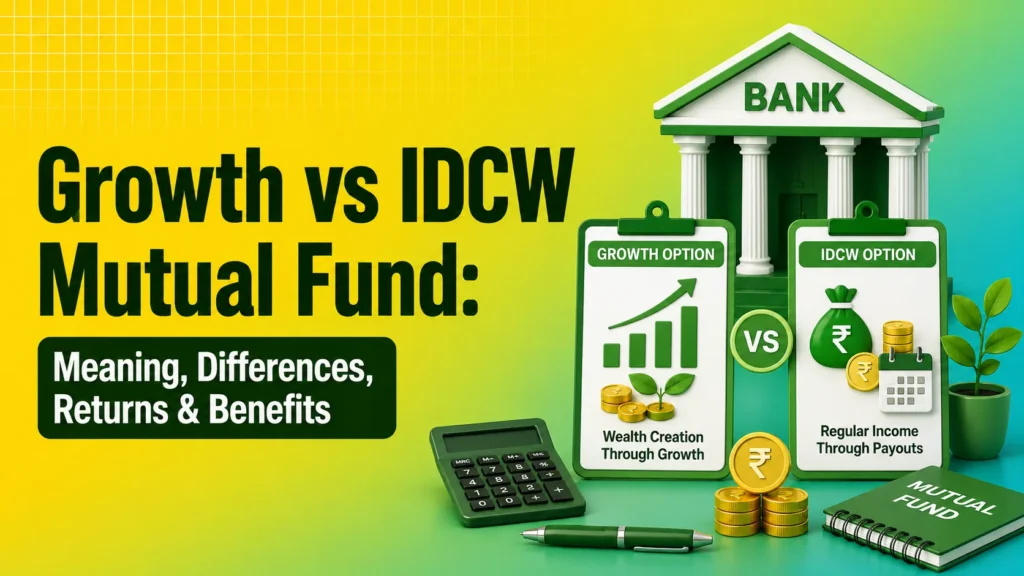
What Is a Growth Option in Mutual Funds?

A Growth option is a mutual fund option in which the profits generated by the fund are not paid out to investors. Instead, they remain invested in the scheme.
This allows the investment value to grow over time through compounding.
For example, if a mutual fund earns returns, they are added back to the investment value rather than being distributed separately.
Key Features of Growth Option:
- Returns remain invested in the mutual fund.
- No regular payout is provided to investors.
- Investment value can grow through compounding.
- Suitable for investors with long-term wealth creation goals.
- Commonly preferred by investors who do not need regular income.
What Is IDCW Option in Mutual Funds?

Income Distribution cum Capital Withdrawal (IDCW) is an option where the mutual fund may distribute income to investors from the available distributable surplus.
Previously, this option was commonly known as the dividend option. The term was changed to IDCW to clarify that the distribution may include income and capital components, depending on the scheme’s available surplus.
The distribution amount and frequency are not guaranteed because they depend on factors such as fund performance and the available surplus.
Read More: ELSS mutual funds
Key Features of IDCW Option:
- Investors may receive periodic payouts.
- Distribution is not guaranteed.
- The NAV generally reduces after distribution because money moves out of the scheme.
- Suitable for investors who prefer receiving cash flow from investments.
Growth vs IDCW Mutual Fund: Key Differences
| Feature | Growth Option | IDCW Option |
|---|---|---|
| Return handling | Returns remain invested | Possible distribution to investors |
| Regular income | Usually not provided | May provide payouts |
| Compounding benefit | Higher potential due to reinvestment | Lower compared to growth if payouts are taken |
| Investment value | Can increase as profits remain invested | NAV adjusts after distribution |
| Suitable for | Long-term wealth creation | Investors looking for possible income |
| Payout frequency | No payout | Depends on scheme decision and availability |
Growth vs IDCW: Difference in Returns

The main difference between Growth and IDCW options is not the fund’s performance. Both options invest in the same portfolio and are managed by the same fund manager.
The difference comes from how the returns are treated.
Growth Option Returns
In the Growth option:
- Profits remain invested.
- The investment value can benefit from compounding.
- Investors usually receive returns when they redeem their units.
This can be useful for long-term goals such as:
- Retirement planning
- Wealth creation
- Long-term savings
IDCW Option Returns
In the IDCW option:
- The mutual fund may distribute available surplus.
- Investors receive payouts when declared.
- The amount received is not an additional return; it is a distribution from the scheme.
Investors should understand that IDCW payouts can reduce the NAV of the mutual fund after distribution.
Growth vs IDCW Example
Suppose two investors invest in the same mutual fund scheme.
Investor A chooses the Growth option.
Investor B chooses the IDCW option.
If the scheme generates returns:
- Investor A’s returns remain invested and continue growing with the investment.
- Investor B may receive a distribution if the fund declares IDCW.
Over a long period, the Growth option may benefit more from compounding because profits remain invested.
However, investors who need periodic cash flow may prefer the IDCW option depending on their requirements.
Tax Difference Between Growth and IDCW Mutual Funds

Tax treatment depends on factors such as:
- Type of mutual fund
- Holding period
- Applicable tax laws at the time of redemption or distribution
Generally, investors should understand that taxation can differ between capital gains from selling mutual fund units and distributions received under IDCW.
Since tax rules may change, investors should check the latest tax regulations or consult a qualified tax professional before making investment decisions.
Benefits of Growth Mutual Fund Option
1. Helps in Long-Term Wealth Creation
Because returns remain invested, investors can benefit from compounding over longer periods.
2. Suitable for Long-Term Goals
Growth options are commonly preferred for goals such as:
- Retirement planning
- Child education
- Long-term wealth accumulation
3. No Regular Distribution Decision
Investors do not need to decide whether to reinvest payouts because returns automatically remain invested.
Benefits of IDCW Mutual Fund Option
1. Potential Cash Flow
Investors may receive distributions when declared, which can provide liquidity.
2. Useful for Income Requirements
Some investors may prefer IDCW options if they want possible periodic income from investments.
3. Can Suit Specific Financial Needs
Investors who require cash flow may consider IDCW depending on their financial situation.
Growth vs IDCW Mutual Fund: Which One Is Better?
There is no single option that is best for every investor. The right choice depends on your financial goals.
Growth Option May Be Suitable If:
- You want long-term wealth creation.
- You do not need regular income from investments.
- You want to benefit from compounding.
- You prefer keeping returns invested.
IDCW Option May Be Suitable If:
- You prefer possible periodic payouts.
- You need cash flow from investments.
- You understand that payouts are not guaranteed.
- You have a specific income requirement.
Common Mistakes Investors Should Avoid
Choosing IDCW Only Because of Regular Payouts
Many investors assume IDCW payouts are extra returns. However, distributions come from the scheme’s available surplus and should not be considered guaranteed income.
Ignoring Investment Goals
The choice between Growth and IDCW should depend on your financial goals, not only on short-term preferences.
Selecting Only Based on Past Returns
Past performance does not guarantee future results. Investors should also consider risk, investment horizon, and suitability.
Growth vs IDCW Mutual Fund: Quick Decision Guide
| Investor Requirement | Suitable Option |
|---|---|
| Long-term wealth creation | Growth Option |
| Retirement corpus building | Growth Option |
| Need possible regular payouts | IDCW Option |
| Want automatic reinvestment of returns | Growth Option |
| Need liquidity from investments | IDCW Option |
Conclusion
Growth and IDCW are two different options available in mutual funds, but both invest in the same scheme and follow the same investment strategy.
The Growth option is generally preferred by investors who want long-term wealth creation and want their returns to remain invested. The IDCW option may be considered by investors who prefer possible cash distributions.
Before selecting between Growth vs IDCW Mutual Fund, consider your financial goals, investment duration, risk capacity, and income requirements. Choosing the right option based on your needs can help you manage your investments more effectively.
Read More: Small Cap Mutual Funds