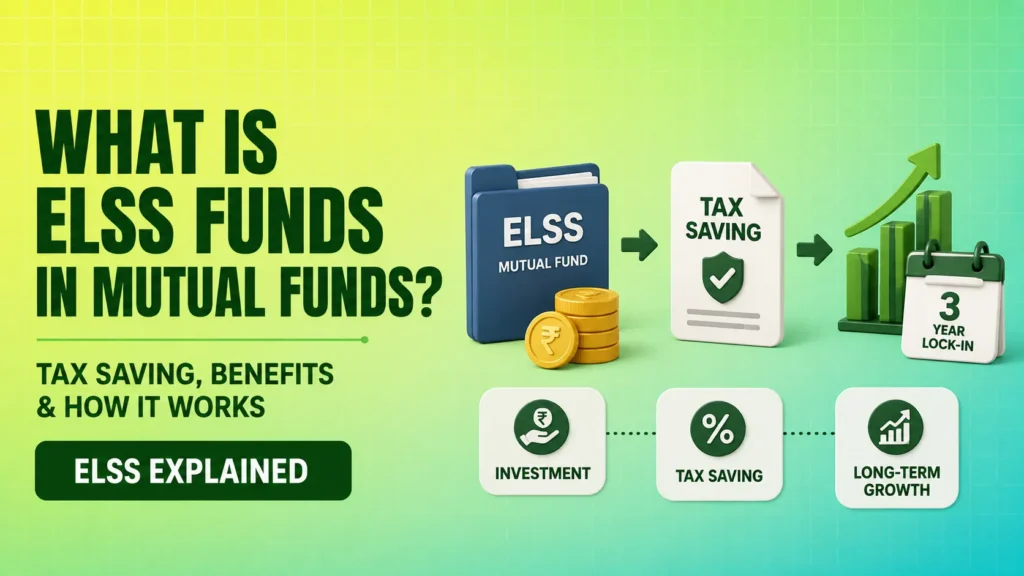
ELSS funds are tax-saving mutual funds that invest mainly in equity and equity-related instruments.
Many Indian taxpayers use ELSS to save tax under Section 80C and get stock market exposure at the same time. It has a 3-year lock-in period, which is shorter than many other tax-saving options like PPF and tax-saving FD.
Quick answer: ELSS stands for Equity Linked Savings Scheme. It is an equity mutual fund that can give tax deduction up to ₹1.5 lakh under Section 80C in the old tax regime. ELSS has a 3-year lock-in period, and returns depend on market performance. SEBI’s investor education page says ELSS invests at least 80% of its corpus in equity and equity-related instruments.
What is ELSS fund in mutual funds?
ELSS means Equity Linked Savings Scheme.
It is a tax-saving mutual fund where your money is mainly invested in shares of companies. Since it invests in equity, returns are market-linked. There is no fixed interest rate.
ELSS is mainly used for 2 reasons:
- Tax deduction under Section 80C
- Long-term equity investment
The Income Tax Act allows deduction under Section 80C up to ₹1.5 lakh for eligible investments and payments. ELSS is one of the common investment options used under this section.
Example: If you invest ₹1 lakh in ELSS and you are using the old tax regime, you can claim that amount under Section 80C, subject to the overall ₹1.5 lakh limit.
How does ELSS fund work?
ELSS works like a regular equity mutual fund with one extra condition: your money stays locked for 3 years.
Here is the simple process:
- You invest in an ELSS fund through lump sum or SIP.
- The fund manager invests the money mainly in stocks.
- Your investment value moves with the market.
- You cannot redeem the units before 3 years.
- After 3 years, you can redeem or continue holding.
SEBI’s investor education page explains that ELSS investments can be made through lump sum or SIP, remain locked for 3 years, and can be redeemed after the lock-in period.
ELSS tax benefit under Section 80C
ELSS qualifies for tax deduction under Section 80C.
The maximum deduction under Section 80C is ₹1.5 lakh per financial year. This limit includes other eligible payments and investments too, such as EPF, PPF, life insurance premium, tax-saving FD, children’s tuition fees, NSC, and home loan principal repayment.
Example
Suppose your taxable income is ₹8 lakh under the old tax regime.
You invest ₹1.5 lakh in ELSS.
Your taxable income may reduce to ₹6.5 lakh, subject to other income tax rules.
This does not mean you save ₹1.5 lakh tax. It means your taxable income reduces by up to ₹1.5 lakh.
Is ELSS useful in the new tax regime?
ELSS tax benefit is mainly useful for taxpayers who choose the old tax regime.
Under the new tax regime, Section 80C deduction is not available. So, if you are using the new tax regime, ELSS will not reduce your taxable income under Section 80C.
You can still invest in ELSS as an equity mutual fund. The tax-saving reason becomes weak if you are already using the new regime.
Before investing only for tax saving, compare both regimes.
ELSS lock-in period
ELSS has a lock-in period of 3 years.
This means you cannot withdraw the invested amount before 3 years from the date of investment. SEBI also states that ELSS has a 3-year lock-in period, which is the shortest among tax-saving investment options under Section 80C.
SIP lock-in rule
If you invest through SIP, every installment gets its own 3-year lock-in.
Example:
| SIP date | Unlock date |
|---|---|
| 5 January 2026 | 5 January 2029 |
| 5 February 2026 | 5 February 2029 |
| 5 March 2026 | 5 March 2029 |
So, after 3 years, only the units that completed 3 years can be redeemed.
This is one of the most common points investors miss.
Types of ELSS investment
Lumpsum investment
In a lump sum investment, you invest a fixed amount at one time.
Example: You invest ₹1.5 lakh in March before the financial year ends.
This is simple, but it carries market timing risk. If the market falls soon after your investment, your portfolio value can drop in the short term.
SIP investment
In SIP, you invest a fixed amount every month.
Example: You invest ₹12,500 per month for 12 months.
SIP is useful for salaried investors because the amount goes from monthly income. It also reduces the pressure of investing a large amount at the end of the year.
Every SIP installment has its own lock-in date.
ELSS returns and risk
ELSS does not give fixed returns.
Returns depend on:
- stock market performance
- fund manager decisions
- portfolio quality
- market cycle
- investment time period
Since ELSS invests mainly in equity, it carries market risk. Your investment value can go up or down.
ELSS is better suited for investors who can stay invested for at least 5 years or more. The lock-in period is 3 years, but equity investments usually need more time to handle market ups and downs.
Tax on ELSS returns
ELSS returns are taxed as equity mutual fund capital gains.
If you redeem ELSS after 3 years, the gain is treated as long-term capital gain because equity mutual fund units become long-term after 12 months.
For long-term capital gains from equity-oriented mutual funds, gains up to ₹1.25 lakh in a financial year are exempt. Gains above that are taxed at 12.5%, subject to conditions.
Example
You invested ₹1.5 lakh in ELSS.
After 3 years, the value becomes ₹2.3 lakh.
Your gain is ₹80,000.
If your total long-term equity gains for that financial year are within ₹1.25 lakh, LTCG tax may be nil.
If your total long-term equity gains cross ₹1.25 lakh, the extra amount may be taxed at 12.5%.
Benefits of ELSS funds
Tax deduction
ELSS gives tax deduction under Section 80C in the old tax regime.
This makes it useful for salaried taxpayers who still use the old tax regime and have not used their full ₹1.5 lakh limit.
Shorter lock-in
ELSS has a 3-year lock-in.
PPF has 15 years. Tax-saving FD has 5 years. So, ELSS has a shorter lock-in compared with many common tax-saving options.
Equity exposure
ELSS invests mainly in equity.
This gives growth potential over the long term. It also means the risk is higher than fixed-return products.
SIP option
You can invest monthly through SIP.
This is useful for salaried people who want to plan tax-saving slowly during the year.
Professional fund management
ELSS is managed by professional fund managers.
They choose stocks based on the fund’s investment strategy, market conditions, and portfolio rules.
Limitations of ELSS funds
Market risk
ELSS returns can be negative in the short term.
If the market falls, your investment value can also fall.
No guaranteed return
ELSS does not give fixed interest.
Do not compare it with FD or PPF as a fixed-return product.
Lock-in period
Money stays locked for 3 years.
If you need emergency funds, ELSS cannot be used before the lock-in ends.
New tax regime issue
If you use the new tax regime, Section 80C deduction is not available. ELSS may still work as an equity investment, but it will not give the old-regime tax deduction.
SIP units unlock separately
Many beginners think the full SIP investment unlocks after 3 years.
Each installment has a separate 3-year lock-in.
ELSS vs PPF vs tax-saving FD
| Point | ELSS | PPF | Tax-saving FD |
|---|---|---|---|
| Product type | Equity mutual fund | Government-backed saving scheme | Bank fixed deposit |
| Lock-in | 3 years | 15 years | 5 years |
| Returns | Market-linked | Government-declared rate | Bank fixed rate |
| Risk | Higher | Low | Low |
| 80C benefit | Yes, old tax regime | Yes, old tax regime | Yes, old tax regime |
| Liquidity | Locked for 3 years | Long lock-in with limited withdrawal rules | Locked for 5 years |
| Suitable for | Equity growth with tax saving | Safe long-term saving | Fixed return seekers |
ELSS is suitable for people who can handle equity risk. PPF and tax-saving FD suit investors who prefer lower risk and fixed or government-linked returns.
Who should invest in ELSS?
ELSS may suit you if:
- you use the old tax regime
- you want Section 80C deduction
- you are comfortable with equity risk
- you can keep money invested for 3 years or more
- you can stay invested for 5 years or longer
- you do not need this money for emergency expenses
- you want a tax-saving option with market-linked growth potential
Salaried people often use ELSS through monthly SIPs. This spreads investment across the year and avoids last-minute tax-saving pressure.
Who should avoid ELSS?
ELSS may not suit you if:
- you use the new tax regime and only want tax saving
- you need money within 3 years
- you want fixed returns
- you cannot handle market volatility
- your full Section 80C limit is already used through EPF, PPF, insurance premium, or home loan principal
- you do not understand equity mutual fund risk
If your employer already deducts a large EPF amount and you also pay life insurance premium or home loan principal, your 80C limit may already be full. Check this before investing in ELSS only for tax saving.
How to choose the best ELSS fund
Do not choose an ELSS fund only because it gave high returns last year.
Check these points:
- 5-year and 7-year performance
- performance against benchmark
- performance against category average
- expense ratio
- fund manager experience
- portfolio quality
- risk level
- investment style
- consistency across market cycles
A direct plan usually has a lower expense ratio than a regular plan. A growth option is commonly used for long-term wealth creation because returns stay invested in the fund.
How to invest in ELSS funds
You can invest in ELSS through:
- mutual fund company website
- AMC mobile app
- mutual fund platforms
- broker apps
- demat account
- investment advisor route
Basic steps:
- Complete mutual fund KYC.
- Choose an ELSS fund.
- Select direct or regular plan.
- Select growth option if your goal is long-term growth.
- Choose SIP or lump sum.
- Complete payment.
- Save investment proof for tax records.
Common mistakes in ELSS investing
Investing only in March
Many taxpayers invest in ELSS at the end of the financial year.
This can create market timing risk. A monthly SIP can make tax planning easier.
Choosing only last year’s top fund
One-year return can be misleading.
Check longer periods and consistency.
Forgetting SIP lock-in
Every SIP installment has a separate lock-in period.
This matters when you plan redemption.
Redeeming immediately after 3 years
ELSS allows redemption after 3 years, but equity funds may need more time.
If the fund is performing well and your goal is long-term, you can continue holding.
Using ELSS under new tax regime without checking benefit
If you are in the new tax regime, Section 80C deduction is not available.
Invest only after checking why you are choosing ELSS.
Treating ELSS as safe like FD
ELSS is an equity mutual fund.
It can give higher returns over time, but it can also fall in value.
Conclusion
ELSS is a tax-saving equity mutual fund.
It can reduce taxable income by up to ₹1.5 lakh under Section 80C in the old tax regime. It has a 3-year lock-in period, and returns depend on stock market performance.
Choose ELSS if you want tax saving under the old regime and are comfortable with equity risk. Check your tax regime, 80C usage, emergency fund, investment time period, and risk comfort before investing.
Disclaimer: This article is for educational purposes only. Please check the latest tax rules or consult a qualified financial advisor before making investment or tax decisions.
FAQs
What is ELSS fund in mutual funds?
ELSS is a tax-saving equity mutual fund. It invests mainly in stocks and gives tax deduction under Section 80C in the old tax regime. It has a 3-year lock-in period.
What is the full form of ELSS?
The full form of ELSS is Equity Linked Savings Scheme.
Is ELSS tax-free?
ELSS investment can give deduction under Section 80C in the old tax regime. Returns are not fully tax-free. Long-term capital gains from equity mutual funds are exempt up to ₹1.25 lakh in a financial year, and gains above that are taxed at 12.5%, subject to tax rules.
What is the lock-in period of ELSS?
ELSS has a 3-year lock-in period. If you invest through SIP, each SIP installment has a separate 3-year lock-in.
Is ELSS better than PPF?
ELSS and PPF are different. ELSS has higher risk and market-linked returns. PPF has lower risk and government-declared returns. ELSS suits investors who want equity exposure, while PPF suits people who prefer safety.
Can I withdraw ELSS before 3 years?
No. ELSS units cannot be redeemed before the 3-year lock-in period ends.
Is ELSS good for salaried employees?
ELSS can be useful for salaried employees who use the old tax regime, need Section 80C deduction, and can handle equity risk. Monthly SIPs can make it easier to invest from salary.