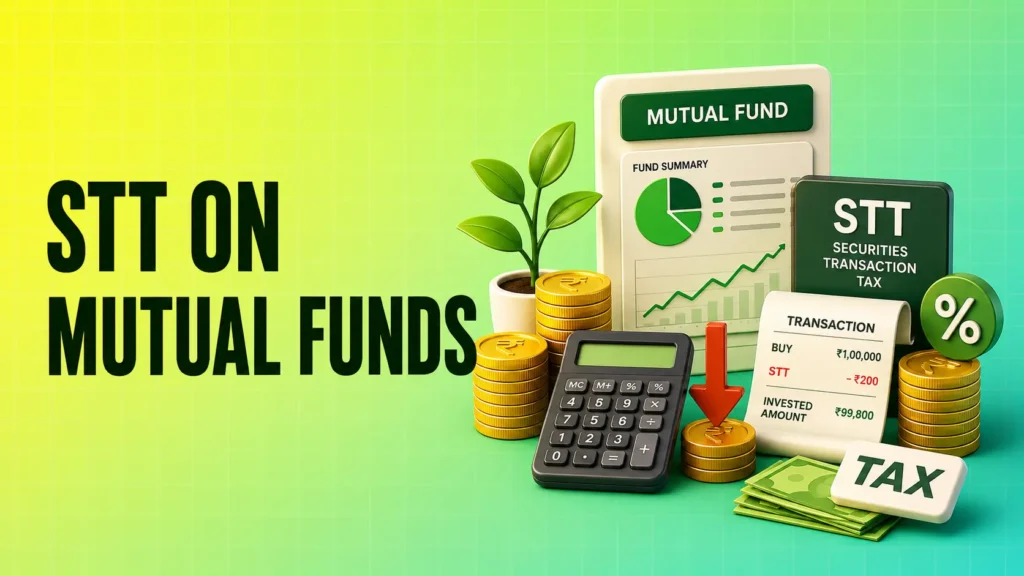
When you redeem an equity mutual fund, the amount credited to your bank account may be slightly lower than the redemption value. One reason is Securities Transaction Tax, commonly called STT.
STT on mutual funds is charged at 0.001% of the transaction value when eligible equity-oriented mutual fund units are redeemed or sold. It is not charged when you purchase mutual fund units or invest through a SIP.
The charge is small, but investors should understand when it applies and how it differs from capital gains tax, exit load and other mutual fund costs.
What Is STT on Mutual Funds?
STT stands for Securities Transaction Tax. It is a government tax charged on certain securities transactions in India.
For mutual fund investors, STT mainly applies when units of an equity-oriented mutual fund are:
- Redeemed directly with the mutual fund
- Sold on a recognised stock exchange, where applicable
The tax is calculated on the total sale or redemption value, not on the profit earned from the investment.
For example, if you redeem eligible equity mutual fund units worth ₹5 lakh, STT is calculated on ₹5 lakh even if your actual profit is much lower.
Key Features of STT on Mutual Funds
- STT is based on the transaction value.
- It applies mainly to equity-oriented mutual funds.
- It is deducted automatically during an eligible transaction.
- It may apply even if the investor incurs a loss.
- Investors do not usually need to pay it separately.
- It is different from capital gains tax and exit load.
Why Is STT Charged on Mutual Funds?
STT provides a direct system for collecting tax on eligible securities transactions. Since the mutual fund or stock exchange handles its collection, investors do not have to calculate and deposit it separately.
The deducted amount usually appears in the redemption statement or contract note.
When Is STT Charged on Mutual Funds?
STT does not apply to every mutual fund transaction. Its applicability depends on the type of scheme and whether units are purchased, sold or redeemed.
Redemption of Equity-Oriented Mutual Fund Units
STT is charged when an investor redeems units of an eligible equity-oriented mutual fund directly with the fund house.
The mutual fund deducts the applicable STT before transferring the redemption proceeds to the investor.
Sale of Equity ETF Units
A delivery-based sale of equity-oriented exchange-traded fund units on a recognised stock exchange generally attracts STT.
The charge is paid by the seller and is usually shown in the contract note issued by the broker.
SIP Investments
STT is not charged when you make a SIP investment because each SIP instalment is a purchase of mutual fund units.
However, when you later redeem units purchased through SIPs, STT may apply if they belong to an eligible equity-oriented scheme.
SWP Transactions
A Systematic Withdrawal Plan involves the regular redemption of mutual fund units.
Therefore, each SWP withdrawal from an eligible equity-oriented mutual fund may attract STT on the value of the units redeemed during that transaction.
STT Rates on Mutual Funds
The following table explains the general STT treatment of common mutual fund transactions:
| Mutual Fund Transaction | Is STT Applicable? | STT Rate | Paid By |
|---|---|---|---|
| Redemption of equity-oriented mutual fund units | Yes | 0.001% | Investor or seller |
| Delivery-based sale of equity ETF units | Yes | 0.001% | Seller |
| Purchase of equity mutual fund units | No | Nil | Not applicable |
| SIP instalment | No | Nil | Not applicable |
| Redemption of debt mutual fund units | No | Nil | Not applicable |
| Redemption of non-equity mutual fund units | No | Nil | Not applicable |
The scheme’s tax classification is important. A fund must qualify as an equity-oriented fund under the applicable tax rules for STT to apply.
How Is STT on Mutual Funds Calculated?
STT is calculated using the following formula:
STT = Eligible transaction value × Applicable STT rate
Suppose you redeem equity mutual fund units worth ₹5,00,000.
- Redemption value: ₹5,00,000
- STT rate: 0.001%
- STT amount: ₹5,00,000 × 0.001%
- STT payable: ₹5
Therefore, ₹5 may be deducted as STT from the redemption proceeds.
The calculation is based on the complete redemption value, not only on the capital gain.
STT on Mutual Funds: Calculation Examples
| Redemption Value | STT Rate | STT Amount |
|---|---|---|
| ₹1,00,000 | 0.001% | ₹1 |
| ₹5,00,000 | 0.001% | ₹5 |
| ₹10,00,000 | 0.001% | ₹10 |
These examples show that STT on mutual fund redemptions is generally a small charge. However, it remains a separate cost that investors may notice in their transaction statement.
STT vs Capital Gains Tax on Mutual Funds
STT and capital gains tax are different charges. Paying STT does not remove the investor’s capital gains tax liability.
| Basis | STT | Capital Gains Tax |
|---|---|---|
| Charged on | Total transaction value | Profit earned from the transaction |
| Trigger | Eligible sale or redemption | Capital gain from sale or redemption |
| Collection | Deducted automatically | Reported and paid under income-tax rules |
| Applicable when there is a loss | May still apply | No tax if there is no taxable gain |
| Rate | Fixed transaction rate | Depends on fund type and holding period |
For example, an investor may pay STT on an equity mutual fund redemption even when the units are sold at a loss. Capital gains tax would not arise if there is no taxable capital gain.
Is STT Applicable to SIP Investments?
No, STT is not charged when a SIP instalment is invested because it represents the purchase of mutual fund units.
STT may be charged later when those units are redeemed, provided the scheme qualifies as an equity-oriented mutual fund.
Each SIP instalment purchases units on a different date. This is important for calculating the holding period and capital gains, but it does not change the basic STT rule.
Is STT Applicable to Debt and Hybrid Mutual Funds?
STT is generally not charged on the purchase, sale or redemption of debt mutual fund units because they are not classified as equity-oriented funds.
For hybrid mutual funds, the treatment depends on the scheme’s tax classification:
- An equity-oriented hybrid fund may attract STT at redemption.
- A non-equity-oriented hybrid fund generally does not attract STT.
- The scheme name alone does not determine its tax treatment.
Investors should check the scheme information document or official fund-house information to confirm whether a hybrid scheme qualifies as equity-oriented.
Does STT Reduce Mutual Fund Returns?
Yes, STT slightly reduces the final amount received from an eligible mutual fund redemption. However, because the rate is only 0.001%, its effect is usually small.
STT should not be confused with other mutual fund costs, such as:
- Expense ratio
- Exit load
- Capital gains tax
- Stamp duty on the purchase of units
- Brokerage and exchange charges for ETFs
Reviewing the transaction statement can help you understand which charges were deducted.
Common Misconceptions About STT
STT applies to every mutual fund
This is incorrect. It mainly applies to eligible equity-oriented mutual fund transactions.
STT is charged on every SIP instalment
STT is not charged when SIP units are purchased. It may apply when eligible units are redeemed later.
STT and capital gains tax are the same
STT is charged on the transaction value, while capital gains tax is based on the taxable profit.
STT applies only when an investor earns a profit
STT may still be charged even if the investment is redeemed at a loss.
Investors must pay STT while filing an income-tax return
STT is normally collected automatically by the mutual fund or stock exchange. Investors do not usually deposit it separately while filing their return.
Conclusion
STT on mutual funds is a small transaction tax generally charged at 0.001% when eligible equity-oriented mutual fund units are redeemed or sold. It is calculated on the total transaction value, irrespective of whether the investor earns a profit or incurs a loss.
STT is not charged on mutual fund purchases, SIP instalments, debt funds or other non-equity-oriented schemes. Since tax rules and scheme classifications may change, investors should check the latest official information before making tax-related decisions.