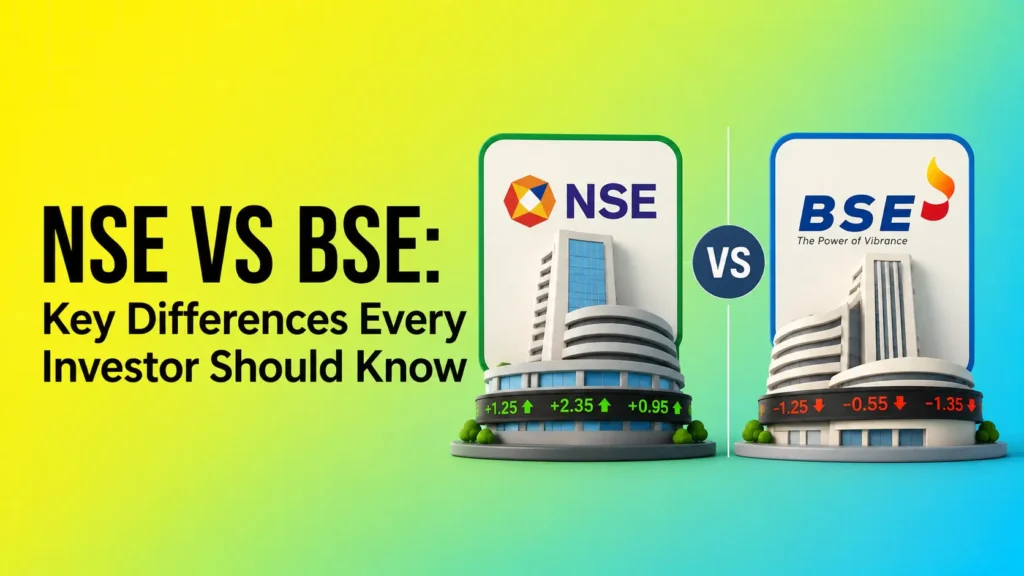
If you’ve recently started investing in the stock market, you’ve probably noticed that shares are traded on either the National Stock Exchange (NSE) or the Bombay Stock Exchange (BSE). Many beginners assume these are competing markets where different companies are traded. In reality, both are India’s leading stock exchanges, and many well-known companies such as Reliance Industries, Infosys, TCS, and HDFC Bank are listed on both.
Understanding the difference between NSE and BSE is important because it helps you understand market liquidity, trading efficiency, benchmark indices, and how stock prices are discovered. Whether you’re a first-time investor or an experienced trader, knowing how these exchanges work can help you make more informed investment decisions.
What is the National Stock Exchange (NSE)?
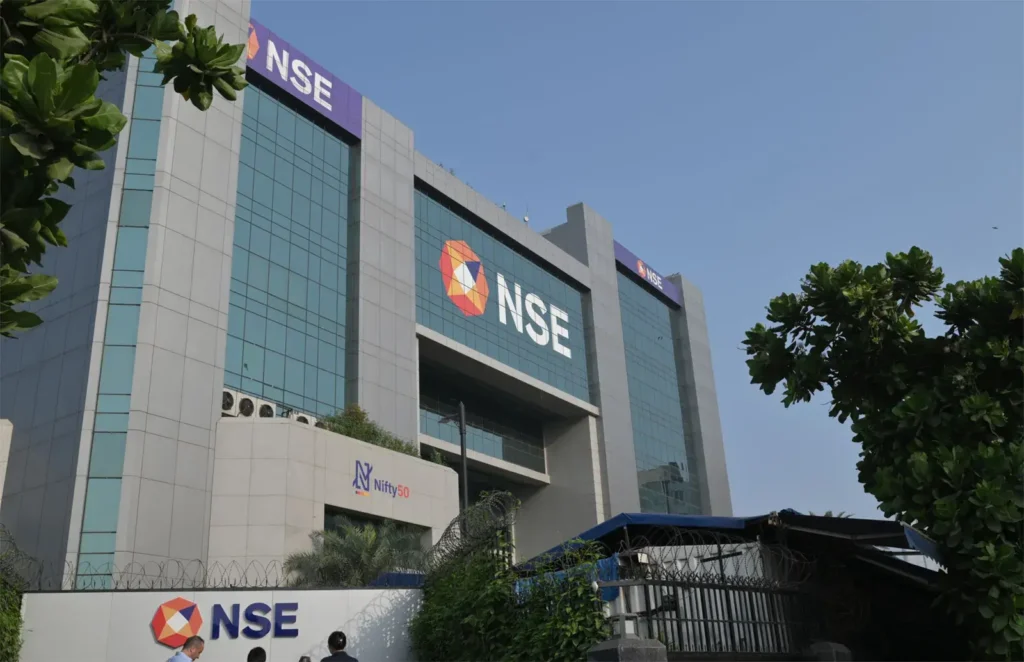
The National Stock Exchange (NSE) was established in 1992 and began electronic trading in 1994. It transformed India’s capital markets by introducing a fully automated, screen-based trading system, replacing the traditional open outcry method used in earlier years.
Today, NSE is India’s largest stock exchange by trading activity and one of the world’s leading derivatives exchanges. It is widely preferred by active traders because of its high liquidity, fast order execution, and advanced trading infrastructure.
The benchmark index of NSE is Nifty 50, which tracks the performance of 50 of India’s largest and most actively traded companies.
What is the Bombay Stock Exchange (BSE)?
The Bombay Stock Exchange (BSE), established in 1875, is the oldest stock exchange in Asia. It has played a significant role in the development of India’s financial markets for more than a century.
While BSE is older than NSE, it has continuously modernized its technology and now offers electronic trading, equity investment, mutual funds, ETFs, bonds, REITs, InvITs, and SME listings. BSE is also known for having the largest number of listed companies in India.
Its benchmark index is the Sensex, which consists of 30 financially strong companies representing major sectors of the Indian economy.
NSE vs BSE: Quick Comparison
| Feature | NSE | BSE |
|---|---|---|
| Established | 1992 | 1875 |
| Full Form | National Stock Exchange | Bombay Stock Exchange |
| Benchmark Index | Nifty 50 | Sensex |
| Trading Volume | Higher | Lower |
| Liquidity | Very High | High |
| Listed Companies | Around 2,600+ | More than 5,000 |
| Preferred By | Active Traders | Long-Term Investors & SMEs |
| Trading System | Fully Electronic | Fully Electronic |
Key Differences Between NSE and BSE
Although both exchanges serve the same purpose, there are several important differences that every investor should understand.
Trading Volume and Liquidity
The biggest advantage of NSE is its significantly higher trading volume. More buyers and sellers participate on the exchange every day, making it easier to buy or sell shares quickly without causing large price changes.
Higher liquidity generally results in narrower bid-ask spreads and better price discovery. This is why most day traders and derivatives traders prefer NSE.
BSE also provides good liquidity for many large-cap companies, but trading activity is comparatively lower in several stocks.
Number of Listed Companies
BSE has more than 5,000 listed companies, making it India’s largest exchange by the number of listed businesses. This gives investors access to a wider variety of small-cap, mid-cap, and SME companies.
NSE lists fewer companies, but many of India’s largest and most actively traded businesses are available on the exchange.
Benchmark Indices
One of the easiest ways to understand the difference between NSE and BSE is by looking at their benchmark indices.
Nifty 50 represents the top 50 companies listed on NSE and is widely used to measure the overall performance of the Indian stock market.
Sensex represents 30 large and established companies listed on BSE. Both indices include businesses from sectors such as banking, IT, energy, pharmaceuticals, automobiles, and FMCG.
Although the number of companies differs, both indices provide a good snapshot of the Indian economy.
Technology and Trading Experience
NSE introduced India’s first fully electronic trading platform, which greatly improved transparency and trading efficiency.
BSE has also upgraded its systems over the years and now offers a modern electronic trading platform capable of handling large trading volumes with fast execution.
From an investor’s perspective, both exchanges provide a secure and reliable trading environment.
Why Are Some Stocks Listed on Both Exchanges?

Many leading Indian companies choose to list their shares on both NSE and BSE to increase their visibility and make it easier for investors to trade.
If you search for companies like Reliance Industries, Tata Consultancy Services (TCS), Infosys, or ICICI Bank, you’ll usually find them available on both exchanges.
Although prices may differ by a few paise due to separate order books and market demand, the difference is generally very small because arbitrage keeps prices closely aligned.
Which Exchange Should You Choose?
For most retail investors, the choice between NSE and BSE makes very little difference because both exchanges are regulated by the Securities and Exchange Board of India (SEBI) and offer a safe environment for investing.
If you actively trade stocks or derivatives, NSE is generally preferred because of its higher liquidity and trading volume.
If you’re a long-term investor looking to explore a wider range of listed companies, including SMEs, BSE can also be an excellent choice.
In practice, many investors use both exchanges through the same Demat and trading account.
A Simple Example
Imagine you want to purchase shares of Reliance Industries.
When you search in your trading app, you may notice that the stock is available on both NSE and BSE. Suppose the share price is ₹1,500.20 on NSE and ₹1,500.35 on BSE.
This small difference occurs because each exchange has its own buyers and sellers. Most brokers automatically allow you to place your order on the exchange offering better execution and liquidity.
Is One Exchange Better Than the Other?
There is no universal winner.
NSE is generally the preferred choice for traders because of its higher liquidity, larger derivatives market, and faster execution.
BSE remains equally important for investors who want access to a broader range of listed companies and India’s oldest stock exchange.
Instead of asking which exchange is better, investors should focus on choosing quality companies and maintaining a disciplined investment strategy.
Are NSE and BSE regulated?
Yes. Both exchanges operate under the supervision of the Securities and Exchange Board of India (SEBI), ensuring transparency and investor protection.
Conclusion
NSE and BSE are the two pillars of India’s stock market, and both play an important role in helping companies raise capital and investors build wealth. While NSE leads in trading volume, liquidity, and derivatives, BSE stands out for its long history and larger number of listed companies.
For most investors, choosing between NSE and BSE is less important than selecting fundamentally strong companies and investing with a long-term perspective. Understanding how both exchanges work will help you navigate the stock market with greater confidence and make smarter investment decisions, regardless of your level of experience.FA