The share market is one of the most popular ways to build long-term wealth. Every day, millions of investors buy and sell shares, but many people don’t realize that the share market is divided into different segments, each serving a unique purpose.
If you’re new to investing, terms like Primary Market, Secondary Market, OTC Market, or Third Market may sound confusing. However, understanding these different types of share markets is essential because they determine how companies raise capital and how investors trade securities.
In this guide, you’ll learn about the major types of share markets in simple language, making it easier to understand how the stock market works and where you, as an investor, fit into the system.
What Is the Share Market?

The share market is a marketplace where companies issue shares to raise money and investors buy or sell those shares. It connects businesses looking for capital with individuals and institutions seeking investment opportunities.
In India, most stock trading takes place through recognized stock exchanges such as the National Stock Exchange (NSE) and the Bombay Stock Exchange (BSE). These exchanges provide a secure and regulated environment for trading shares, bonds, exchange-traded funds (ETFs), and other financial securities.
The share market is broadly divided into several types, each playing a different role in the investment process.
Types of Share Market
Although most investors only interact with one or two market types, the share market consists of several segments that work together to keep the financial system running smoothly.
The main types of share markets include:
| Market Type | Main Purpose |
|---|---|
| Primary Market | Companies issue new securities to raise capital |
| Secondary Market | Investors buy and sell existing securities |
| Over-the-Counter (OTC) Market | Trading takes place directly between parties without a formal exchange |
| Third Market | Exchange-listed securities traded outside traditional exchanges |
| Fourth Market | Direct trading between large institutional investors |
Let’s understand each of these in detail.
Primary Market
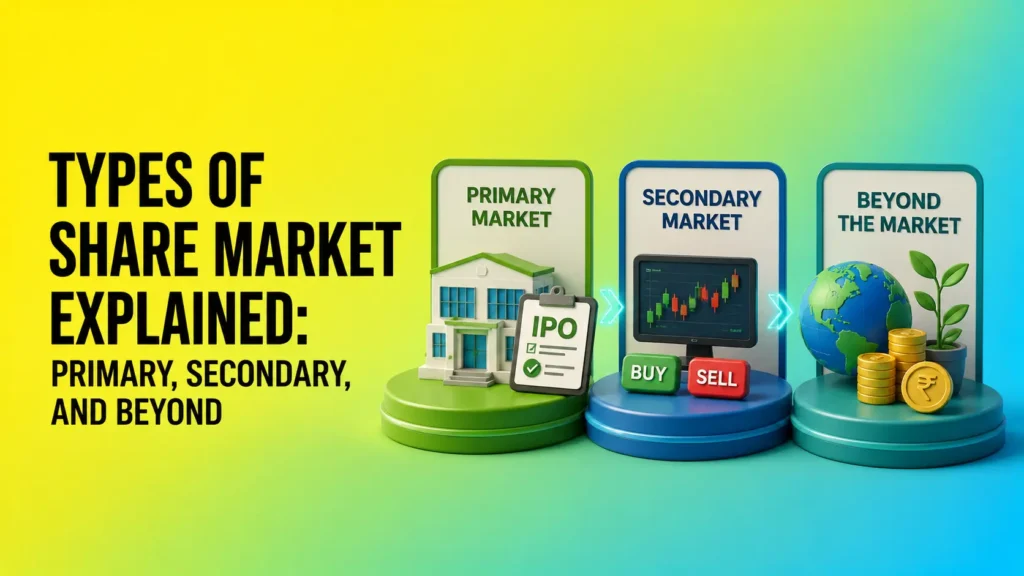
The Primary Market is where a company sells its shares to investors for the first time. Instead of buying shares from another investor, you purchase them directly from the company.
The most common example of the primary market is an Initial Public Offering (IPO). During an IPO, a private company offers its shares to the public and becomes a publicly listed company.
For businesses, this market provides capital to expand operations, reduce debt, or fund new projects. For investors, it offers the opportunity to become shareholders at the time of the company’s public listing.
Example
Imagine a technology startup decides to raise ₹2,000 crore by launching an IPO. Investors apply for shares during the IPO period. Once the allotment is complete, the shares are listed on a stock exchange.
At this stage, the transaction takes place in the primary market.
Secondary Market
After shares are listed on a stock exchange, they begin trading in the Secondary Market.
This is where investors buy and sell shares among themselves. The company no longer receives money from these transactions. Instead, ownership simply changes from one investor to another.
Every time you buy or sell shares through your trading app, you’re participating in the secondary market.
The secondary market provides liquidity, meaning investors can easily convert their investments into cash whenever required.
It also helps determine the market price of a company’s shares based on demand and supply.
Primary Market vs Secondary Market
Understanding the difference between these two markets is important because almost every investor interacts with them.
| Feature | Primary Market | Secondary Market |
|---|---|---|
| Purpose | Raise capital for companies | Trading among investors |
| Seller | Company | Existing investors |
| Price | Fixed by the company | Determined by market demand and supply |
| Example | IPO, FPO | NSE and BSE trading |
| Company Receives Money | Yes | No |
While companies use the primary market to raise funds, investors rely on the secondary market for regular buying and selling.
Over-the-Counter (OTC) Market
Not all securities are traded on major stock exchanges.
Some financial instruments are traded directly between buyers and sellers through dealer networks. This is known as the Over-the-Counter (OTC) Market.
OTC trading is commonly used for certain bonds, derivatives, and shares of companies that are not listed on major stock exchanges.
Since these trades happen outside organized exchanges, they may involve higher risks and lower transparency compared to exchange-traded securities.
Retail investors generally have limited exposure to the OTC market.
Third Market
The Third Market refers to the trading of exchange-listed securities outside traditional stock exchanges.
Large financial institutions sometimes execute trades directly with brokers rather than through the exchange to reduce transaction costs or improve execution efficiency.
This market mainly serves institutional investors and has little impact on everyday retail investors.
Fourth Market
The Fourth Market involves direct transactions between large institutional investors without the involvement of brokers or public exchanges.
Examples of participants include:
- Mutual funds
- Insurance companies
- Pension funds
- Investment banks
Because these transactions are usually very large, they are conducted privately to minimize their impact on market prices.
Retail investors rarely participate in the fourth market.
Which Share Market Do Retail Investors Use?

Most individual investors primarily use two market segments:
- The Primary Market when applying for IPOs or other new security offerings.
- The Secondary Market when buying and selling listed shares through stock exchanges.
The OTC, Third, and Fourth Markets are mainly used by institutions, brokers, and professional market participants.
For beginners, understanding the primary and secondary markets is more than enough to start investing confidently.
A Simple Example
Suppose a company named ABC Ltd. launches an IPO.
You apply for shares during the IPO and receive an allotment. This transaction takes place in the Primary Market because you’re buying shares directly from the company.
A few weeks later, the shares begin trading on the NSE and BSE. If you decide to sell your shares or buy more through your trading account, you’re now participating in the Secondary Market.
This example shows how a company’s shares move from the primary market to the secondary market after listing.
Common Misconceptions
Many beginners believe the share market consists only of stock exchanges. In reality, exchanges are just one part of a much larger financial ecosystem.
Another common misconception is that companies earn money every time investors buy or sell their shares. In fact, companies receive funds only during primary market offerings. Once shares are listed, trading happens between investors.
Understanding these concepts helps investors make better decisions and avoid common misunderstandings.
Conclusion
The share market is much more than a place where stocks are bought and sold. It consists of several interconnected markets, each serving a specific purpose in the financial system. The Primary Market helps companies raise capital, while the Secondary Market allows investors to trade shares freely. Other segments, such as the OTC Market, Third Market, and Fourth Market, support specialized trading activities for institutions and large investors.
For most retail investors, understanding the primary and secondary markets is the key to building a strong foundation in investing. As your knowledge grows, learning about the other market segments will give you a deeper understanding of how the financial markets operate and how different participants contribute to the overall economy.