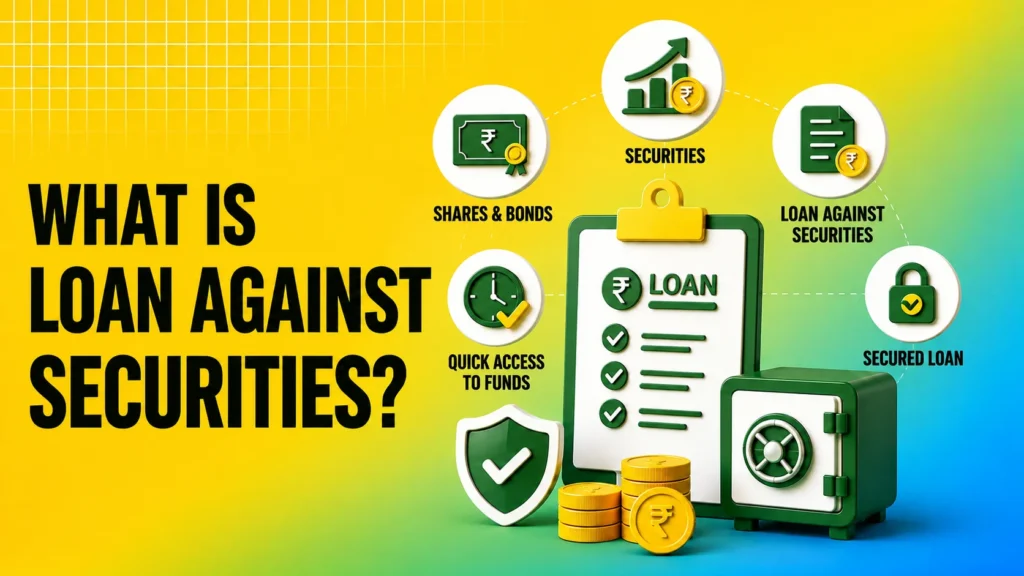
What is a loan against securities?
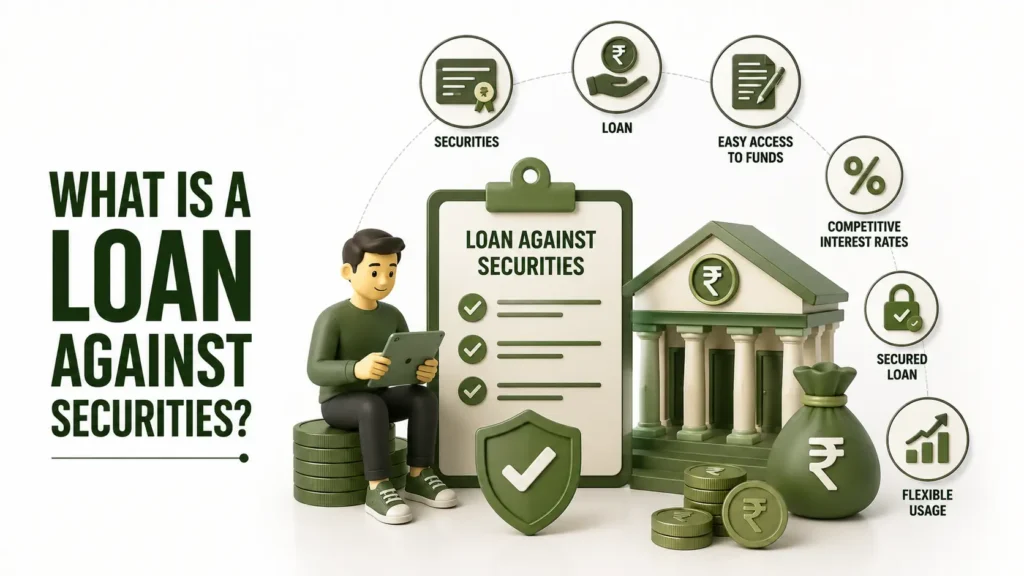
A loan against securities (also called loan against shares) is a secured credit facility in which you pledge your financial assets—such as listed shares, mutual fund units, bonds, ETFs, insurance policies, or government securities—as collateral to a bank or NBFC. In return, the lender provides you with a loan or overdraft facility.
You continue to own the pledged securities. You continue to receive dividends, bonuses, or interest income from them. The lender creates a lien (pledge) on the assets. Once you repay the loan, the lien is released, and full control returns to you.
Unlike personal loans, loans against securities are backed by collateral. This usually results in lower interest rates and faster processing times. Interest is typically charged only on the amount you actually withdraw and for the period you use it, not on the entire sanctioned limit of the loan.
How Does a Loan Against Securities Work?
The process is straightforward.
- You select eligible securities from your Demat or mutual fund holdings.
- The lender evaluates the current market value of the securities.
- Based on the loan-to-value (LTV) ratio, a credit limit is sanctioned.
- An overdraft or loan account has been opened in your name.
- You can withdraw funds as needed, within the sanctioned limit.
- Interest is calculated daily only on the amount utilized.
- When the outstanding amount is repaid, the pledge is released.
The LTV ratio depends on the type of security. As per the latest RBI guidelines (effective from July 2026), the maximum LTV ceilings are generally:
- Listed equity shares: up to 60%
- Equity mutual funds, ETFs, REITs and InvITs: up to 75%
- Debt mutual funds: up to 85%
- AAA-rated listed debt securities: up to 85%
Individual loan limits against eligible securities are capped at ₹1 crore across the banking systems. Lenders continuously monitor the LTV ratio on an ongoing basis. If the value of the securities falls and the LTV limit is breached, you may be asked to provide additional collateral or repay part of the outstanding amount, usually within seven working days.
Read Also: What is Simple Interest
Key Benefits of Loan Against Securities
Leading lenders have highlighted several clear advantages of a loan against securities.
- Liquidity without selling investments: You obtain funds without liquidating your portfolio, so your long-term wealth creation continues.
- Lower interest rates – As a secured facility, rates are generally lower than those of unsecured personal loans or credit cards. Current market rates often range between 8% and 15% per annum, depending on the lender, borrower profile, and quality of securities.
- Interest only on utilized amount – You pay interest only on the money you actually withdraw and only for the days it remains outstanding.
- Continued ownership benefits – Dividends, bonuses, and capital appreciation continue to belong to you.
- Flexible usage – Funds can be used for personal needs, business requirements, education, medical emergencies, or any other purpose (subject to lender terms).
- Faster processing – Valuation is based on transparent market prices, and many lenders offer fully digital or online application options.
- Minimal documentation: Compared with unsecured loans, paperwork is usually lighter once KYC and demat details are in place.
- No prepayment penalty in many cases: Several lenders allow prepayment without extra charges.
These benefits make loans against securities particularly useful when short-term liquidity is required while preserving the investment portfolio.
Eligibility Criteria
While the exact criteria vary by lender, common requirements include the following:
- Indian resident (individuals, HUFs, companies, partnerships, and trusts may also be eligible with some lenders).
- Age is usually between 18 and 70–75 years.
- Valid demat account and ownership of eligible securities.
- Minimum portfolio value (often ₹1 lakh or higher, depending on the lender).
- Basic KYC documents (PAN, Aadhaar, or other identity and address proof).
- Satisfactory credit history in most cases.
Securities must generally be from the lender’s approved list and be free from any lock-in or other restrictions.
Documents Required
Typical documents needed for a loan against securities are as follows:
- KYC documents (PAN, Aadhaar, passport, driving licence, etc.)
- Demat account statement or mutual fund statement showing holdings
- Bank account details
- Income proof (may be required by some lenders)
- Application form and any lender-specific declarations
Many digital processes now allow online verification of holdings through depositories or RTAs, thereby reducing physical paperwork.
Step-by-Step Process to Apply
- Check the eligibility and approved list of securities with the chosen bank or NBFC.
- Gather KYC and holding statements.
- Apply online through net banking, mobile app, lender’s website, or visit a branch.
- Select the securities to be pledged.
- Complete verification and sign the agreement (often digitally).
- Once approved, the credit limit is activated, and funds can be withdrawn as needed.
The processing time can range from a few hours (for fully digital facilities) to a couple of days.
Read Also: Different Types of Business Loans
Important Points and Risks to Consider
While a loan against securities offers clear advantages, it is important to understand the risks.
- Market volatility can reduce the value of pledged securities and trigger margin calls.
- Failure to maintain the required LTV or repay on time may lead the lender to sell the securities.
- Interest continues to accrue even if your investment performs well.
- Only securities on the lender-approved list are accepted.
- Funds generally cannot be used for further capital market investments according to regulatory norms.
Always compare interest rates, LTV ratios, processing fees, and other charges across lenders before deciding.
Conclusion
A loan against securities is a practical way to raise funds without selling investments. It combines lower interest costs, flexibility, and the ability to continue earning from the portfolio. With clear RBI guidelines now in place regarding LTV ratios and overall limits, the product has become more structured and transparent for borrowers.
If you hold eligible shares, mutual funds, or other securities and need short-term liquidity, exploring a loan against securities can be a sensible option. Compare offers from different banks and NBFCs, check the latest approved lists and LTV policies, and choose the facility that best matches your needs and risk appetite.
Understanding what a loan against securities fully entails helps you make an informed decision and use this facility effectively for your financial requirements.