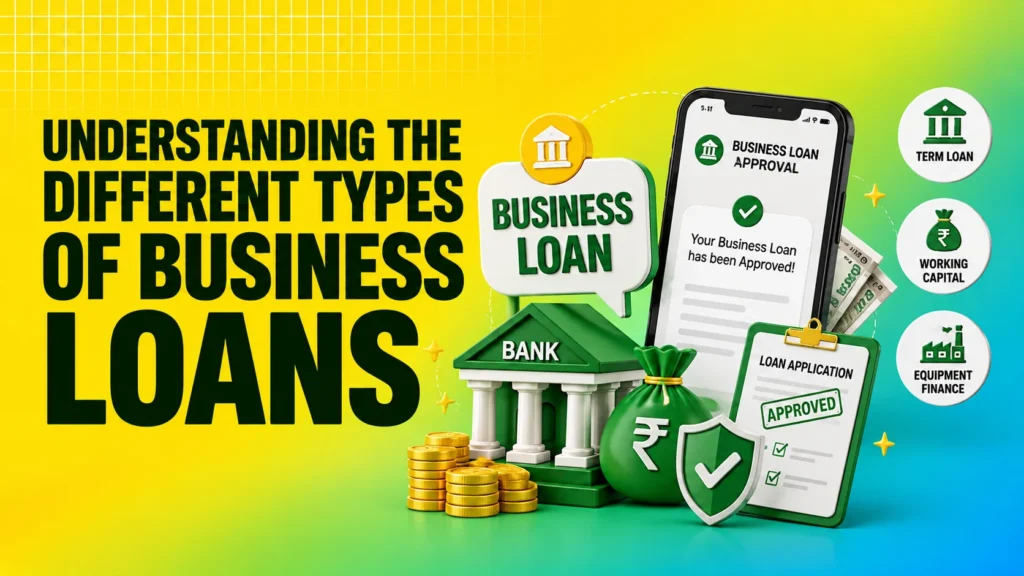
Business loans help companies manage their day-to-day operations, buy equipment, expand, or bridge temporary cash shortages. Not all loans function in the same manner. The right choice depends on why you need the money, how quickly you need it, how long you can take to repay it, and whether you can offer collateral to secure the loan.
This guide explains the main types of business loans in clear language so that first-time borrowers, growing businesses, and experienced owners can understand the differences and make informed decisions.
Read Also: Power of Compounding Interest
Table of Contents
Why Different Types of Business Loans Exist
Businesses face different financial needs at different stages of their development. A new shop may require a small amount of inventory. A manufacturing unit may require funds to purchase machinery. A trading company may need quick cash against pending invoices, for example. Lenders design specific products for each situation. Choosing the wrong type can lead to higher costs and repayment pressure.
1. Term Loans
A term loan provides a fixed amount of money upfront. You repay it in regular instalments (usually monthly) over a set period that can range from one year to several years.
Best for: Buying fixed assets, expanding the business, renovating premises, or funding a large, one-time expense.
Key points:
- This can be short-, medium-, or long-term.
- Interest rates are usually fixed or floating in nature.
- It may be secured (against property or assets) or unsecured.
- A predictable repayment schedule aids in planning.
Term loans are suitable for businesses with steady cash flows and a clear plan for using the funds.
2. Working Capital Loans
Read Also: Retail Loans
Working capital loans cover the everyday expenses of running a business, such as salaries, rent, raw materials, utility bills, and inventory.
These loans are typically short-term. They help maintain smooth operations when money is tied up in stock or when customer payments are pending.
Best for: Managing seasonal fluctuations and bridging the gap between paying suppliers and receiving payments from customers.
Common forms include cash credits and overdraft facilities linked to business bank accounts. You pay interest only on the amount that you actually use.
3. Business Line of Credit (or Overdraft Facility)
A business line of credit functions like a flexible credit limit. You can withdraw money as needed, up to the approved limit, repay it, and withdraw again.
Best for: Unexpected expenses, managing uneven cash flow, or short-term needs that keep changing.
You pay interest only on the amount drawn and not on the full limit. This makes it more flexible than traditional term loans.
4. Equipment or Machinery Loans
These loans are specifically meant for purchasing or upgrading business equipment or machinery. The equipment often serves as collateral.
Best for: Manufacturing units, clinics, transport companies, or any business that needs costly machinery without depleting cash reserves.
Because the asset secures the loan, interest rates are often lower than unsecured options, and approval can be relatively straightforward when the equipment has a clear market value.
5. Invoice Financing, Invoice Factoring, and Bill Discounting
When customers take 30–90 days to pay invoices, businesses can face cash flow shortages. Invoice-based financing solves this problem.
- Invoice financing/Bill discounting: You receive an advance against your unpaid invoices while still managing the collection.
- Invoice factoring: You sell the invoices to a third party at a discount, and that party collects the payments.
Best for: Businesses with reliable customers who have longer payment cycles (common in trading, manufacturing, and B2B services).
This option provides quick access to cash without creating new long-term debt in the traditional sense.
6. Merchant Cash Advance (or POS Loans)
A merchant cash advance provides a lump sum in exchange for a percentage of future card or digital sales. Repayment occurs automatically as a portion of daily or weekly sales.
Best for: Retail shops, restaurants, and businesses with strong and consistent card sales that need funds quickly and may not qualify for traditional loans.
These advances are usually faster to obtain but often cost more than standard loans because of higher effective rates of interest.
7. Microloans and Startup-Focused Loans
Microloans are small-value loans designed for new or small businesses. Government-supported schemes in many countries (including MSME and similar programs) often fall into this category of support.
Best for: Startups, microenterprises, women entrepreneurs, and businesses that need modest amounts for inventory, tools, or initial working capital.
These loans usually have simpler eligibility criteria and lower amounts than regular term loans.
8. Secured vs Unsecured Business Loans
Read Also: Secured vs Unsecured Loan
This is a broad classification that applies to many of the types mentioned above.
- Secured loans require collateral (property, machinery, or other assets). They generally offer higher loan amounts and lower interest rates because lenders have security.
- Unsecured loans do not require collateral to be provided. Approval depends more on a business’s financial strength, credit history, and cash flow. Interest rates are typically higher.
Understanding this distinction helps you decide how much risk you are willing to take with your business or personal assets.
9. Commercial Real Estate Loans
These loans finance the purchase, construction, or renovation of commercial properties such as offices, shops, warehouses, or factories.
Best for: Businesses that want to own their premises instead of renting or that need to expand their physical space.
Tenure is often longer, and the property itself serves as a collateral.
How to Choose the Right Type of Business Loan
Ask yourself the following practical questions:
- What do I need the money for? (Equipment, daily expenses, expansion, or cash-flow gap?)
- How quickly do I need the funds?
- How long can I comfortably take to repay it?
- Can I offer collateral?
- How predictable is my cash flow?
The answers were matched to the loan types described above. A mismatch, such as using a high-cost short-term advance for a long-term asset purchase, can create unnecessary financial pressure.
Quick Comparison of Common Business Loan Types
| Loan Type | Typical Purpose | Collateral | Flexibility | Speed of Funding |
|---|---|---|---|---|
| Term Loan | Expansion, assets | Often required | Low | Moderate |
| Working Capital / Overdraft | Daily operations | Optional | High | Fast |
| Line of Credit | Variable short-term needs | Optional | Very High | Fast |
| Equipment Loan | Machinery purchase | Equipment | Low | Moderate |
| Invoice Financing | Cash against unpaid bills | Invoices | Medium | Fast |
| Merchant Cash Advance | Quick funds via sales | Future sales | Low | Very Fast |
| Microloan / Startup Loan | Small initial needs | Usually none | Medium | Moderate |
Final Thoughts
Understanding the different types of business loans helps you borrow with purpose instead of pressure. Each product is designed for a specific situation. The most suitable loan is the one that matches your actual needs, repayment capacity, and risk comfort.
Before applying, carefully review the interest structure, fees, repayment schedule, and any collateral requirements. Clear knowledge of the options allows you to compare offers more effectively and choose financing that supports your business rather than strains it.
If you are evaluating a specific need, such as working capital, equipment, or expansion, matching that need to the right loan type is the most important first step.
FAQs Understanding the Different Types of Business Loans
What are the main types of business loans?
The most common types are term loans, working capital loans, business lines of credit (or overdraft), equipment/machinery loans, invoice financing or factoring, merchant cash advances, microloans or startup loans, and commercial real estate loans. Each serves a different business need.
What is the difference between a term loan and a working capital loan?
A term loan gives you a fixed amount upfront for a specific purpose (like expansion or buying assets) and is repaid in instalments over a set period. A working capital loan is meant for day-to-day expenses such as salaries, rent, and inventory, and is usually short-term.
What is a business line of credit?
A business line of credit gives you a flexible credit limit. You can withdraw money as needed, repay it, and withdraw again. You pay interest only on the amount you actually use, not on the full limit.
Do all business loans require collateral?
No. Secured loans require collateral (such as property or equipment). Unsecured loans do not require collateral and are approved mainly on the basis of the business’s financial strength and credit history. Unsecured loans usually have higher interest rates.
What is an equipment loan?
An equipment loan is used specifically to purchase or upgrade machinery and equipment. The equipment itself often acts as collateral, which can make approval easier and interest rates relatively lower.