The Power of Compounding is one of the most powerful concepts in personal finance and investing. It allows your money to grow not only through the returns you earn but also through the returns generated on those accumulated earnings.
The biggest advantage of compounding is that time works in your favor. By starting early and staying invested for the long term, even small investments can grow into a significant corpus because of the combined effect of consistent investing and reinvested returns.
In this article, we explore the Power of Compounding, how it works, its formula, examples, benefits, and practical ways to maximize its impact on your financial goals.
Also read: Best Investment Plans for Monthly Income
What is the Power of Compounding?
The power of compounding refers to the process by which investment returns start generating additional returns over time.
In simple terms, when you invest money, you earn returns on that investment. Instead of withdrawing these returns, when you reinvest them, they become part of your investment amount and generate further returns.
This creates a cycle:
Initial Investment → Returns Earned → Returns Reinvested → Higher Investment Value → More Returns
Over a long period, this cycle can significantly increase the value of investments.
Example:
Suppose you invest ₹1,00,000 at an annual return of 10%.
- After 1 year, you earn ₹10,000 as returns.
- Your total investment becomes ₹1,10,000.
- In the next year, you earn returns on ₹1,10,000 instead of only ₹1,00,000.
This additional growth results from compounding.
How Does the Power of Compounding Work?
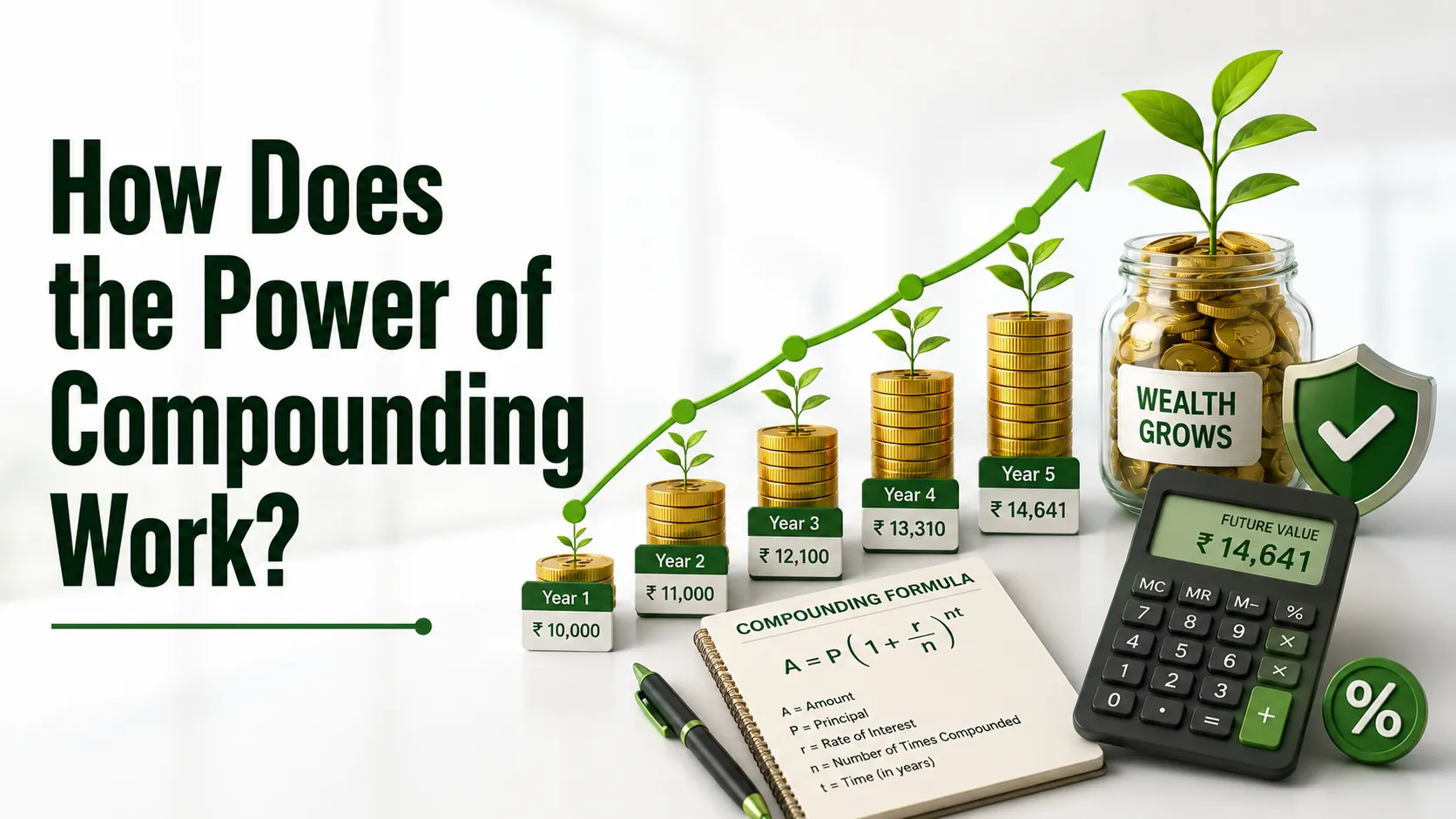
Compounding works on three major factors.
1. Initial Investment
The amount you invest initially acts as the foundation for your wealth-creation journey. A higher investment can generate larger returns over time.
2. Rate of Return
The return percentage directly affects the speed at which money grows. A higher return rate can increase the final investment value, although higher returns typically involve higher risks.
3. Time Period
Time is the most important factor in compounding processes. The longer your money remains invested, the more opportunities it has to generate additional returns.
For example:
- Investor A starts investing at the age of 25 years.
- Investor B starts investing at the age of 35.
Even if both invest the same amount, Investor A may accumulate significantly more wealth because the investment has an extra 10 years to compound.
Compound Interest Formula Explained
Compound interest helps calculate the growth of an investment over a specific period.
Compound Interest Formula
A = P (1 + r/n)ⁿᵗ
Where:
- A = Final investment value
- P = Initial investment amount (Principal)
- r = Annual interest rate
- n = Number of times interest is compounded in a year
- t = Investment duration
The formula shows how an investment grows when the earned interest is added to the principal amount.
Components of Compound Interest Formula
Principal Amount (P)
The principal is the original amount invested.
Example:
If you invest ₹50,000, then ₹50,000 is your principal.
Rate of Return (r)
This represents the annual return on your investment.
Example:
A 10% annual return means that your investment grows by 10% every year.
Compounding Frequency (n)
This shows how often returns are added to the investment.
Compounding can happen:
- Daily
- Monthly
- Quarterly
- Annually
More frequent compounding can slightly increase the final maturity amount required.
Time Period (t)
The duration for which your money is invested.
A longer investment period allows compounding to have a larger impact.
Power of Compounding Example: How Money Grows Over Time
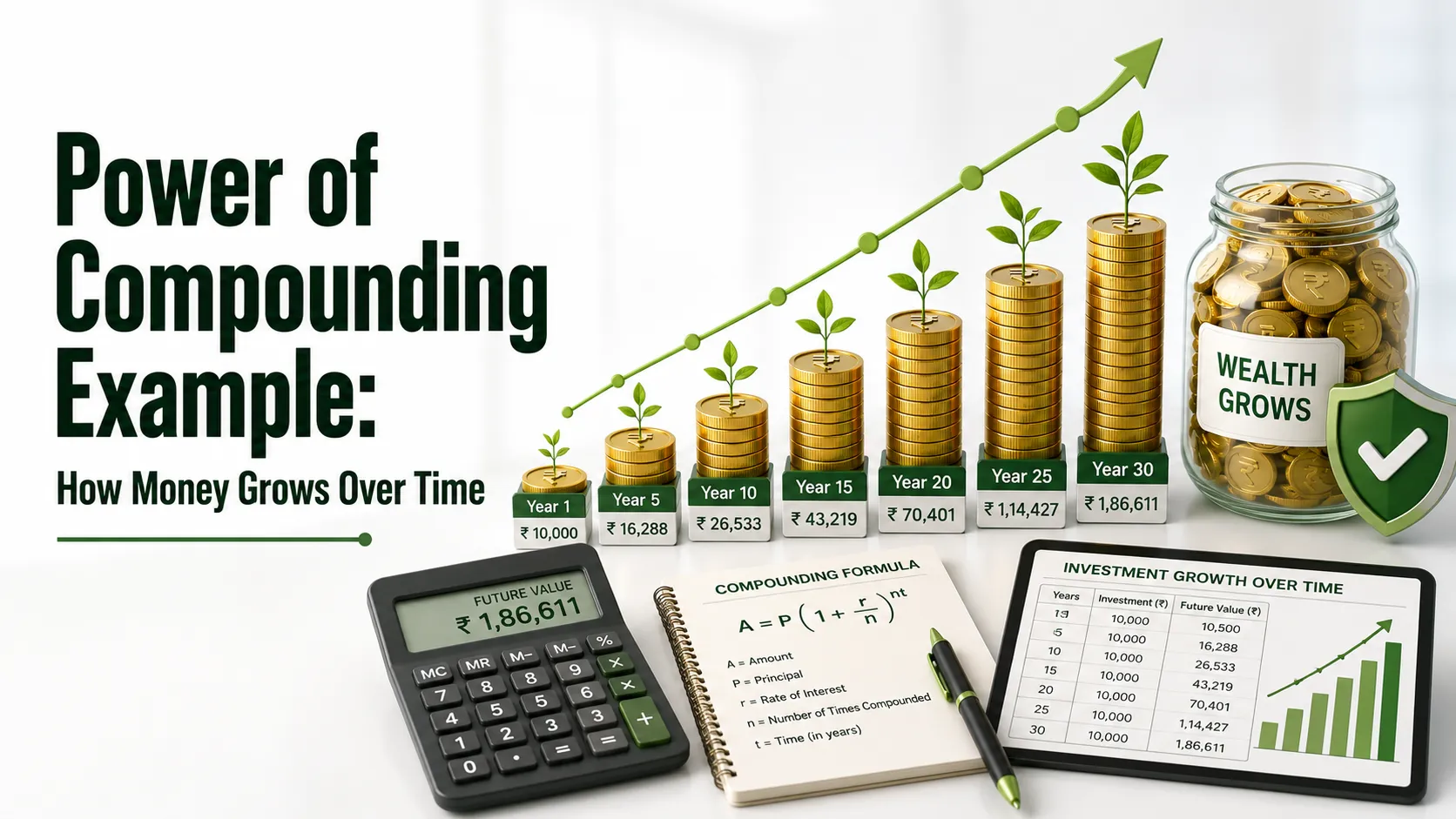
The real impact of compounding becomes visible when you remain invested for a longer period. Even a small investment can grow into a significant amount because your returns continue to generate additional returns.
This can be understood with an example.
Example: Investment Growth Through Compounding
Suppose you invest ₹1,00,000 at an annual return of 10%.
| Investment Period | Approximate Value |
|---|---|
| After 5 years | ₹1,61,051 |
| After 10 years | ₹2,59,374 |
| After 20 years | ₹6,72,750 |
| After 30 years | ₹17,44,940 |
From this example, it can be seen that investment growth becomes faster as time increases. The initial years may show moderate growth, but over longer periods, compounding effects create a snowball effect.
This is why investors often say that time in the market is more important than timing the market.
Simple Interest versus Compound Interest: Which Creates More Wealth?
Both simple and compound interest help your money grow, but the calculation methods are different.
Simple Interest
In simple interest, returns are calculated only on the original investment amount (the principal).
Formula:
SI = (P × R × T) / 100
Example:
If you invest ₹1,00,000 at 10% interest for 10 years,
- Interest earned every year = ₹10,000
- Total interest after 10 years = ₹1,00,000
- Final amount = ₹2,00,000
Compound Interest
In compound interest, returns are calculated on the original investment plus the previously earned interest.
For the same investment,
- Initial investment = ₹1,00,000
- Rate = 10%
- Period = 10 years
The final amount is approximately
₹2,59,374
The ₹ 59, 374 difference comes from the power of compounding.
Difference Between Simple Interest and Compound Interest
| Feature | Simple Interest | Compound Interest |
|---|---|---|
| Interest calculation | Only on principal | On principal + accumulated interest |
| Growth speed | Slower | Faster over time |
| Best suited for | Short-term loans/investments | Long-term wealth creation |
| Returns | Fixed growth | Exponential growth potential |
Does Compounding Frequency Affect Returns
Yes, the frequency at which returns are compounded can impact the final investment value.
The compounding frequency indicates how often the earned interest is added back to the principal amount.
Common compounding frequencies include
- Daily compounding
- Monthly compounding
- Quarterly compounding
- Annual compounding
Generally, more frequent compounding can result in slightly higher returns because money starts generating returns sooner.
Daily vs Monthly vs Annual Compounding Example
Suppose you invest ₹1,00,000 at an annual interest rate of 8% for five years.
| Compounding Frequency | Approximate Maturity Amount |
|---|---|
| Annual | ₹1,46,933 |
| Monthly | ₹1,48,989 |
| Daily | ₹1,49,146 |
The difference may appear small in the short term; however, over longer periods, frequent compounding can have a greater impact.
Also read: Index Fund vs Mutual Fund: Which Is Better?
How Compounding Works in Different Investments
The power of compounding is not limited to a single type of investment. Several financial products allow investors to benefit from this long-term growth.
Power of Compounding in Fixed Deposits
Fixed Deposits (FDs) are one of the simplest examples of compounding.
In a cumulative fixed deposit, the interest earned is added back to the deposit amount and paid at the maturity. This allows the investment to grow through compounding growth.
For example:
- Initial FD amount: ₹1,00,000
- Interest earned: Added back to the principal
- Next interest calculation: Done on the increased amount
Over time, this increases the maturity value of the FD account.
Factors affecting FD compounding include:
- Interest rate
- Deposit tenure
- Compounding frequency
- Type of FD selected
Power of Compounding in Mutual Funds
Mutual funds can help investors benefit from compounding, especially when investing for long-term goals.
Through Systematic Investment Plans (SIPs), investors regularly invest a fixed amount. The returns generated from investments can be reinvested, allowing the investment value to grow over time.
For example:
A person investing ₹5,000 every month for 20 years may create a significantly larger corpus compared to simply saving the same amount without investing it.
Actual returns depend on market performance, as mutual funds are market-linked investments.
Also read: What Is a Liquid Mutual Fund?
Power of Compounding in Stocks
Long-term stock investors can benefit from compounding in the following ways:
- Increase in company value
- Dividend reinvestment
- Growth in earnings over time
Successful investors often focus on holding quality companies for the long term, rather than making frequent short-term trades.
Benefits of the Power of Compounding
The power of compounding offers several advantages to investors.
1. Helps Create Long-Term Wealth
Compounding allows investments to grow exponentially over longer periods of time. It helps investors build wealth without depending solely on increasing their investment amount.
2. Rewards Early Investors
Starting early gives your investment more time to grow.
For example, investing at age 25 provides more years for compounding than starting at age 40.
3. Encourages Financial Discipline
Regular investing and remaining invested help develop good financial habits.
4. Helps Achieve Financial Goals
Compounding can support long-term goals, such as
- Retirement planning
- Buying a house
- Children’s education
- Building emergency savings
5. Maximises the Benefit of Reinvested Returns
Instead of spending returns, reinvesting them allows your money to generate additional growth.
How to Maximize the Power of Compounding?
To maximize the benefits of compounding, the following principles should be followed:
1. Start Investing Early
The earlier you begin, the more time your investment has to compound.
2. Stay Invested for the Long Term
Frequent buying and selling can reduce the benefits of compounding. Long-term investing allows money to grow steadily.
3. Invest Regularly
Consistency is crucial. Regular investments through options such as SIPs can help build wealth gradually.
4. Reinvest Your Returns
Allow your interest, dividends, or profits to remain invested so that they can generate further returns.
5. Increase Your Investment Over Time
As your income grows, increasing your investment can accelerate wealth creation.
Factors That Influence the Power of Compounding
The growth potential of compounding depends on several factors, including understanding these factors, which can help investors make better decisions and maximize their long-term returns.
1. Investment Duration
Time is the most powerful factor in the compounding process. The longer your money remains invested, the more opportunities it gets to generate additional returns.
For example, an investment that compounds for 25 years can create significantly more wealth than the same investment held for only 5 years.
Therefore, starting early is considered one of the biggest advantages of investing.
2. Rate of Return
The rate of return directly impacts the speed at which an investment grows.
A higher return rate can increase the final investment value; however, investors should also consider the risk involved. Choosing investments solely based on high returns without understanding the risk can affect long-term financial goals.
A balanced approach based on financial objectives and risk appetite is important.
3. Amount Invested
The amount invested also affects the final corpus. A larger investment amount provides a larger base for earning returns.
However, even small investments can grow significantly when given sufficient time.
For example, consistently investing a small amount every month can create substantial wealth over several decades due to compounding.
4. Compounding Frequency
The number of times your returns are added to your investment can influence its growth.
More frequent compounding means that your returns start generating additional returns sooner.
Common frequencies included:
- Daily compounding
- Monthly compounding
- Quarterly compounding
- Annual compounding
Conclusion: Start Early to Unlock the Power of Compounding
The power of compounding can help transform small investments into significant wealth. By allowing returns to generate further returns, compounding creates a growth cycle that becomes stronger over time.
The key factors behind successful compounding are starting early, investing consistently, staying invested for the long term, and reinvesting earnings.
Whether you choose fixed deposits, mutual funds, stocks, or other investment options, understanding compounding can help you make smarter financial decisions.
Wealth creation through compounding is not about quick gains. It is about giving your money enough time to grow and allowing patience and discipline to work in your favor.