Repo rate is one of the most important terms in Indian banking and personal finance. It directly affects loan interest rates, home loan EMIs, car loans, personal loans, business credit, fixed deposit returns, inflation, and overall economic growth.
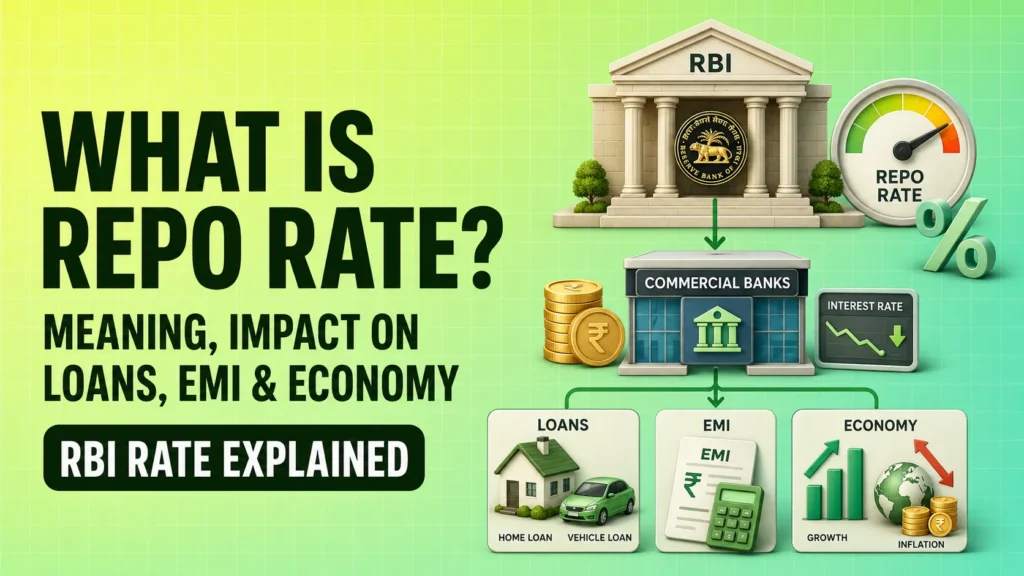
In simple words, repo rate is the interest rate at which the Reserve Bank of India lends short-term money to commercial banks against government securities. When banks need funds, they borrow from the RBI, and the interest charged on that borrowing is called the repo rate.
As of the latest verified data, India’s policy repo rate is 5.25%. The RBI’s data also shows the reverse repo rate at 3.35%, CRR at 3.00%, and SLR at 18.00%.
What is Repo Rate?
Repo rate stands for Repurchase Agreement Rate. It is called “repo” because banks borrow money from the RBI by selling government securities with an agreement to repurchase them later.
For example, if a bank needs short-term funds, it can give government securities to the RBI as collateral and borrow money. Later, the bank repurchases those securities by paying back the borrowed amount along with interest. That interest rate is the repo rate.
The RBI explains that its Liquidity Adjustment Facility allows banks to borrow or park funds against government securities, and these operations are conducted through repos and reverse repos.
So, repo rate is not just a banking term. It is a powerful monetary policy tool used by the RBI to manage liquidity, inflation, credit flow, and economic stability.
Repo Rate Meaning in Simple Words
Repo rate means the cost of borrowing money for banks from the RBI.
When the repo rate increases, banks have to pay more interest to borrow from the RBI. Because their borrowing cost rises, they may increase interest rates on loans given to customers.
When the repo rate decreases, banks can borrow money at a lower cost. This may allow them to reduce interest rates on loans, especially floating-rate loans.
In simple terms:
| Repo Rate Movement | Meaning for Borrowers |
|---|---|
| Repo rate increases | Loans may become expensive |
| Repo rate decreases | Loans may become cheaper |
| Repo rate remains unchanged | EMIs may stay stable |
Why Does RBI Change the Repo Rate?
The RBI changes the repo rate mainly to control inflation and support economic growth.
When inflation is high, prices of goods and services rise quickly. To control this, the RBI may increase the repo rate. Higher rates make borrowing expensive, which can reduce spending and slow down price increases.
When economic growth slows down, the RBI may reduce the repo rate. Lower rates make loans cheaper, which can encourage people and businesses to borrow, spend, invest, and expand.
That is why repo rate works like a balancing tool. The RBI uses it to maintain price stability while also supporting growth.
How Repo Rate Affects Loans
Repo rate has a direct impact on many loans, especially floating-rate loans.
In India, many home loans and retail loans are linked to external benchmarks such as the RBI policy repo rate. RBI introduced external benchmark-based lending to improve transparency and faster transmission of rate changes to borrowers. From October 1, 2019, new floating-rate personal or retail loans and floating-rate loans to micro and small enterprises were required to be linked to external benchmarks such as the RBI repo rate, Treasury Bill yields, or other FBIL-published benchmarks.
This means when the RBI changes the repo rate, banks may revise repo-linked loan rates.
Repo rate can affect:
Home loans, car loans, personal loans, education loans, business loans, MSME loans, and credit lines.
However, the impact is usually faster on repo-linked floating-rate loans compared to older MCLR or base-rate loans.
How Repo Rate Affects EMI
EMI stands for Equated Monthly Instalment. It is the fixed amount you pay every month toward your loan.
When repo rate increases, your loan interest rate may increase. As a result, your EMI may go up, or your loan tenure may become longer.
When repo rate decreases, your loan interest rate may come down. In that case, your EMI may reduce, or your loan tenure may become shorter.
For example, assume you have a ₹50 lakh home loan for 20 years.
| Interest Rate | Approx. EMI |
|---|---|
| 8.50% | ₹43,391 |
| 8.00% | ₹41,822 |
A 0.50% reduction in interest rate can reduce the EMI by around ₹1,569 per month. The actual benefit depends on your bank, loan type, remaining tenure, credit profile, and reset date.
Repo Rate and Home Loan EMI
Home loan borrowers are among the most affected by repo rate changes because home loans are usually large and long-term.
If your home loan is linked to the repo rate, any RBI rate change can reflect in your loan interest rate after the reset period. Some banks revise rates monthly, quarterly, or as per the loan agreement.
When repo rate falls, borrowers may get relief through lower EMIs or shorter tenure. When repo rate rises, borrowers may face higher EMIs or longer repayment periods.
This is why home loan borrowers should regularly check:
Their current interest rate, loan benchmark, reset date, spread charged by the bank, and balance transfer options.
Repo Rate and Personal Loans
Personal loans are usually unsecured loans. Since banks take higher risk in personal loans, the interest rates are generally higher than home loans.
Repo rate changes can influence personal loan interest rates, but the impact may not always be immediate. Banks also consider your credit score, income, employment stability, repayment history, and internal risk policy.
If the repo rate is low and your credit profile is strong, you may get a personal loan at a better rate. But if the repo rate is high, personal loan rates may also remain expensive.
Repo Rate and Car Loans
Car loans can also be affected by repo rate changes. When interest rates are low, car loan EMIs become more affordable, which may increase vehicle sales.
When interest rates rise, customers may delay car purchases because EMIs become higher. This is why repo rate changes can also affect sectors like automobiles, real estate, consumer durables, and business expansion.
Repo Rate and Fixed Deposits
Repo rate does not only affect borrowers. It also affects savers.
When repo rate rises, banks may increase fixed deposit rates to attract more deposits. This is good for FD investors because they can earn better returns.
When repo rate falls, FD rates may also decline over time. In that case, borrowers benefit from cheaper loans, but FD investors may get lower returns.
So, repo rate has opposite effects for borrowers and depositors.
For borrowers, lower repo rate is generally good.
For FD investors, higher repo rate is generally better.
Repo Rate Impact on Economy
Repo rate plays a major role in the economy because it influences the cost of money.
When repo rate is low, borrowing becomes cheaper. People may take more home loans, car loans, and personal loans. Businesses may also borrow more for expansion. This increases spending, investment, production, and employment.
But if too much money flows into the economy, inflation can rise.
When repo rate is high, borrowing becomes expensive. People may reduce spending, and businesses may delay expansion. This can help control inflation, but it may also slow down economic growth.
So, the RBI has to balance two goals:
Control inflation and support economic growth.
Repo Rate vs Reverse Repo Rate
Repo rate and reverse repo rate are opposite concepts.
| Point | Repo Rate | Reverse Repo Rate |
|---|---|---|
| Meaning | Rate at which RBI lends money to banks | Rate at which RBI borrows money from banks |
| Purpose | Inject liquidity into the system | Absorb excess liquidity |
| Impact | Helps banks borrow funds | Helps banks park surplus funds |
| Borrower | Commercial banks | RBI |
| Lender | RBI | Commercial banks |
Repo rate is more directly connected with loan rates and EMIs. Reverse repo rate is mainly used to manage excess liquidity in the banking system.
What Happens When Repo Rate Increases?
When the RBI increases the repo rate, banks’ borrowing cost rises. Banks may pass this cost to borrowers by increasing loan interest rates.
This can lead to:
Higher home loan EMIs, expensive personal loans, reduced borrowing demand, lower spending, slower business expansion, and better FD returns.
A repo rate hike is usually used when inflation is high and the RBI wants to reduce excess demand in the economy.
What Happens When Repo Rate Decreases?
When the RBI decreases the repo rate, banks can borrow funds at a lower cost. This can make loans cheaper for customers.
This can lead to:
Lower EMIs, cheaper home loans, cheaper business loans, higher credit demand, more consumption, and stronger economic activity.
A repo rate cut is usually used when the RBI wants to support growth or increase liquidity in the economy.
Does Repo Rate Immediately Reduce Your EMI?
Not always.
Your EMI will not automatically reduce the same day RBI cuts the repo rate. The change depends on your loan type and reset period.
If your loan is repo-linked, the rate change may reflect faster. If your loan is linked to MCLR or an older benchmark, the transmission may be slower.
Also, some banks reduce tenure instead of EMI. That means your monthly payment may remain the same, but your loan may close earlier.
So, after every RBI repo rate change, check your loan statement or contact your bank to understand how the change affects your loan.
Why Repo Rate Matters for Common People
Repo rate matters because it affects everyday financial decisions.
If you are planning to buy a house, repo rate can influence your home loan rate. If you already have a loan, it can affect your EMI. If you invest in fixed deposits, it can affect your returns. If you run a business, it can affect your cost of borrowing.
Even if you do not take loans, repo rate still affects inflation, job creation, business confidence, and overall economic activity.
Final Verdict
Repo rate is the rate at which the RBI lends short-term money to commercial banks against government securities. It is one of the most important tools used by the RBI to control inflation, manage liquidity, and support economic growth.
For borrowers, a lower repo rate can mean cheaper loans and lower EMIs. For depositors, a higher repo rate can mean better FD returns. For the economy, repo rate helps maintain balance between growth and inflation.
Before taking any loan, always check whether your loan is repo-linked, MCLR-linked, or based on another benchmark. This small detail can make a big difference in how quickly RBI rate changes affect your EMI.
FAQs on Repo Rate
What is repo rate in simple words?
Repo rate is the interest rate at which the RBI lends money to commercial banks for short-term needs against government securities.
What is the current repo rate in India?
As per the latest verified RBI data, the current policy repo rate is 5.25%.
Does repo rate affect home loan EMI?
Yes. If your home loan is linked to the repo rate or an external benchmark, a change in repo rate can affect your EMI or loan tenure.
What happens when repo rate increases?
When repo rate increases, loan interest rates may rise. This can make EMIs higher and borrowing more expensive.
What happens when repo rate decreases?
When repo rate decreases, banks may reduce loan interest rates. This can lower EMIs or reduce loan tenure for borrowers.