Table of Contents
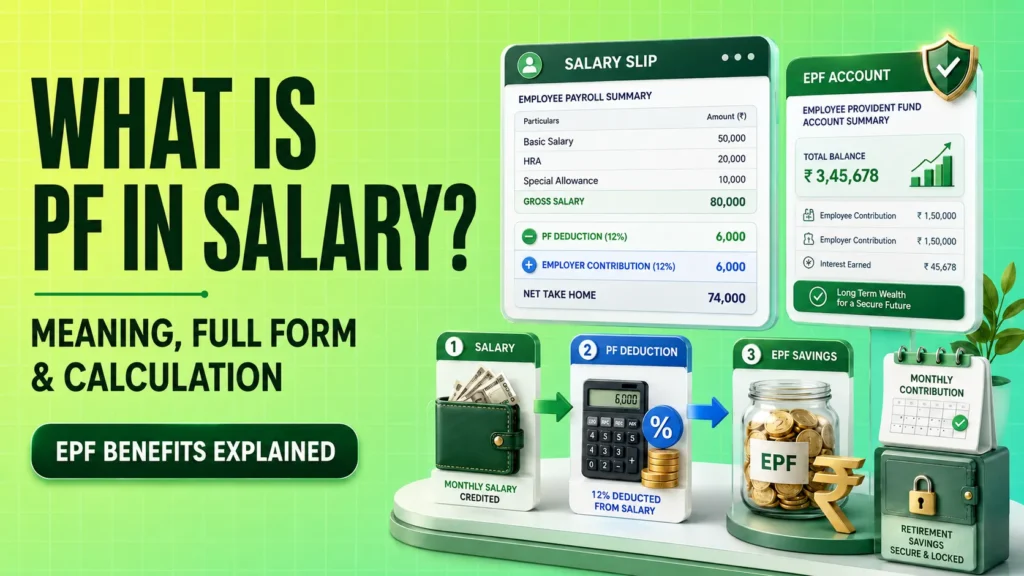
PF in salary stands for Provident Fund. For salaried employees in India, it usually refers to the Employees’ Provident Fund or EPF. A portion of eligible salary is contributed every month toward retirement savings, and the employer also makes a contribution.
The standard employee EPF contribution is generally 12% of eligible wages. The employer generally contributes another 12%, with a portion of the employer’s contribution going toward the Employees’ Pension Scheme or EPS where applicable.
Important 2026 update: From 17 September 2026, the statutory EPFO wage ceiling for mandatory coverage was increased from ₹15,000 to ₹25,000 per month. This change affects employees who fall within the revised coverage limit and also changes the maximum standard EPS contribution.
This guide explains what PF means in salary, how much PF is deducted, whether PF is calculated on basic or gross salary, how employee and employer contributions work, and how the ₹25,000 wage ceiling affects PF calculations.
What Is PF in Salary?
PF in salary is a monthly contribution made toward an employee’s Provident Fund account. It is mainly designed to help salaried employees build savings for retirement and long-term financial security.
When your salary slip shows terms such as PF, EPF, Employee PF or Provident Fund, it generally means part of your eligible salary has been contributed to your EPF account.
Your employer also contributes separately. However, the employer’s contribution does not necessarily go entirely into the EPF balance because part of it may be allocated to EPS under the applicable rules.
PF is therefore different from a normal expense deducted from salary. The employee contribution is part of your long-term retirement savings.
PF Full Form in Salary
PF full form in salary is Provident Fund.
For most salaried employees in India, PF commonly refers to EPF, or Employees’ Provident Fund. EPF is administered by the Employees’ Provident Fund Organisation, commonly known as EPFO.
Another term you may see while checking your PF details is EPS, which stands for Employees’ Pension Scheme.
| Term | Full Form | Purpose |
|---|---|---|
| PF | Provident Fund | General term for provident fund savings |
| EPF | Employees’ Provident Fund | Retirement savings for eligible employees |
| EPS | Employees’ Pension Scheme | Pension benefit under applicable EPFO rules |
| EPFO | Employees’ Provident Fund Organisation | Administers EPF and related schemes |
PF in Salary: Quick Overview
| Question | Simple Answer |
|---|---|
| What is PF in salary? | A retirement-focused contribution from eligible salary |
| PF full form? | Provident Fund |
| Normal employee contribution | Generally 12% of eligible PF wages |
| Does the employer contribute? | Yes, generally a matching statutory contribution applies |
| Current statutory wage ceiling | ₹25,000 per month from 17 September 2026 |
| Is PF normally calculated on full CTC? | No. PF wages are different from total CTC |
| Where can you check your PF? | EPFO passbook, UAN services and other official EPFO channels |
How Much PF Is Deducted From Salary?
For most employees covered under the standard contribution rate, the employee contributes 12% of eligible PF wages.
The employer generally contributes another 12%. However, the employer contribution is divided between EPF and EPS where pension contribution is applicable.
A lower statutory contribution rate may apply to certain specified establishments, so 12% should not be treated as a universal rate for every employer in every situation.
The simple formula is:
Employee PF = Eligible PF Wages × Applicable Contribution Rate
For a standard 12% contribution and eligible PF wages of ₹25,000:
₹25,000 × 12% = ₹3,000 per month
This means ₹3,000 would be the employee contribution in this example.
Is PF Calculated on Basic Salary or Gross Salary?
PF is generally calculated on eligible PF wages rather than the employee’s complete gross salary or CTC.
Basic wages and dearness allowance, where applicable, are important components for PF calculation. However, employees should not assume that simply labelling an allowance differently on a salary slip automatically keeps it outside PF wages. The exact treatment depends on applicable EPF law, scheme rules and the nature of the salary component.
This is why two employees with the same gross salary can sometimes have different PF deductions depending on their salary structure and contribution arrangement.
Basic Salary vs Gross Salary vs CTC
| Salary Term | What It Usually Means |
|---|---|
| Basic Salary | Core fixed salary component |
| Gross Salary | Basic salary plus applicable allowances before deductions |
| CTC | Total cost incurred by the employer, which can include employer benefits and contributions |
| Eligible PF Wages | Salary components considered for PF contribution under applicable rules |
How Is PF Calculated on Salary?
PF calculation becomes easier when you separate the employee and employer portions.
Employee Contribution
The employee’s contribution generally goes to EPF.
Employee EPF = Eligible PF Wages × 12%
For example, if eligible PF wages are ₹20,000:
₹20,000 × 12% = ₹2,400
So ₹2,400 would normally be contributed by the employee in this example.
Employer Contribution
The employer also generally makes a statutory contribution. Where EPS contribution applies, the employer’s share is divided between EPF and EPS.
The employee does not make a separate EPS contribution from the employee share. EPS is funded from the employer contribution according to applicable rules.
EPF and EPS Contribution Split
A common mistake is to assume that the employer always contributes exactly 3.67% to EPF and 8.33% to EPS regardless of salary.
That shortcut can become misleading, especially when salary exceeds the statutory pensionable wage ceiling.
Under the current ₹25,000 ceiling, the maximum standard EPS contribution, where applicable, is approximately:
₹25,000 × 8.33% = ₹2,083 per month after rounding
The remaining portion of the employer’s statutory contribution goes to EPF, subject to the applicable scheme rules.
New PF Wage Ceiling of ₹25,000 in 2026
The Government increased the statutory EPFO wage ceiling for mandatory coverage from ₹15,000 to ₹25,000 per month with effect from 17 September 2026.
This is particularly important for employees in the ₹15,000 to ₹25,000 wage range who were earlier outside mandatory coverage solely because their wages were above the previous ₹15,000 threshold, subject to the other applicable eligibility conditions.
The revision also increased the pensionable wage ceiling used for the standard maximum EPS contribution.
| Particular | Earlier Ceiling | From 17 September 2026 |
|---|---|---|
| Statutory wage ceiling | ₹15,000 | ₹25,000 |
| Maximum standard EPS wage base | ₹15,000 | ₹25,000 |
| Maximum EPS contribution at 8.33% | About ₹1,250 | About ₹2,083 |
Employees should remember that the wage ceiling is not the same as saying that every employee earning more than ₹25,000 suddenly stops having PF. Existing membership, employer arrangements, higher-wage contributions and other applicable provisions can affect the actual deduction.
PF Calculation Example Under the ₹25,000 Wage Ceiling
Suppose the employee’s eligible PF wages for statutory contribution are ₹25,000 per month and the normal 12% rate applies.
| Contribution | Calculation | Approx. Amount |
|---|---|---|
| Employee EPF | ₹25,000 × 12% | ₹3,000 |
| Employer total statutory contribution | ₹25,000 × 12% | ₹3,000 |
| Employer EPS portion | ₹25,000 × 8.33% | ₹2,083 |
| Remaining employer EPF portion | ₹3,000 − ₹2,083 | ₹917 |
In this simplified example, the employee contributes ₹3,000 and the employer contributes another ₹3,000. The employer contribution is divided between EPF and EPS where EPS applies.
Note: Actual payroll figures can differ because of rounding, employee eligibility, pension rules, higher-wage contribution arrangements and other statutory conditions.
What If Your Salary Is More Than ₹25,000?
Earning more than ₹25,000 does not automatically mean that PF cannot apply to you.
The ₹25,000 figure is the statutory wage ceiling relevant to mandatory coverage and standard ceiling-based contribution calculations under the revised rules.
An employee’s actual PF can still depend on factors such as existing EPF membership, when the employee joined, the employer’s payroll policy and whether contribution on higher wages is applicable.
For example, if your salary slip shows a PF deduction higher than ₹3,000, it may indicate that contribution is being calculated on wages above ₹25,000. Check your salary structure or ask the payroll team how your PF wage has been determined instead of assuming the deduction is incorrect.
Why Is PF Deducted From Salary?
PF is designed to help employees build long-term retirement savings through regular contributions.
Instead of relying completely on voluntary monthly saving, eligible employees contribute automatically through payroll. Employer contribution adds another layer of retirement support.
PF savings may also be available for specified withdrawals or advances under applicable EPFO rules. However, PF is primarily a retirement-focused benefit, so withdrawing it unnecessarily can reduce the amount available later in life.
If you are planning your finances beyond PF, you can also read our guide on creating an early retirement plan.
How Does PF Affect Your Take-Home Salary?
Your employee PF contribution normally reduces the amount that reaches your bank account as take-home salary because it appears as a deduction from eligible salary.
For example:
| Salary Item | Example Amount |
|---|---|
| Gross monthly salary | ₹50,000 |
| Employee PF deduction | ₹3,000 |
| Other deductions | Depends on employee |
| Take-home salary | Gross salary minus applicable deductions |
The employer PF contribution may also form part of the employee’s CTC, depending on how the company structures compensation.
This is why your CTC, gross salary and actual bank credit are often different amounts.
Where Is PF Shown in a Salary Slip?
PF usually appears under the Deductions section of a salary slip.
Depending on the employer, it may be labelled as:
- PF
- EPF
- Employee PF
- Provident Fund
- EPF Contribution
The employer contribution may be shown separately in the CTC or employer-benefits section instead of the monthly deductions section.
If the deduction in your salary slip does not match your expectation, first identify the PF wage used by your employer rather than calculating 12% directly on total CTC.
Employee PF vs Employer PF
| Point | Employee Contribution | Employer Contribution |
|---|---|---|
| Who pays? | Employee | Employer |
| Normal standard rate | Generally 12% | Generally 12% |
| Where does it go? | EPF | EPF and EPS where applicable |
| Reduces take-home? | Yes | Not deducted from employee’s take-home in the same way |
| May be part of CTC? | Employee deduction comes from salary | Often included in CTC structure |
What Are the Benefits of PF in Salary?
1. Builds Retirement Savings
Regular monthly contributions help build a long-term retirement corpus without requiring the employee to manually invest the amount every month.
2. Employer Also Contributes
The employer contribution increases the total retirement-related amount being set aside for an eligible employee.
3. EPF Earns Interest
EPF balances earn interest at the rate approved for the relevant financial year. The rate can change, so employees should check the latest official EPFO announcement instead of assuming that an old interest rate still applies.
4. Pension Benefit May Apply
Part of the employer contribution may go to EPS for eligible members, helping provide pension-related benefits subject to the scheme rules.
5. Can Support Long-Term Financial Planning
PF can form one part of a broader retirement plan. It should generally be considered alongside an emergency fund, insurance and other long-term investments rather than being treated as the employee’s only financial asset.
If you have not yet built a cash buffer, see our guide on how much emergency fund you should save.
Does PF Give Tax Benefits?
EPF can have tax benefits under applicable income-tax rules, but the exact treatment depends on factors such as the tax regime selected, contribution amount, employer contribution and withdrawal conditions.
Tax rules can change, so avoid assuming that every PF contribution automatically gives the same deduction to every employee.
For a broader comparison of eligible options, read our guide to tax-saving investments.
Who Is Eligible for PF?
PF eligibility depends on factors such as the employee’s wages, establishment coverage, employment status and applicable EPFO provisions.
With the statutory wage ceiling increased to ₹25,000 from 17 September 2026, eligible employees within the revised wage range can fall under mandatory EPFO coverage subject to the applicable conditions.
Employees earning above the statutory ceiling may still have EPF depending on their existing membership and contribution arrangement.
If you are unsure whether PF should apply to your salary, check:
- Your appointment or offer letter
- Your salary structure
- Your latest payslip
- Your UAN and EPFO records
- Your employer’s payroll or HR team
How to Check Your PF Balance
EPFO members can check their available PF information through official EPFO services.
Common options include:
- EPFO Member Passbook service
- UAN member services
- UMANG app
- EPFO SMS facility where eligible
- EPFO missed-call service where eligible
Your UAN and required KYC details should be correctly updated to avoid problems while accessing or claiming PF benefits.
When Can You Withdraw PF?
PF is primarily meant for retirement, but withdrawals or advances may be available in specified circumstances under applicable EPFO rules.
These can include situations connected with unemployment, medical needs, housing, education, marriage and other permitted purposes.
Withdrawal limits, minimum balance requirements, service conditions and settlement rules can change. Always check the latest EPFO conditions before submitting a claim.
Do not treat PF as your first source of money for normal monthly expenses. Building a separate emergency fund can reduce the need to disturb long-term retirement savings.
EPF vs PPF: What Is the Difference?
EPF and PPF both help with long-term savings, but they are different products.
| Point | EPF | PPF |
|---|---|---|
| Full Form | Employees’ Provident Fund | Public Provident Fund |
| Main Users | Eligible employees | Eligible individuals |
| Contribution | Employee and employer | Individual |
| Main Purpose | Employee retirement savings | Long-term individual savings |
| Employer Contribution | Yes, where applicable | No |
| Rules | Governed by applicable EPFO provisions | Governed by PPF scheme rules |
Do not confuse the two simply because both contain the words “Provident Fund.”
Common PF Mistakes Employees Should Avoid
Calculating PF Directly on Gross Salary
Do not automatically multiply your complete gross salary or CTC by 12%. First understand the eligible PF wage used for your contribution.
Assuming Employer EPF Is Always 3.67%
The employer EPF amount is the remaining employer contribution after the applicable EPS portion. The simple 3.67% figure does not correctly explain every salary situation.
Ignoring the New ₹25,000 Wage Ceiling
Articles and calculators still using ₹15,000 as the current statutory ceiling may now be outdated after the September 2026 revision.
Not Checking the EPFO Passbook
Periodically compare your salary-slip deduction with contributions reflected in your EPFO records.
Ignoring UAN and KYC Details
Incorrect Aadhaar, bank, PAN or other member details can create problems when trying to access EPFO services.
Withdrawing PF Without Considering Retirement
PF is meant to build long-term savings. Before withdrawing it for a non-essential expense, consider whether you can manage the expense from regular savings instead.
For practical saving ideas, you can read how to save money on a low income.
Key Takeaways
- PF full form in salary is Provident Fund.
- For salaried employees, PF usually refers to EPF.
- The normal employee contribution is generally 12% of eligible PF wages.
- The employer also generally contributes, with a portion going toward EPS where applicable.
- PF is not automatically calculated on the full gross salary or CTC.
- The statutory EPFO wage ceiling increased from ₹15,000 to ₹25,000 from 17 September 2026.
- The maximum standard EPS contribution at the ₹25,000 pensionable wage ceiling is about ₹2,083 per month.
- Actual PF deductions can differ depending on salary structure, membership and higher-wage contribution arrangements.
FAQs About PF in Salary
What is PF in salary?
PF in salary is a contribution toward an employee’s Provident Fund. For most salaried employees in India, it refers to EPF, which is intended mainly for retirement savings.
What is PF full form in salary?
PF stands for Provident Fund. EPF stands for Employees’ Provident Fund.
How much PF is deducted from salary?
The employee contribution is generally 12% of eligible PF wages under the standard rate. The actual amount depends on the employee’s PF wage and applicable contribution rules.
Is PF calculated on basic salary or gross salary?
PF is generally calculated on eligible PF wages rather than the entire gross salary or CTC. Basic wages and dearness allowance, where applicable, are important components, but the exact statutory wage treatment can depend on the nature of other salary components.
What is the PF wage limit in 2026?
The statutory wage ceiling for mandatory EPFO coverage was increased from ₹15,000 to ₹25,000 per month with effect from 17 September 2026, subject to applicable provisions.
Can PF be higher than ₹3,000 per month?
Yes. A PF deduction can be higher where contribution is being made on eligible wages above the ₹25,000 statutory ceiling under the applicable arrangement. Check your salary breakup and payroll policy for the exact calculation.
Disclaimer: This article is for educational purposes only. PF contribution, coverage, pension and tax treatment can depend on an employee’s specific circumstances and the rules applicable at the time. For an individual payroll or EPFO issue, verify the latest official EPFO guidance or consult your employer’s payroll team or a qualified professional.