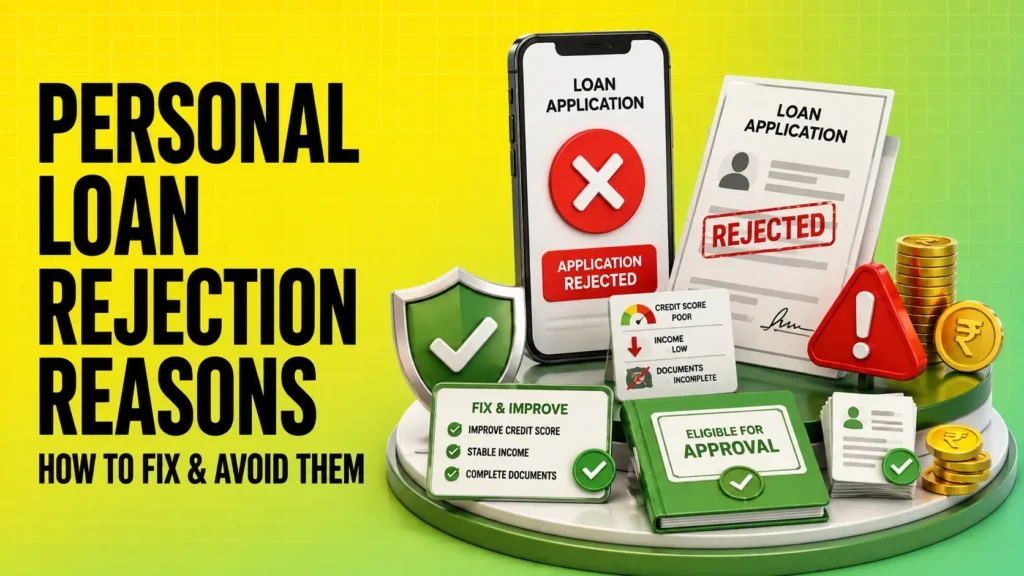
Getting a personal loan rejection can feel like a door slammed in your face — especially when you need the money urgently. You filled out the form, submitted your documents, and waited. Then came the message: “We regret to inform you that your loan application has been declined.”
The worst part? Most lenders do not tell you exactly why.
This guide explains every major personal loan rejection reason in plain language. More importantly, it tells you how to fix each problem and how to avoid rejection the next time you apply. Whether you were rejected yesterday or are planning to apply next month, this article will save you time, stress, and another hit to your credit score.
Table of Contents
How Personal Loan Approval Works in India
Before jumping into the reasons, understand the process. When you apply, lenders check three things:
- Your willingness to repay — shown by your credit score and repayment history
- Your ability to repay — shown by your income, job stability, and existing debts
- Your profile risk — shown by your age, location, employer, and loan amount requested
If any of these three pillars is weak, your application gets rejected. Let us look at each reason in detail.
Reason 1: Low CIBIL or Credit Score
What It Means
Your CIBIL score is a three-digit number between 300 and 900. It tells lenders how responsibly you have handled credit in the past. Most banks want a score of 750 or above. NBFCs may accept 650+, but with higher interest rates. A score below 600 usually means instant rejection.
Real Example
Rahul from Pune had a CIBIL score of 580. He had missed two credit card payments six months ago. He applied for a ₹3 lakh personal loan. Rejected within 24 hours.
How to Fix It
- Pay all EMIs and credit card bills on time for the next 6 months
- Keep your credit card utilization below 30% of the limit
- Do not close old credit cards — they build your credit history length
- Check your CIBIL report for errors and raise a dispute if you find any
Timeline to fix: 3 to 6 months of consistent good behavior
Also Read: How to Improve CIBIL Score from 600 to 750
Reason 2: High Debt-to-Income Ratio (FOIR)
What It Means
FOIR stands for Fixed Obligation to Income Ratio. It measures what percentage of your monthly income already goes toward paying EMIs and credit card bills.
Formula:
FOIR = (Total Monthly EMIs + Credit Card Minimum Dues) / Gross Monthly Income × 100
Most lenders reject applications if FOIR crosses 50%. Some conservative banks cap it at 40%.
Real Example
Priya earns ₹60,000 per month. She already pays:
- Car EMI: ₹12,000
- Credit card minimum: ₹5,000
- Education loan EMI: ₹8,000
Total obligations: ₹25,000. FOIR: ₹25,000 / ₹60,000 = 41.6%
She applied for a personal loan with an EMI of ₹10,000. New FOIR would be 59.1%. Rejected.
How to Fix It
- Pay off or close one existing loan before applying
- Request a lower loan amount to reduce the EMI
- Include your spouse’s income if the lender allows a co-applicant
- Clear credit card outstanding instead of paying minimum dues
Timeline to fix: 1 to 3 months
Also Read: Best Apps to Track and Manage Monthly Expenses
Reason 3: Unstable Employment or Income
What It Means
Lenders love stability. If you switch jobs frequently, work in a cash-based business, or have less than 6 months in your current company, banks see you as risky. Self-employed individuals often face extra scrutiny.
Real Example
Amit is a freelance graphic designer. His income varies between ₹40,000 and ₹80,000 per month. He has no ITR filed for the last year. Every bank rejected him. An NBFC approved him, but at 24% interest.
How to Fix It
- Salaried employees: Wait until you complete at least 6 months in your current job
- Self-employed: File ITR for at least 2 consecutive years
- Show additional income sources: rental income, freelancing, dividends
- If possible, add a salaried co-applicant (spouse or parent)
Timeline to fix: 6 months to 2 years depending on your situation
Reason 4: Errors in Application or Documents
What It Means
Sometimes rejection has nothing to do with your creditworthiness. A mismatch between your PAN card and Aadhaar name, an old salary slip, or a wrong bank account number can trigger an automatic rejection.
Common Document Errors
- Name mismatch across documents
- Outdated address proof
- Salary slip older than 2 months
- Bank statement not showing salary credit
- Missing signature on the application form
How to Fix It
- Double-check every field before submitting
- Ensure your name is identical on PAN, Aadhaar, and bank records
- Submit the latest 3 months of salary slips and 6 months of bank statements
- Use the same mobile number registered with your bank and Aadhaar
Timeline to fix: Immediate — just reapply with corrected documents
Reason 5: Applying with Multiple Lenders at Once
What It Means
Every time you apply for a loan, the lender checks your CIBIL report. This is called a hard inquiry. Multiple hard inquiries in a short time make you look desperate for credit. Lenders assume you are in financial trouble.
The Damage
- Each hard inquiry drops your CIBIL score slightly
- 3+ inquiries in 30 days can reduce your score by 10 to 20 points
- Lenders can see all recent inquiries on your report
How to Fix It
- Research first, apply once. Use eligibility calculators before applying
- Wait at least 30 to 45 days between applications
- If rejected by one lender, find out why before applying to the next
- Consider using a loan aggregator that does a soft check
Timeline to fix: 1 to 2 months of no new applications
Reason 6: Loan Amount Too High for Your Income
What It Means
Lenders use a simple multiplier rule. Most offer personal loans up to 10 to 15 times your monthly net income. If you ask for too much, the system auto-rejects you.
Real Example
Suresh earns ₹25,000 per month. He applied for a ₹5 lakh personal loan. Even with zero existing EMIs, the bank’s system flagged it as high risk. His eligible amount was closer to ₹2.5 to ₹3 lakh.
How to Fix It
- Calculate your eligible amount before applying: Net monthly income × 10
- If you need more, apply with a co-applicant
- Offer collateral if the lender accepts secured personal loans
- Split the need: take a smaller personal loan and use savings for the rest
Timeline to fix: Immediate — just apply for a lower amount
Reason 7: Existing Defaults or Settlements
What It Means
A default means you did not pay a loan or credit card bill for 90+ days. A settlement means you paid less than what you owed and closed the account. Both stay on your CIBIL report for 7 years and are red flags for lenders.
How to Fix It
- If the default is recent, pay it off completely and request a No Dues Certificate
- If the report shows a settled status, some lenders may still reject you
- Focus on NBFCs and fintech lenders who are more flexible with past defaults
- Build a clean repayment record for 12 to 24 months after the default
Timeline to fix: 1 to 2 years of clean credit behavior
Reason 8: Living in a Negative Pincode Area
What It Means
Some lenders maintain internal lists of pincodes with high default rates. If you live in one of these areas, your application may be rejected even with a good credit score. This is more common with certain NBFCs.
How to Fix It
- Apply with a nationalized bank instead of a small NBFC
- Use your office address if it is in a different, approved pincode
- Apply with a co-applicant who lives in an approved area
Timeline to fix: Immediate — just change the approach
Reason 9: Age Too Close to Retirement
What It Means
Personal loans usually have tenures of 1 to 5 years. If you are 58 years old and the lender’s retirement age limit is 60, they will not give you a 5-year loan because your income stops before the loan ends.
How to Fix It
- Apply for a shorter tenure (1 to 2 years)
- Add a younger co-applicant (working son or daughter)
- Apply with lenders who have higher age limits (some go up to 65)
- Consider a loan against FD or property instead
Timeline to fix: Immediate
Reason 10: No Credit History at All
What It Means
This is called having a -1 or NH (No History) CIBIL score. You have never taken a loan or credit card. Lenders have no data to judge your repayment behavior, so they play safe and reject.
How to Fix It
- Get a credit card against FD (secured credit card)
- Use it for small purchases and pay the full bill every month
- After 6 months of usage, your score will be generated
- Then apply for the personal loan
Timeline to fix: 6 to 12 months
Also read: Best Credit Cards in India
What to Do Immediately After Rejection
If your loan was rejected today, follow this exact order:
Step 1: Do not panic-apply elsewhere. Wait. Multiple rejections make it worse.
Step 2: Request the reason. Call the lender’s customer care or visit the branch. Ask for the specific reason in writing.
Step 3: Check your CIBIL report. Download your free report from the CIBIL website. Look for errors, defaults, or inquiries you did not authorize.
Step 4: Fix the root cause. Use the table above to identify your problem and follow the fix.
Step 5: Wait for the cooling period. Most experts recommend waiting 3 to 6 months before reapplying.
Step 6: Reapply strategically. Choose a lender whose criteria match your profile. If banks reject you, try NBFCs. If NBFCs reject you, try fintech apps.
Final Thoughts
A personal loan rejection is not the end. It is feedback. It tells you exactly where your financial profile is weak, and that information is valuable.
The key is to stop, diagnose, fix, and then reapply. Do not let ego or urgency push you into a cycle of repeated rejections. Every rejection costs you a few CIBIL points. Every smart fix brings you closer to approval.
Build your credit score. Lower your FOIR. Keep your documents clean. And when you are ready, apply once — with confidence.
Frequently Asked Questions
Q1. How long should I wait after a personal loan rejection?
Q2. Does a personal loan rejection affect my CIBIL score?
Q3. Can I apply for a personal loan after rejection?
Q4. Which lender is best after rejection?
Q5. What is the minimum CIBIL score for a personal loan?
Q6. What is FOIR in personal loans?
FOIR stands for Fixed Obligation to Income Ratio. It is the percentage of your income already committed to EMIs and credit card payments. Keep it below 40% to 50% for easy approval.