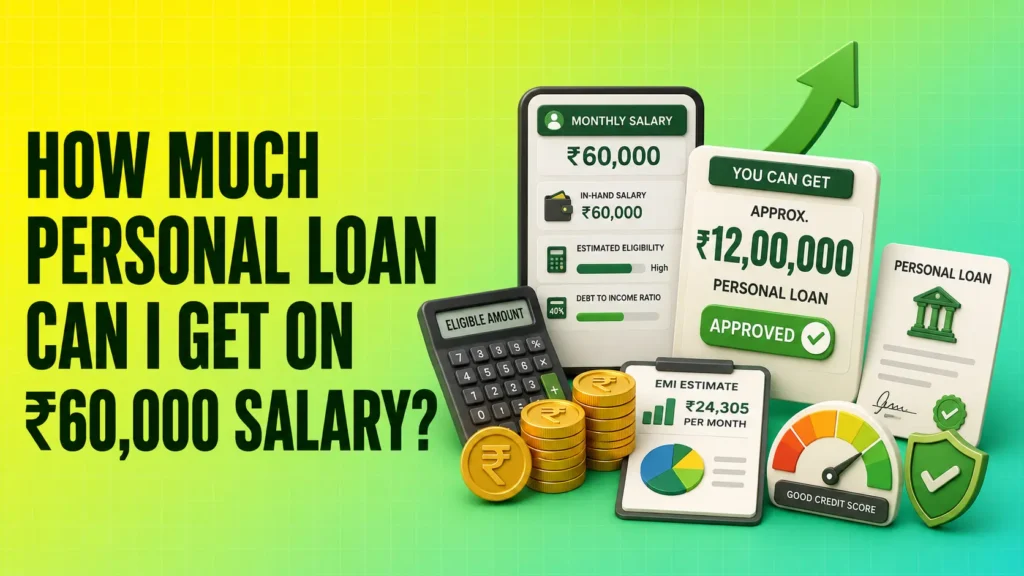
If you earn a monthly salary of ₹60,000, you may be eligible for a personal loan ranging from ₹6–18 lakhs. However, the exact amount depends on several factors, including your monthly income, CIBIL score, existing EMIs, employer profile, loan tenure, age, and lender eligibility criteria.
Most banks and NBFCs follow an EMI-to-Income Ratio (FOIR), which means that your total monthly loan obligations should generally not exceed 40% to 55% of your monthly income. The lower your existing financial commitments and the better your credit profile, the higher the loan amount you may qualify for.
Table of Contents
Factors on Which the Approval of the Loan Amount Depends
A monthly salary of ₹60,000 makes you eligible to apply for a personal loan with most banks and non-banking financial companies (NBFCs). However, your salary alone does not determine the loan amount you can avail. Lenders assess several financial and personal factors before deciding how much loan they can sanction. Understanding these factors can help improve your eligibility and increase your chances of obtaining a higher loan amount.
1. Monthly Income
Your monthly income is one of the first factors that lenders consider. A higher income generally indicates a stronger repayment capacity, allowing banks to offer larger loan amounts. Applicants earning ₹60,000 per month often qualify for higher loan limits than those with lower salaries, provided that other eligibility conditions are met.
2. Credit Score
Your credit score reflects your repayment history and financial discipline. Banks and NBFCs prefer applicants with strong credit profiles because they indicate lower lending risk.
- 750 and above – Excellent chances of approval
- 700–749 – Good chances
- 650–699 – Moderate chances
- Below 650 – Approval may become difficult
A higher credit score may also help secure lower interest rates.
3. Existing EMIs and Outstanding Loans
Lenders check your current financial obligations before approving a new loan application. If you are already paying multiple EMIs or have significant outstanding debt, your loan eligibility may decrease.
Applicants with lower existing liabilities usually have better chances of receiving higher loan amounts.
4. Employer Profile
Your employer’s reputation and business stability also influence loan approvals.
Employees working with:
- Government departments
- Public Sector Undertakings (PSUs)
- Multinational companies (MNCs)
- Reputed private companies
are often considered lower-risk borrowers and may receive better loan offers than other borrowers.
5. Employment Stability
Banks prefer applicants with stable employment histories. A longer work history with the same employer demonstrates a consistent income and improves lender confidence.
Frequent job changes may negatively affect loan eligibility.
6. Age
Age plays an important role in determining the loan eligibility.
Generally, lenders prefer applicants with sufficient working years remaining before retirement. Younger applicants with stable incomes often have better repayment capacities over longer loan tenures.
7. Loan Tenure
The repayment tenure you choose affects both your monthly EMI and loan eligibility.
A longer tenure generally reduces the EMI, which may allow lenders to approve higher loan amounts. However, a longer repayment period usually increases the total interest payable over the loan’s life.
8. Banking Relationship
Customers who maintain salary accounts, fixed deposits, or other banking relationships with a lender may receive faster approvals and better loan offers.
9. Repayment History
Lenders carefully review your previous repayment behavior.
Timely repayment of:
- Personal loans
- Home loans
- Vehicle loans
- Credit card bills
improves overall creditworthiness and increases the likelihood of loan approval.
Application Process for the Personal Loan
Applying for a personal loan is simple, especially since most banks and NBFCs now offer fully online applications for personal loans.
Step 1: Compare Different Lenders
Before applying, various banks and NBFCs should be compared based on:
- Interest rates
- Processing fees
- Loan amount
- Loan tenure
- Customer reviews
- Prepayment charges
Selecting the right lender can help reduce the overall borrowing costs.
Step 2: Check Your Eligibility
Review the lender’s eligibility criteria to ensure that you meet the minimum requirements before submitting an application.
Step 3: Keep Documents Ready
Collect all necessary documents in advance to avoid delays in the verification process.
Step 4: Fill Out the Loan Application
Complete the online or offline application form by providing the following:
- Personal details
- Employment information
- Monthly income
- Address details
- Bank account information
Ensure that all information is accurate.
Step 5: Submit Required Documents
Please upload or submit the requested documents for verification.
Step 6: Verification Process
The lender verifies the following:
- Identity
- Address
- Employment
- Income
- Credit history
- Banking details
Additional verification may be performed if required.
Step 7: Loan Approval
If your profile meets the lender’s criteria, your loan application is approved, and the sanctioned amount is communicated to you.
Step 8: Loan Disbursement
After completing the necessary formalities, the approved loan amount is directly transferred to your registered bank account.
Eligibility Criteria for Getting a Personal Loan
Although eligibility requirements vary across lenders, most banks and NBFCs consider the following criteria:
Basic Eligibility
You should generally:
- Be an Indian citizen.
- Be a salaried employee.
- They earn a monthly salary of approximately ₹60,000.
- Fall within the lender’s eligible age range.
- They have a stable source of income.
- Maintain a satisfactory credit score.
- Meet the lender’s minimum work experience requirement.
Preferred Applicant Profile
Applicants with the following profiles often receive better loan offers:
- Credit score above 750
- Stable employment
- Regular salary credits
- Low existing EMIs
- Strong repayment history
- Complete documentation
Documents Required for Personal Loan of Rs. 60,000 Salary
Most lenders require standard KYC, income, and employment documents during the application process.
Identity Proof
You may submit any of the following:
- Aadhaar Card
- PAN Card
- Passport
- Voter ID Card
- Driving Licence
Address Proof
Accepted address proofs generally include the following:
- Aadhaar Card
- Passport
- Utility Bill
- Driving Licence
- Rental Agreement (where accepted)
Income Proof
To verify your repayment capacity, lenders generally request the following:
- Latest salary slips
- Salary certificate (if applicable)
- Form 16 (where applicable)
Bank Statement
Applicants are generally required to provide recent bank statements that show regular salary credits.
Employment Proof
Depending on the lender, you may also need the following:
- Employee ID Card
- Appointment Letter
- Employment Confirmation Letter
- Passport-size Photographs
Some lenders may request recent passport-sized photographs during the application process.
PAN Card
A PAN Card is mandatory for most personal loan applications as it helps lenders verify your financial records and complete KYC formalities.
Eligibility Criteria for Getting a Personal Loan
Although eligibility requirements vary across lenders, most banks and NBFCs consider the following criteria:
Basic Eligibility
You should generally:
- Be an Indian citizen.
- Be a salaried employee.
- They earn a monthly salary of approximately ₹60,000.
- Fall within the lender’s eligible age range.
- They have a stable source of income.
- Maintain a satisfactory credit score.
- Meet the lender’s minimum work experience requirement.
Preferred Applicant Profile
Applicants with the following profiles often receive better loan offers:
- Credit score above 750
- Stable employment
- Regular salary credits
- Low existing EMIs
- Strong repayment history
- Complete documentation
Documents Required for Personal Loan of Rs. 60,000 Salary
Most lenders require standard KYC, income, and employment documents during the application process.
Identity Proof
You may submit any of the following:
- Aadhaar Card
- PAN Card
- Passport
- Voter ID Card
- Driving Licence
Address Proof
Accepted address proofs generally include the following:
- Aadhaar Card
- Passport
- Utility Bill
- Driving Licence
- Rental Agreement (where accepted)
Income Proof
To verify your repayment capacity, lenders generally request the following:
- Latest salary slips
- Salary certificate (if applicable)
- Form 16 (where applicable)
Bank Statement
Applicants are generally required to provide recent bank statements that show regular salary credits.
Employment Proof
Depending on the lender, you may also need the following:
- Employee ID Card
- Appointment Letter
- Employment Confirmation Letter
Passport-size Photographs
Some lenders may request recent passport-sized photographs during the application process.
PAN Card
A PAN Card is mandatory for most personal loan applications as it helps lenders verify your financial records and complete KYC formalities.
Conclusion
A monthly salary of ₹60,000 can make you eligible for a substantial personal loan, provided that you satisfy the lender’s eligibility criteria and maintain a strong credit profile. Before applying, compare the interest rates, processing fees, repayment tenures, and loan amounts offered by different nationalized banks, private banks, and NBFCs. Choosing the right lender and borrowing within your repayment capacity can help you manage your finances effectively while minimizing the overall loan cost.
FAQs
How much personal loan can I get with a ₹60,000 monthly salary?
Depending on your credit score, repayment capacity, employer profile, and lender policies, you may be eligible for a personal loan ranging from ₹5–20 lakhs or more.
What is the minimum credit score required for a personal loan?
Most lenders prefer applicants with a credit score of 750 or above, although some may consider lower scores based on other eligibility factors.
Can I get a ₹10 lakh personal loan on a ₹60,000 salary?
Yes. Many banks and NBFCs may approve a ₹10 lakh personal loan if you meet their eligibility criteria and have a solid repayment history.
Which bank offers the lowest personal loan interest rate?
Interest rates vary across lenders and depend on the borrower’s financial profile. Comparing multiple banks before applying can help you find the most competitive rates.
What is the maximum repayment tenure for a personal loan?
Most lenders offer repayment tenures ranging from 1 to 7 years, while some NBFCs may provide longer tenures.