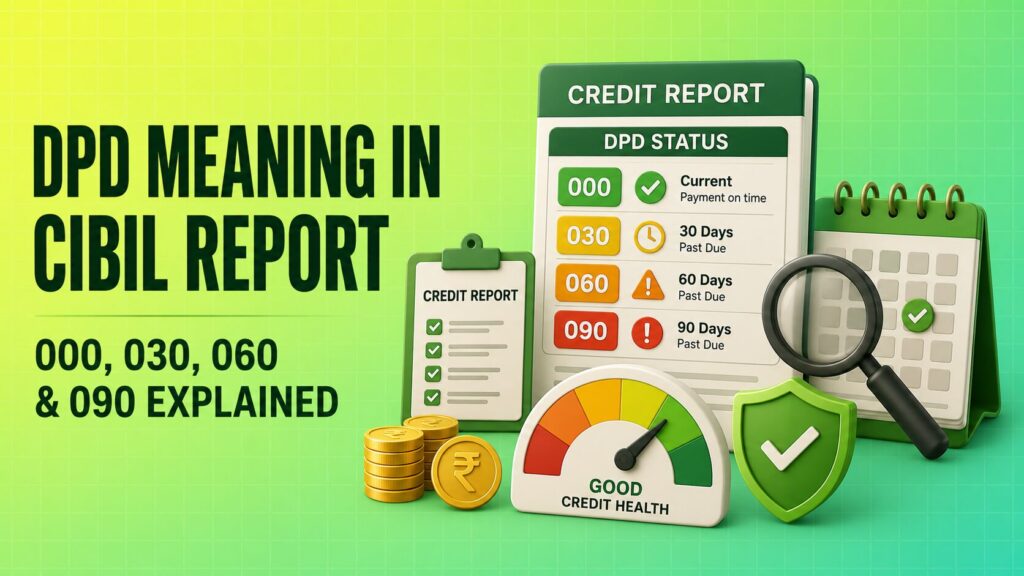
When you check your CIBIL report, you may notice terms like DPD, 000, 030, 060, 090, or even XXX in your payment history section. Many borrowers get confused after seeing these codes because they do not know whether these values are good or bad.
The DPD meaning in CIBIL report is simple. DPD stands for Days Past Due. It shows how many days late you were in paying your loan EMI or credit card bill.
For example, if your CIBIL report shows 000 DPD, it usually means your payment was made on time. If it shows 030 DPD, it means the payment was delayed by around 30 days. TransUnion CIBIL explains that if there is a number in the DPD column, it indicates how many days the payment was late; 000 means there was no deviation from the due date.
Understanding DPD is very important because lenders check your repayment history before approving a personal loan, home loan, credit card, vehicle loan, or any other retail loan.
What Is DPD in CIBIL Report?
DPD in CIBIL report means Days Past Due. It tells lenders whether you paid your loan EMI or credit card bill on time or delayed it.
In simple words, DPD shows your monthly repayment behaviour.
If you have a loan or credit card account, your lender reports repayment data to credit information companies like TransUnion CIBIL. This data appears in your CIBIL report under the payment history section. Your payment history may show month-wise DPD values such as 000, 030, 060, 090, XXX, STD, SMA, SUB, DBT, or LSS. TransUnion CIBIL’s own report guide shows that the payment history section can display either Days Past Due values or asset classification terms such as STD, SMA, SUB, DBT, and LSS.
DPD is important because it gives lenders a quick view of your payment discipline. A borrower with regular 000 DPD looks more reliable than a borrower with repeated 030, 060, or 090 DPD entries.
For example, if you apply for a personal loan, the bank may check your CIBIL score as well as your DPD history. Even if your score looks decent, repeated late payments in your DPD record can make lenders careful.If you are applying for a loan, your repayment history can directly affect your retail loan approval, interest rate, and eligibility.
DPD Full Form in CIBIL
The DPD full form in CIBIL is Days Past Due.
It means the number of days by which your EMI or credit card payment was delayed after the due date.
Here is a simple example:
| DPD Code | Meaning |
|---|---|
| 000 | Payment made on time |
| 030 | Payment delayed by around 30 days |
| 060 | Payment delayed by around 60 days |
| 090 | Payment delayed by around 90 days |
| XXX | Data not reported for that month |
CIBIL states that XXX in the DPD column means information for those months was not reported by the bank or lender. It does not automatically mean a late payment, but it also does not show a confirmed on-time payment for that month.
So, when you read your CIBIL report, you should not only look at your credit score. You should also check your DPD values month by month.
DPD Codes Meaning: 000, 030, 060, 090
DPD codes help you understand your repayment history in a simple number format. These codes show how late your payment was in a particular month.
000 DPD Meaning in CIBIL
000 DPD meaning in CIBIL is positive. It means your payment was made on time and there was no delay.
If your loan account or credit card account shows 000 for many months, it means you are maintaining a clean repayment record. This is good for your CIBIL score and loan approval chances.
For example:
| Month | DPD |
|---|---|
| January | 000 |
| February | 000 |
| March | 000 |
This means your payments were regular for these months.
A continuous 000 DPD history can help you build trust with lenders. It shows that you are responsible with your EMIs and credit card bills.
030 DPD Meaning in CIBIL
030 DPD meaning in CIBIL is that your payment was delayed by around 30 days.
This is not good for your credit report. A single 030 DPD may not destroy your credit profile completely, but it can still create a negative mark in your repayment history.
For example, if your EMI due date was 5 March and you paid it around 5 April, your lender may report it as 030 DPD.
A 030 DPD entry tells lenders that you missed the due date and paid after a delay. If this happens once due to a genuine reason, you should avoid repeating it. If it happens many times, it may reduce your loan approval chances.
060 DPD Meaning in CIBIL
060 DPD meaning in CIBIL is that your payment was delayed by around 60 days.
This is more serious than 030 DPD. It shows that the borrower did not pay the EMI or credit card bill for nearly two months.
A 060 DPD entry can create a stronger negative impact on your credit profile. Lenders may see this as a sign of repayment stress.
For example, if your personal loan EMI was due in January and you paid it after two months, your report may show 060 DPD.
Borrowers should take 060 DPD seriously and clear dues as soon as possible.
090 DPD Meaning in CIBIL
090 DPD in CIBIL means your payment was delayed by around 90 days.
This is a serious negative sign in your CIBIL report. A 90-day delay may indicate that the account is becoming risky from the lender’s point of view.
If your report shows 090 DPD, it can affect your chances of getting new loans or credit cards. Banks and NBFCs may reject your application or offer loans at a higher interest rate.
A 090 DPD entry should not be ignored. You should contact the lender, clear pending dues, and check whether the account status is updated correctly in your credit report.
What Is a Good DPD Value?
The best DPD value in a CIBIL report is 000.
A good repayment history usually means your report shows 000 DPD for most months. This tells lenders that you pay your EMIs and credit card bills on or before the due date.
Here is a simple table:
| DPD Value | Is It Good or Bad? | Meaning |
|---|---|---|
| 000 | Good | Payment made on time |
| 030 | Negative | Around 30 days delay |
| 060 | More negative | Around 60 days delay |
| 090 | Serious negative | Around 90 days delay |
| XXX | Neutral/needs checking | Data not reported by lender |
A 000 DPD record is good for your CIBIL score because it reflects disciplined repayment. On the other hand, repeated 030, 060, or 090 DPD entries show late payments and can reduce lender confidence.
So, your goal should be simple: maintain 000 DPD every month.
How DPD Affects Your CIBIL Score
DPD affects your CIBIL score because repayment history is one of the most important parts of your credit profile.
When you pay your loan EMI or credit card bill on time, your report shows positive repayment behaviour. But when you miss payments, your DPD values increase. These delays can affect your credit score and make lenders see you as a risky borrower.
For example:
| Borrower | DPD History | Lender View |
|---|---|---|
| Borrower A | 000, 000, 000, 000 | Reliable borrower |
| Borrower B | 000, 030, 000, 060 | Irregular repayment |
| Borrower C | 030, 060, 090, 090 | High-risk borrower |
If your DPD history has repeated delays, lenders may ask these questions:
- Can this borrower repay a new loan on time?
- Is the borrower already under financial pressure?
- Should we approve the loan or reject it?
- Should we charge a higher interest rate?
This is why DPD in CIBIL report is important for personal loans, home loans, vehicle loans, credit cards, and other credit products.
A low CIBIL score is not the only problem. Sometimes, even if your score is improving, old DPD entries can still make lenders cautious.
If your credit score is around 700, you should also check your DPD history before applying. You can read our guide on whether a CIBIL score of 700 is good or bad for loan approval.
Can You Remove Wrong DPD from CIBIL Report?
Yes, you can raise a dispute if the DPD value in your CIBIL report is wrong.
For example, suppose you paid your EMI on time, but your report shows 030 DPD. In that case, you should not ignore it. You should first collect proof of payment, such as bank statement, payment receipt, EMI debit message, or loan account statement.
Then you can raise a dispute with TransUnion CIBIL or contact the lender directly. The lender needs to verify and correct the information if the reported data is wrong.
As per the credit information correction framework, credit institutions and credit information companies have a total resolution timeline of 30 calendar days, split as 21 days for the credit institution and 9 days for the credit information company.
Steps to Correct Wrong DPD in CIBIL Report
- Download your latest CIBIL report.
- Check the loan or credit card account where wrong DPD is shown.
- Match the payment date with your bank statement.
- Keep proof of EMI or credit card bill payment.
- Raise a dispute with CIBIL.
- Also contact the bank or NBFC that reported the wrong data.
- Track the dispute until correction is completed.
Wrong DPD entries can hurt your credit profile, so it is better to correct them quickly.
How to Maintain 000 DPD Every Month
Maintaining 000 DPD is one of the best habits for a strong credit profile.
Here are practical ways to maintain 000 DPD every month:
1. Pay EMI Before the Due Date
Do not wait until the last day. Try to pay your EMI 2–3 days before the due date, especially if you pay manually.
Sometimes bank holidays, technical issues, or insufficient balance can delay payments. Paying early reduces this risk.
2. Keep Auto-Debit Active
If your loan EMI is on auto-debit, make sure your bank account has enough balance before the EMI date.
Many borrowers get DPD marks not because they do not want to pay, but because their account balance is low on the EMI date.
3. Set Payment Reminders
Set reminders for credit card bills and loan EMIs. You can use phone reminders, Google Calendar, banking app alerts, or SMS alerts.
A simple reminder can help you avoid 030 DPD.
4. Avoid Taking Too Many Loans
If you already have multiple EMIs, avoid taking more loans unless necessary.
Too many EMIs can increase your monthly burden and create late payment risk. This can affect your DPD history and CIBIL score.
5. Pay Credit Card Bill in Full
Try to pay your credit card bill in full before the due date.
Minimum payment may help you avoid late payment charges in some cases, but it can increase interest burden. Paying the full amount is better for long-term financial health.
6. Check Your CIBIL Report Regularly
Check your CIBIL report regularly to ensure your DPD values are correct.
Sometimes payment data may be delayed or wrongly reported. If you check your report early, you can raise a dispute before applying for a new loan.
Difference Between DPD and CIBIL Score
DPD and CIBIL score are related, but they are not the same.
| Point | DPD | CIBIL Score |
|---|---|---|
| Full Form | Days Past Due | Credit score by TransUnion CIBIL |
| Meaning | Shows payment delay in days | Shows overall creditworthiness |
| Format | 000, 030, 060, 090, XXX | Usually a 3-digit score |
| Purpose | Tracks monthly repayment history | Helps lenders judge loan eligibility |
| Good Value | 000 | Higher score is better |
| Bad Sign | Repeated 030, 060, 090 | Low score |
Your CIBIL score gives a broad view of your credit profile. DPD gives a detailed month-wise view of your repayment behaviour.
That is why lenders may check both.
DPD vs STD, SMA, SUB, DBT and LSS
Sometimes your CIBIL report may show asset classification terms instead of only DPD numbers.
Here is a simple meaning:
| Term | Meaning |
|---|---|
| STD | Standard account; generally regular repayment |
| SMA | Special Mention Account; early sign of stress |
| SUB | Sub-standard account |
| DBT | Doubtful account |
| LSS | Loss account |
These terms are more common in asset classification and credit reporting. If you see negative terms like SUB, DBT, or LSS, you should take them seriously and contact the lender for clarification.
For a normal borrower, the most important thing is to keep repayment regular so that the account remains clean and DPD stays at 000.
Why DPD Matters Before Applying for a Loan
Before approving your loan application, lenders do not only check your income. They also check your credit behaviour.
Your DPD history helps lenders understand whether you have paid past loans on time.
For example, if two borrowers have the same salary, but one has 000 DPD and the other has repeated 060 or 090 DPD, the lender may prefer the borrower with clean repayment history.
DPD can affect:
- Personal loan approval
- Credit card approval
- Home loan approval
- Vehicle loan approval
- Interest rate offered by lender
- Loan amount eligibility
- Processing speed
- Need for guarantor or collateral
So, if you are planning to apply for a loan, check your DPD history first.
For salaried borrowers, lenders may check salary, bank statement, EMI burden, and credit behaviour together. You can also read our guide on the best loan app for salaried person to understand approval factors.
Common Mistakes That Can Create Bad DPD
Many borrowers damage their DPD history due to small mistakes. Here are some common reasons:
Missing EMI Due Date
This is the most common reason. Even one missed EMI can appear in your DPD history.
Ignoring Credit Card Bills
Many people focus on loan EMIs but forget credit card bills. Delayed credit card payment can also affect your credit report.
Low Balance in Bank Account
If auto-debit fails due to low balance, your payment may become late.
Assuming Settlement Means Clean Report
If you settle a loan for less than the total outstanding amount, it may still appear negatively in your credit report.
Not Checking CIBIL Report
If wrong DPD is reported and you do not check your report, the error may stay there and affect future loan applications.
Quick Summary: DPD Meaning in CIBIL Report
DPD means Days Past Due in CIBIL report. It shows how many days late you were in paying your loan EMI or credit card bill.
The best DPD value is 000, which means payment was made on time. A DPD value like 030, 060, or 090 means the payment was delayed by around 30, 60, or 90 days.
If your CIBIL report shows wrong DPD, you should raise a dispute and contact the lender with payment proof.
To maintain a healthy credit profile, pay every EMI and credit card bill on time and try to maintain 000 DPD every month.
FAQs on DPD Meaning in CIBIL Report
What is DPD meaning in CIBIL report?
DPD meaning in CIBIL report is Days Past Due. It shows how many days late you were in paying your EMI or credit card bill.
What is DPD full form in CIBIL?
DPD full form in CIBIL is Days Past Due.
Can wrong DPD be removed from CIBIL?
Yes, if the DPD entry is wrong, you can raise a dispute with CIBIL and contact the lender with payment proof.
Does DPD affect loan approval?
Yes, DPD can affect loan approval because lenders check your repayment history before approving loans and credit cards.
How can I maintain 000 DPD?
You can maintain 000 DPD by paying EMIs and credit card bills on time, keeping enough balance for auto-debit, setting reminders, and checking your CIBIL report regularly.