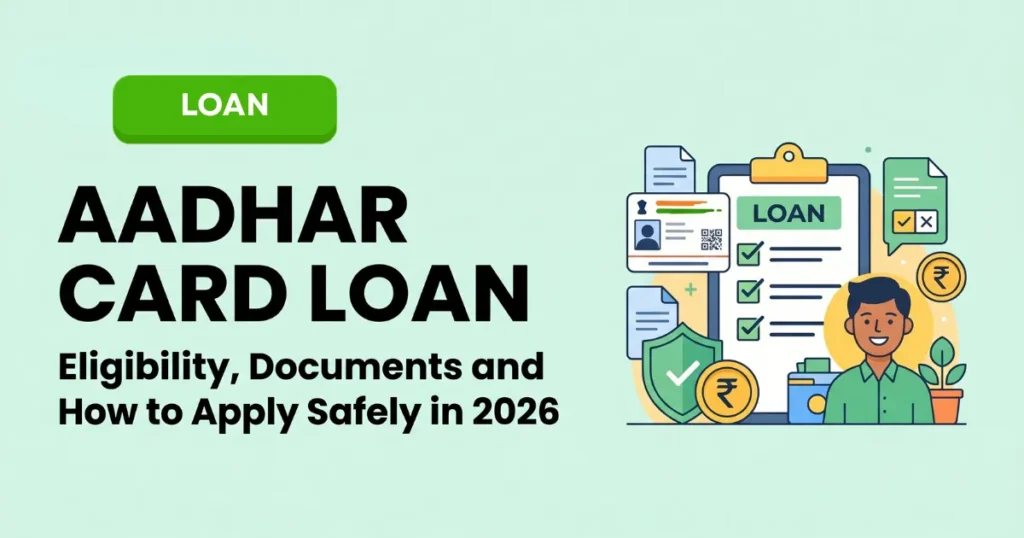
Let’s be honest. When most people search for “Aadhar card loan”, they usually want one thing: a quick loan with less paperwork and a simple online process. No long queues, no confusing forms, no running around. Just upload a few details, get approved, and move on.
But here’s where many people get confused.
A lot of loan apps and websites make it sound like having an Aadhaar card is all you need. In reality, that is not how lending works. Aadhaar can definitely make the process easier because it helps with identity and address verification, but Aadhaar alone does not guarantee loan approval.
Think of it like this. Aadhaar may help open the door, but it does not decide whether the lender will let you in.
In 2026, this matters even more because digital lending has become faster, but the rules around borrower protection have also become tighter. Lenders are expected to be clearer about interest, charges, recovery practices, and complaint handling. So before you apply, it helps to know what an Aadhar card loan actually means, what documents you may still need, and how to avoid shady apps or hidden charges.
What Is an Aadhar Card Loan, Really?
An Aadhar card loan is not a special loan category in the formal sense. It is simply a common phrase people use for a loan where Aadhaar is used during the KYC process.
That means the loan itself could still be a personal loan, a small instant loan, a consumer finance loan, or some other retail loan from a bank or NBFC. Aadhaar is just one part of the application process. It helps confirm who you are and where you live.
So if you have ever thought, “My Aadhaar card is enough, so I should get approved easily,” that is only half true.
Yes, Aadhaar can make verification faster. No, it does not replace the lender’s job of checking whether you can actually repay the loan.
Can You Get a Loan With Only Aadhaar Card?
Usually, no.
This is probably the biggest misunderstanding around Aadhaar based loans. Aadhaar is widely used for KYC, but most lenders still ask for more than one document. In many cases, they may also want PAN or Form 60, and sometimes extra details related to your financial profile.
And honestly, that makes sense.
Imagine someone applies for a loan using only an identity document, but the lender has no proper idea of the person’s income, existing debt, or repayment ability. That would be risky for both sides. The lender could end up giving credit to the wrong person, and the borrower could take a loan they are not in a position to manage.
So even if an app claims “instant loan on Aadhaar card,” expect follow-up checks. You may be asked for income details, bank information, work details, or other financial information before final approval.
How Aadhaar Actually Helps During the Loan Process
Aadhaar is still useful. Very useful, actually. It just helps in a more practical way than many ads suggest.
Faster identity verification
One of the biggest reasons digital lenders prefer Aadhaar is speed. Aadhaar based KYC can make identity and address verification simpler than traditional manual paperwork.
For borrowers, this often means less document handling, quicker onboarding, and a smoother start to the application.
Offline e-KYC options make things easier
A lot of people do not realize this, but Aadhaar verification is not just about uploading a plain card copy. There are offline options too, such as XML, PDF, or QR based sharing.
That can help reduce the need to send unnecessary photocopies everywhere, which honestly feels like a relief in a time when data privacy matters more than ever.
Better privacy with VID and masked Aadhaar
This is one part more borrowers should pay attention to.
If a lender supports it, you may be able to use a Virtual ID, also called VID, instead of directly sharing your full Aadhaar number. There is also something called masked Aadhaar, where the first eight digits are hidden and only the last four are visible.
That small step can make a real difference. A lot of people casually share Aadhaar copies without thinking twice, and later wonder where their data went. Being a little careful here is worth it.
What Documents May Be Needed Along With Aadhaar?
Even if Aadhaar is the main document used for KYC, lenders often need more.
In most real-world cases, you should be prepared for documents such as identity proof, PAN or Form 60, and in some cases details linked to your financial status. Depending on the lender and the loan type, they may also review your banking pattern, repayment history, or work profile.
This is where many applicants feel annoyed. “Why call it Aadhaar card loan if you still need other documents?” Fair question. But the answer is simple. Aadhaar helps with verification, not with proving repayment capacity.
If you are already an existing customer of the same bank or NBFC and your KYC is up to date, the process may be easier. In some situations, you may not need to submit the same KYC documents again unless something important has changed, such as your address.
What Really Decides Whether You Get Approved?
Here’s the truth most ads skip.
Loan approval is usually based less on the document you upload first and more on whether the lender feels confident you can repay on time.
That means they may look at things like:
- your income stability
- monthly expenses
- current liabilities
- overall debt burden
- job or occupation profile
- basic financial history
So when a loan gets rejected, it is not always because something was wrong with Aadhaar. Very often, the issue is somewhere else. Maybe the applicant’s profile looks unstable. Maybe existing debts are already too high. Maybe the income is not enough for the requested loan amount.
This is why two people with valid Aadhaar cards can get completely different outcomes.
One may get approved quickly.
The other may get rejected or offered a much smaller amount.
How to Apply for an Aadhar Card Loan Safely in 2026
This part matters a lot. Fast loans can be useful, but only if you apply through the right channel.
Choose a regulated lender
Before anything else, check whether the lender is a bank or an RBI regulated NBFC.
That one step can save you from a lot of trouble. A slick looking app means nothing on its own. Plenty of unsafe apps look polished. Always verify whether the lending entity is genuine and whether the app is actually linked to a regulated institution.
A simple rule? Never trust speed alone. Trust verification.
Read the Key Fact Statement properly
Most borrowers scroll past the loan terms and head straight to the “Accept” button. Bad move.
The Key Fact Statement, or KFS, is where you should focus. This is where the lender is expected to disclose important details like charges, annual percentage rate related information, and other costs that may affect the total borrowing amount.
If a loan looks cheap at first glance but becomes expensive after fees, processing deductions, or penalty charges, the KFS is often where that reality shows up.
Track how the money moves
You should also understand how the loan amount is disbursed and how repayments are collected.
The flow should be transparent. If things look confusing, or if money seems to be routed through unclear third-party channels, that is a warning sign. A proper lending process should not feel mysterious.
If it feels messy, pause.
Understand penalties and recovery practices
This is another area people ignore until it is too late.
Before taking the loan, check what happens if you miss a payment. What are the penal charges? How will recovery communication happen? Who is authorized to contact you?
Nobody takes a loan expecting to miss an EMI. But life happens. A delay, a job gap, an emergency, it can happen to anyone. That is exactly why you should know the consequences in advance instead of discovering them under stress.
Keep complaint options in mind
A lender being genuine does not mean every experience will be smooth.
If you face harassment, service problems, or unresolved complaints, it helps to know where to escalate. Borrowers should always keep official complaint routes in mind, especially when dealing with digital lenders and loan apps.
And yes, if you suspect fraud or a fake loan app, act quickly. Waiting usually makes things worse.
How to Protect Your Aadhaar Details While Applying
Let me say this clearly: do not treat Aadhaar like a random file you forward to anyone who asks.
That habit causes a lot of unnecessary risk.
Where possible, use privacy friendly tools like VID, masked Aadhaar, or offline e-KYC methods. These options are much smarter than casually uploading your full Aadhaar everywhere.
Also, avoid downloading loan apps from random SMS links, social media forwards, or unknown websites. A lot of these links are designed to look urgent. “Limited offer.” “Instant approval.” “Get cash in 5 minutes.” That kind of pressure is exactly what should make you slow down.
Before you install any app, check its permissions. Ask yourself a basic question: Does this loan app really need access to everything on my phone? If the answer feels uncomfortable, trust that instinct.
Common Reasons Aadhaar Based Loan Applications Get Rejected
If a loan application gets rejected, the reason is usually bigger than Aadhaar.
In many cases, lenders are not convinced by the applicant’s overall profile. Maybe the repayment ability looks weak. Maybe the financial details are incomplete. Maybe there are already too many liabilities. Maybe the income pattern does not match the loan request.
Sometimes, it is simply a mismatch between what the borrower wants and what the lender is comfortable approving.
It can feel frustrating, no doubt. But a rejection is not always a sign that your documents are invalid. Often, it is a sign that the lender’s risk check did not go in your favor.
Final Thoughts
An Aadhar card loan can absolutely be convenient. It can save time, reduce paperwork, and make the start of the loan process much easier. That part is real.
But the smarter way to look at it is this: Aadhaar helps with KYC. It does not replace eligibility checks, income review, or lender due diligence.
So if you are planning to apply, keep your expectations practical. Use a regulated lender. Read the KFS carefully. Share only the details that are actually needed. And wherever possible, protect your Aadhaar information using privacy friendly options.
A quick loan is helpful only when it is also a safe loan. Otherwise, what looks easy at the start can turn into a headache very fast.
FAQs
Can I get a loan using only Aadhaar card?
Usually, no. Aadhaar can help with KYC, but lenders often need more information before approving a loan. Approval depends on your financial profile and repayment ability, not just one document.
Is Aadhaar accepted as identity and address proof?
Yes, Aadhaar is commonly used for identity and address verification during the KYC process.
What is the benefit of Aadhaar in a loan application?
The main benefit is convenience. It can make identity verification faster and reduce paperwork, especially in digital applications.
Can I avoid sharing my full Aadhaar number?
In some cases, yes. If supported, options like VID or masked Aadhaar can help you avoid exposing the full number unnecessarily.
What should I check before accepting a digital loan?
Check whether the lender is regulated, read all charges carefully, understand repayment terms, and review app permissions before sharing any data.
Why do some Aadhaar based loan applications get rejected?
Usually because of factors like low repayment capacity, incomplete financial details, existing liabilities, or internal lender risk checks.