Many employees see “life insurance” in their company benefits and assume their family is fully protected. The problem appears only when they check the actual cover amount, exclusions, or what happens after leaving the organisation.
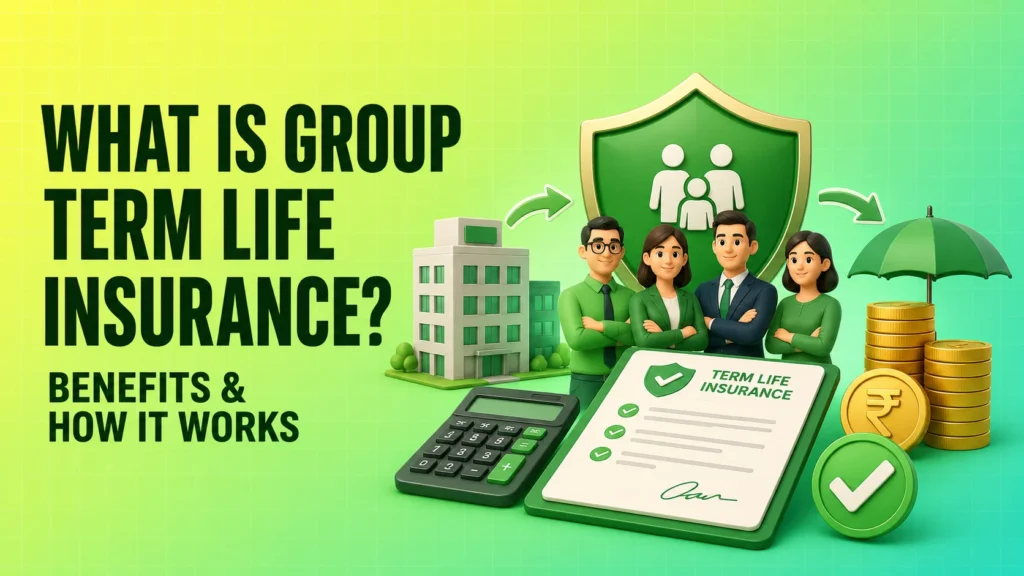
Group term life insurance provides life cover to multiple people under one master policy. It is commonly offered by employers to employees, although associations, banks, lenders, professional bodies, and other eligible groups may also arrange group cover.
It is affordable and convenient, but it should usually be treated as basic protection rather than a complete replacement for personal term insurance.
What Is Group Term Life Insurance?

Group term life insurance is a life insurance arrangement in which an insurer covers eligible members of a group under a single master policy.
The organisation purchasing the policy becomes the master policyholder. Employees or other eligible members are insured under that policy, and each member can nominate a beneficiary.
If an insured member dies while the coverage is active, the nominee may receive the applicable death benefit, subject to the master policy’s terms.
The four main parties are:
- Master policyholder: The employer, association, bank, or organisation purchasing the policy
- Insurer: The life insurance company providing the cover
- Insured member: The employee or eligible group member
- Nominee: The person entitled to receive the approved death benefit
Unlike an individual policy, most terms of employer-provided life insurance—such as the sum assured, eligibility rules, and riders—are decided at the group level.
How Does Group Term Life Insurance Work?
The employer or organisation purchases a master policy covering its eligible members. The cover may be the same for everyone or calculated using factors such as salary, employee grade, job role, or outstanding loan balance.
The process generally works as follows:
- The organisation selects an insurer and purchases a master policy.
- Eligible employees or members are enrolled in the plan.
- The sum assured is decided according to the policy structure.
- The employer pays the premium fully or shares the cost with employees.
- Each insured member provides nominee details.
- If a covered member dies while the policy is active, the nominee submits a claim.
- The insurer verifies the documents and pays the approved death benefit.
For example, suppose an employee earns ₹8 lakh annually and the company provides life cover equal to twice the annual salary. The available cover would be ₹16 lakh. If the employee dies while covered, the nominee may receive ₹16 lakh according to the policy conditions.
The benefit is usually paid only when the member is eligible and the coverage is active. Therefore, employees should not assume that the cover automatically continues after resignation, retirement, or termination.
Who Can Be Covered Under Group Life Insurance?
Group cover is not limited to permanent company employees. The eligible members depend on the type of group and the insurer’s conditions.
Common employer–employee groups include:
- Permanent employees
- Eligible contractual employees
- Employees who have completed a required service period
- Workers meeting the company’s age and employment conditions
Non-employer groups may include:
- Members of professional associations
- Bank customers
- Borrowers covered against a loan
- Members of cooperative organisations
- Members of recognised affinity or social groups
Eligibility, entry age, minimum group size, and coverage amount can differ between policies. Employees should check the actual policy certificate or benefit summary instead of relying only on verbal information from HR.
Benefits of Group Term Life Insurance
The main advantage of group term life insurance is that it gives members basic life protection through a simple and relatively low-cost arrangement.
Benefits for Employees
- Affordable cover: The premium may be fully or partly paid by the employer.
- Simple enrolment: Eligible employees can often join without purchasing a separate policy.
- Limited medical underwriting: Basic group cover may be available without individual medical tests, although higher optional cover can require additional underwriting.
- Family protection: The death benefit can help the nominee manage household expenses, loans, or other immediate needs.
- Optional additional cover: Some employers allow employees to increase the sum assured through payroll deductions.
- Rider benefits: Selected plans may include accidental death, critical illness, disability, or other additional benefits.
Benefits for Employers
- Improves the employee benefits package
- Supports employee welfare and financial security
- Can help with recruitment and retention
- Allows multiple employees to be covered under one policy
- Reduces the administrative work involved in separate policies
- May allow different coverage levels for employee categories
These benefits make group life insurance useful, but convenience should not be confused with sufficient financial protection.
How Much Does Group Term Insurance Cost?

There is no fixed premium for all group policies. The cost is decided after the insurer evaluates the overall risk of the group.
Premiums may depend on:
- Number of insured members
- Average age of the group
- Total sum assured
- Nature of work or occupation
- Previous claims experience
- Riders included
- Employee turnover
- Medical underwriting requirements
- Policy tenure and renewal terms
A large group may receive lower pricing because the insurer spreads the risk across many members. However, a low premium does not necessarily mean that the life cover is enough for every employee.
Employees purchasing additional cover through the employer should compare its cost, portability, and conditions with an individual term insurance plan.
Is Employer Group Life Insurance Enough?
For many employees, the answer is no.
Employer-provided cover can be useful as an additional benefit, but the amount may be too low to replace years of income or meet a family’s long-term financial needs.
To identify your life-cover gap, consider:
- Outstanding home loans
- Vehicle and personal loans
- Family’s annual living expenses
- Children’s education costs
- Number of financially dependent family members
- Existing savings and investments
- Current personal life insurance
- Number of years your income needs to be replaced
Suppose your family needs total life cover of ₹75 lakh, but your employer provides only ₹15 lakh. Your protection gap is ₹60 lakh.
In this situation, depending only on the company policy may leave your family underinsured. An individual term insurance policy can be used to cover the remaining amount.
Employer cover should generally be seen as an extra benefit, not the only source of life insurance.
Group Term Life Insurance vs Individual Term Insurance
| Point | Group Term Life Insurance | Individual Term Insurance |
|---|---|---|
| Policyholder | Employer or organisation | Individual buyer |
| Coverage amount | Decided mainly by the group policy | Selected according to personal needs |
| Premium | Often employer-paid or subsidised | Paid by the policyholder |
| Medical test | May not be required for basic cover | May be required based on risk |
| Portability | Usually linked to employment or membership | Continues even after a job change |
| Customisation | Limited | More flexible |
| Policy tenure | Often periodically renewed | Chosen for a longer fixed term |
| Nominee control | Member can usually nominate | Controlled by the policyholder |
| Best use | Additional basic cover | Main family protection |
The biggest difference is control. Under individual term insurance, you choose the sum assured, tenure, nominee, riders, and premium payment terms. Under group insurance, these features are largely decided by the organisation.
What Happens When You Leave Your Job?
Group term insurance usually depends on your employment or membership status. Coverage may end when you:
- Resign
- Retire
- Are laid off or terminated
- Move to another employer
- Leave the association
- Repay a loan connected to the group cover
Some policies may allow conversion or continuation, but this is not automatic. The new cover may involve a higher premium, fresh conditions, or medical underwriting.
Before leaving your job, ask HR or the group administrator:
- What is the last date of my cover?
- Can the policy be converted into an individual plan?
- What is the time limit for conversion?
- Will a medical test be required?
- What premium will apply?
- Will existing riders continue?
Do not wait until your final working day to check these details. If personal life insurance is needed, arranging it earlier may help avoid a gap in coverage.
How to Claim Group Term Life Insurance
The nominee usually needs to contact the employer, HR department, or group administrator to begin the claim process after the insured member’s death.
The common claim process includes:
- Inform the employer or policy administrator.
- Obtain the member’s policy and coverage details.
- Complete the insurer’s claim form.
- Submit the death certificate.
- Provide nominee identity and bank details.
- Submit medical records, if requested.
- Provide police or legal documents for accidental or unnatural death.
- Track the claim through the employer or insurer.
The insurer may request additional documents depending on the cause of death and policy terms.
Nominees should know the insurer’s name, policy number, sum assured, and employer contact person. Without this information, even a valid claim can become difficult to initiate.
What Should Employees Check in Their Group Policy?
Most employees know that they have insurance but do not know the actual terms. Ask HR or the group administrator for the policy certificate, membership confirmation, or benefit summary.
Check these details:
- Insurer’s name
- Master policy number
- Member or certificate number
- Exact sum assured
- Nominee details
- Start and end date of cover
- Included riders
- Eligibility conditions
- Major exclusions
- Claim contact details
- Rules after resignation or retirement
- Option to purchase additional cover
Also verify whether the cover is fixed or linked to salary. A salary-linked policy may exclude bonuses, incentives, commissions, or other income components unless the policy specifically includes them.
Should You Buy Personal Term Insurance Along With Group Cover?

Personal term insurance is worth considering when:
- Employer cover is lower than your family’s financial need
- You have dependants
- You have large loans
- You may change jobs
- You want cover beyond retirement
- You need a fixed long-term sum assured
- You want control over policy tenure and riders
- Your company can change or discontinue the group benefit
Buying an individual plan also reduces dependence on your employer. The cover can continue even when you switch jobs, start a business, or take a career break, provided premiums are paid and policy conditions are met.
The right approach is to calculate your total protection need, subtract the group cover and existing personal insurance, and cover the remaining gap through a suitable individual policy.
Conclusion
Group term life insurance offers affordable and convenient life cover to employees or other eligible members under one master policy. It can provide valuable financial support to the nominee if a covered member dies while the policy is active.
However, its main limitations are restricted customisation, possible underinsurance, and dependence on employment or group membership.
Employees should check their exact sum assured, nominee details, exclusions, claim process, and job-exit conditions. If the employer-provided cover does not meet the family’s long-term needs, it should be supplemented with suitable personal term insurance.
FAQs
Does group term life insurance require a medical test?
Basic group cover may be available without individual medical tests because the insurer evaluates the group collectively. However, medical underwriting may be required for higher optional cover, older members, or specific policy conditions.
Can group term life insurance continue after changing jobs?
Coverage usually ends when employment or group membership ends. Some policies may offer conversion or continuation, but the option, premium, and time limit depend on the master policy.
Who receives the group term insurance claim amount?
The approved death benefit is generally paid to the nominee registered by the insured member. If no valid nominee is available, the insurer may follow applicable legal and policy procedures.
Can an employee increase the employer-provided life cover?
Some employers allow employees to purchase additional cover by paying an extra premium. The availability, maximum amount, and medical requirements depend on the group policy.
Is group term life insurance enough without a personal policy?
It may not be enough if the cover is lower than your loans, income-replacement needs, and future family expenses. Group cover is usually better treated as additional protection, while personal term insurance can provide independent and portable long-term cover.