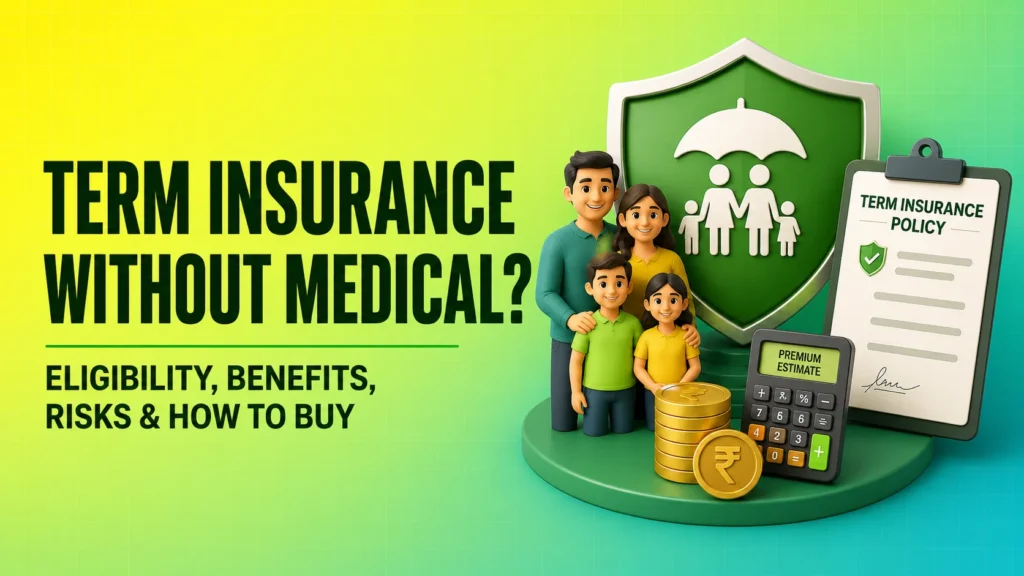
Term insurance without medical test is available in India, but not every applicant qualifies for it. Insurers usually offer this option to young and healthy buyers who have no major medical history and choose a lower or moderate life cover.
In this type of term plan, the insurance company may approve your policy based on your age, income, occupation, lifestyle habits, and health declaration instead of asking you to visit a diagnostic centre for medical tests. However, if your profile shows higher risk, the insurer can still ask for medical tests before issuing the policy.
Can You Buy Term Insurance Without Medical?

Yes, you can buy term insurance without medical test in selected cases. Many insurers offer this option, but approval depends on underwriting rules. Policybazaar notes that this option is usually limited and more common for young, healthy people or buyers choosing lower coverage amounts.
The insurer may check:
- Your age
- Your current health condition
- Smoking or drinking habits
- Existing diseases
- Family medical history
- Occupation risk
- Sum assured selected
- Income proof
If your application shows low risk, the insurer may approve the policy without medical tests. But if you apply for high coverage, have a medical condition, or disclose risky lifestyle habits, medical tests may become necessary.
What is Term Insurance Without Medical?
Term insurance without medical is a term life insurance plan where the applicant does not need to undergo physical medical tests before policy approval.
Instead of lab tests, the insurer may depend on:
- Online application form
- Self-declared health details
- Income documents
- Lifestyle declaration
- Tele-medical verification
- Video medical assessment, if required
This type of policy is usually faster and easier to buy. But it does not mean the insurer ignores your health. Your health declaration still plays a very important role.
If you hide any important health or lifestyle information, it can create problems at the time of claim.
Importance of Medical Tests in Term Insurance
Medical tests help the insurance company understand the actual health risk of the applicant. A term insurance policy gives a large life cover at a relatively low premium, so insurers need to check whether the applicant has any serious health risk.
Medical tests are important because they help in:
- Deciding the right premium
- Checking existing health conditions
- Approving higher life cover
- Reducing claim-related disputes
- Creating clear health records before policy issuance
For example, if a person has high blood pressure, diabetes, heart-related issues, or high cholesterol, medical tests help the insurer price the risk properly.
A medical test can also benefit the buyer. If your reports are normal, you may get better underwriting clarity and sometimes a better premium compared to a self-declaration-only plan.
When Are Medical Tests Required to Buy Term Insurance?
Medical tests may be required when the insurer feels the applicant’s risk is higher. In many cases, this depends on the product rules and underwriting policy of the insurance company.
Medical tests are commonly required in these situations:
- You are applying for a high sum assured
- Your age is above the insurer’s no-medical limit
- You have diabetes, blood pressure, heart disease, asthma, kidney disease, or other medical history
- You are a smoker or regular alcohol consumer
- Your BMI is high
- You have undergone surgery in the past
- Your family has a history of serious illness
- Your job involves high physical or occupational risk
- Your income does not support the selected cover amount
Tata AIA also explains that insurers consider factors such as age, lifestyle, and family medical history while offering term plans without medical tests.
When Can You Buy Term Insurance Without Medical?
You may be able to buy term insurance without medical if your profile is simple and low-risk.
This option is generally more suitable for:
- Young applicants
- Healthy individuals
- Non-smokers
- People with no major pre-existing illness
- Applicants choosing lower or moderate life cover
- Salaried individuals with stable income proof
- Buyers with clean family medical history
Some insurers may offer no-medical term insurance for lower sum assured limits. Tata AIA mentions that, in many cases, term plans without medical tests are offered for a sum assured below ₹1 crore, depending on the insurer’s terms and conditions.
However, this is not a fixed rule for every company. Each insurer has its own underwriting process.
Common Medical Tests Required for Term Insurance
If the insurer asks for medical tests, the required tests may depend on your age, coverage amount, health declaration, and medical history.
Common medical tests may include:
- Blood pressure test
- Blood sugar test
- Cholesterol test
- Urine test
- BMI check
- Complete blood count
- Liver function test
- Kidney function test
- ECG
- Treadmill test, if required
- Tele-medical or video medical assessment
Not every buyer needs all these tests. A young and healthy applicant may need only basic tests, while an older applicant or high-cover buyer may need more detailed medical checks.
Benefits of Term Insurance Without Medical

Term insurance without medical is popular because it makes the buying process faster and simpler.
Main benefits include:
- Faster approval: Policy issuance can be quicker when medical tests are not required.
- Less paperwork: The process is usually more digital and simple.
- No clinic visit: You do not need to visit a diagnostic centre for basic approval.
- Convenient for busy people: Working professionals can complete the process online.
- Good for young buyers: Healthy applicants may get basic protection without delay.
- Quick family protection: It helps buyers get life cover faster when they need immediate financial security.
But convenience should not be the only reason to choose this option. Your life cover should be enough for your family’s future needs.
How to Buy Term Insurance Without Medical Online?
Buying term insurance without medical online is simple, but you should not rush the process.
Step 1: Compare Term Insurance Plans
Start by comparing different term plans based on premium, life cover, claim settlement record, policy tenure, riders, and insurer reputation.
Do not choose a plan only because it does not require medical tests.
Step 2: Select Coverage Amount
Choose the sum assured based on your family’s needs. Consider:
- Annual income
- Existing loans
- Children’s education
- Monthly household expenses
- Future financial goals
- Inflation
A low cover may get approved faster, but it may not protect your family properly.
Step 3: Fill Personal and Health Details
Enter your personal, income, and health details carefully.
You may need to declare:
- Smoking habit
- Alcohol use
- Existing diseases
- Past surgeries
- Current medicines
- Family medical history
- Existing life insurance policies
Never hide health details to avoid medical tests. Wrong declaration can create claim problems later.
Step 4: Complete Underwriting Process
After you submit the application, the insurer checks your details. Based on your profile, the insurer may:
- Approve the policy without medical test
- Ask for tele-medical verification
- Ask for video medical assessment
- Request physical medical tests
- Change premium after risk assessment
- Reject the application in high-risk cases
Step 5: Pay Premium and Check Policy Document
Once the policy is approved, pay the premium and download the policy document.
After receiving the policy, check:
- Name and personal details
- Sum assured
- Policy term
- Premium payment term
- Nominee details
- Riders
- Exclusions
- Claim conditions
- Free-look period
The free-look period gives policyholders time to review policy terms and cancel the policy if they are not satisfied, subject to applicable rules and deductions. Recent reporting on IRDAI’s 2024 policyholder protection changes notes a 30-day free-look period for policies.
Who Should Consider Term Insurance Without Medical?
Term insurance without medical may be suitable for people who want quick and simple coverage.
It can be useful for:
- Young working professionals
- First-time term insurance buyers
- People with no major health issues
- Non-smokers
- Salaried employees
- People who need basic life cover quickly
- Buyers comfortable with online policy purchase
However, if you need a high sum assured or have any medical history, a regular term plan with medical tests may be better.
How to Choose the Right Term Insurance Without Medical?

Before buying a no-medical term plan, check these points carefully:
- Is the life cover enough for your family?
- Is the premium affordable for the full policy term?
- Does the insurer have a good claim settlement record?
- Are riders useful for your needs?
- Are exclusions clearly mentioned?
- Is your health declaration complete and honest?
- What happens if the insurer asks for medical tests later?
- Is the policy available for your age and income profile?
Also, compare the premium difference between medical and no-medical options. Sometimes, a plan with medical tests may offer better clarity and suitable coverage.
Points to Consider Before Buying Term Insurance Without Medical
Term insurance without medical is convenient, but you should understand its limits.
Important points to remember:
- No-medical approval is not guaranteed.
- The insurer can ask for medical tests after reviewing your application.
- Higher life cover may require medical tests.
- Premium can be higher if the insurer has limited health information.
- Claim issues may happen if health details are hidden.
- It may not be suitable for people with serious medical history.
- Do not choose low coverage only to avoid medical tests.
The main rule is simple: disclose everything honestly. A term plan is bought for family protection, so claim safety matters more than fast approval.
Term Insurance With Medical Test vs Term Insurance Without Medical
| Factor | With Medical Test | Without Medical |
|---|---|---|
| Approval Time | May take more time | Usually faster |
| Health Check | Detailed medical tests | Based on declaration or basic verification |
| Premium | Can be more accurate | May be slightly higher in some cases |
| Coverage Amount | Higher cover may be easier | Cover limit may be restricted |
| Suitable For | High cover buyers and people with health history | Young and healthy applicants |
| Claim Clarity | Better health record available | Depends heavily on honest disclosure |
| Convenience | Requires medical appointment | More convenient and digital |
Conclusion
Term insurance without medical can be a useful option for young, healthy buyers who want quick life cover without going through physical medical tests. It makes the buying process simple, fast, and convenient.
But it is not the best option for everyone. If you need high coverage, have medical history, or want stronger underwriting clarity, a term plan with medical tests may be better.
The most important thing is honesty. Whether you buy term insurance with or without medical tests, always disclose your health, lifestyle, income, and existing policy details correctly. A term plan should protect your family, not create claim problems later.
FAQs Term Insurance Without Medical
Can I buy term insurance without medical?
Yes, you can buy term insurance without medical in selected cases. Approval depends on your age, health, lifestyle, income, occupation, and selected sum assured.
Is term insurance without medical safe?
Yes, it can be safe if you provide correct health and lifestyle details. The risk increases when applicants hide diseases, smoking habits, or past medical history.
Who is eligible for term insurance without medical?
Young, healthy, non-smoking applicants with no major medical history and lower or moderate coverage needs are more likely to qualify.
Can smokers buy term insurance without medical?
Smokers may find it difficult to get no-medical approval, especially for higher coverage. The insurer may ask for medical tests or charge a higher premium.
Is premium higher in term insurance without medical?
It can be slightly higher in some cases because the insurer has less medical information. However, premium depends on age, health, cover amount, policy term, and insurer rules.