Table of Contents
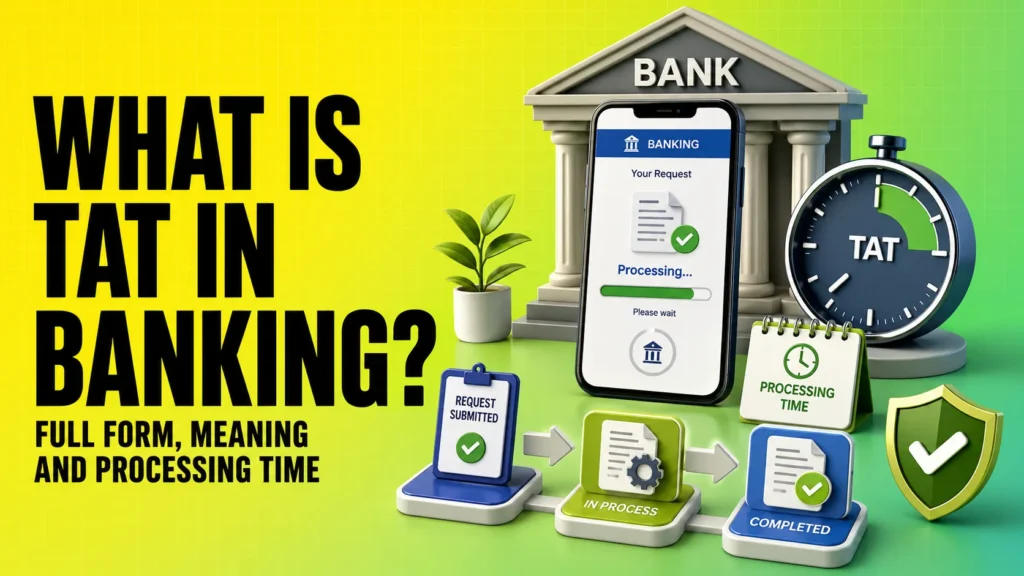
TAT full form in banking is Turnaround Time. It refers to the total time taken by a bank or financial institution to complete a service, request, application, or transaction.
For example, if a bank states that a personal loan application will be processed within seven working days, the promised TAT is seven working days. The actual time may vary depending on document verification, credit checks, internal approvals, bank holidays, and the type of service requested.
What Is the Full Form of TAT?
The full form of TAT is Turnaround Time.
| Term | Meaning |
|---|---|
| TAT full form | Turnaround Time |
| Banking meaning | Time taken to complete a banking service or process |
| Commonly used for | Loans, KYC, account opening, credit cards and complaints |
| Measured in | Hours, working days or calendar days |
In simple words, TAT tells a customer how long a bank may take to complete a particular request.
What Does TAT Mean in Banking?
In banking, TAT means the time taken from the start of a banking process until its completion. The process may begin when the bank receives an application, document, request, or transaction instruction.
Banking TAT can apply to services such as:
- Personal loan processing
- Home loan processing
- Business loan approval
- Credit card applications
- Bank account opening
- KYC verification
- Cheque clearing
- Fund transfer-related requests
- Account closure
- Customer complaints
- Document verification
- Insurance or loan claim processing
For example, if a bank receives a complete loan application on Monday and completes the verification by Thursday, the TAT may be three working days, depending on the bank’s calculation method.
TAT can refer to either:
- Promised TAT: The time committed by the bank.
- Actual TAT: The time actually taken to complete the process.
How Does TAT Work in Banking?
Most banking processes follow a series of steps before completion. A typical process may include:
- The customer submits an application or request.
- The bank checks the submitted information and documents.
- KYC and identity verification are completed.
- Credit, income, or account-related checks are performed.
- The request goes through internal approval.
- The bank completes the service or communicates the final decision.
For example, a loan application may follow this process:
Loan application → Document submission → KYC verification → Credit assessment → Income verification → Approval → Disbursal
The total time taken across these stages is generally referred to as the processing TAT.
Common Banking Services and Their TAT
The TAT for a banking service depends on the bank, product, customer profile, documentation, and verification requirements.
| Banking service | Factors affecting TAT |
|---|---|
| Savings account opening | KYC documents, identity verification and account type |
| Personal loan processing | Income, credit score, employment details and documents |
| Home loan processing | Property verification, legal checks, income and credit assessment |
| Credit card approval | Eligibility, credit history and internal verification |
| KYC update | Document accuracy and verification |
| Cheque clearing | Clearing cycle, bank timings and cheque details |
| Bank complaint resolution | Complaint type, investigation and supporting documents |
| Account closure | Pending dues, document verification and bank policy |
| Fund transfer issue | Transaction status and investigation requirements |
The bank may publish a standard TAT, but the actual time can vary from one case to another.
What Is Loan Processing TAT?
Loan processing TAT is the time taken by a bank or lender to process a loan application. It may start when the application and required documents are submitted and may end when the loan is approved, rejected, or disbursed.
Loan processing usually includes:
- Application submission
- Eligibility assessment
- KYC verification
- Income verification
- Credit score and credit history checks
- Document verification
- Property verification, where applicable
- Loan approval or rejection
- Agreement completion
- Loan disbursal
The TAT may be shorter for applications with complete and accurate information. Applications requiring additional verification may take longer.
To understand the personal loan approval process in more detail, customers should also know the common reasons that may lead to processing delays or rejection.
Personal Loan Processing TAT
Personal loan processing may involve:
- Identity and address verification
- Employment verification
- Income assessment
- Credit score evaluation
- Existing loan and repayment checks
- Internal approval
Some lenders may process eligible online applications quickly, while other cases may require additional documents or manual verification.
Home Loan Processing TAT
Home loan processing usually involves more checks than a personal loan because the lender must verify both the borrower and the property.
The process may include:
- Application and KYC verification
- Income and employment verification
- Credit assessment
- Property valuation
- Legal verification of property documents
- Loan sanction
- Agreement and documentation
- Final disbursal
The home loan TAT may increase if property papers are incomplete, ownership details need clarification, or external legal and valuation checks are pending.
Also read: How to Improve CIBIL Score
Credit Card Processing TAT
Credit card processing may include:
- Application submission
- KYC verification
- Eligibility assessment
- Credit history checks
- Internal approval
- Card dispatch and delivery
Approval TAT and delivery TAT are different. A credit card may be approved quickly but take additional time to reach the customer.
How Is TAT Calculated?
The basic formula for calculating TAT is:
TAT = Completion Time − Start Time
For example:
Application submitted: Monday at 10:00 AM
Application completed: Wednesday at 3:00 PM
Actual TAT: 2 days and 5 hours
However, banks may calculate TAT using:
- Working days
- Calendar days
- Business hours
- Banking hours
- Service-specific timelines
Therefore, customers should check whether the bank’s stated TAT includes weekends and public holidays.
Working Days vs Calendar Days
A calendar day includes every day on the calendar, including weekends and holidays.
A working day generally refers to a day on which the bank operates and processes requests. Sundays and public holidays are usually excluded, while the treatment of Saturdays may vary by bank and service.
For example, a five-calendar-day TAT and a five-working-day TAT may result in different completion dates.
Always check the terms and conditions of the specific banking service to understand how its TAT is calculated.
Promised TAT vs Actual TAT
A bank may provide an expected timeline for completing a service. This is called the promised TAT.
| Type | Meaning |
|---|---|
| Promised TAT | Time communicated or committed by the bank |
| Actual TAT | Time actually taken to complete the process |
| TAT breach | Process completion after the promised TAT |
For example, if a bank promises to process an application within three working days but completes it after five working days, the actual TAT is longer than the promised TAT.
A difference between promised and actual TAT does not always mean that the bank made an error. The timeline may be affected by missing documents, customer response time, holidays, third-party verification, or additional checks.
Also read: NOC after loan closure
Factors That Affect Banking TAT
Several factors can affect the time required to complete a banking process:
- Incomplete or incorrect documents
- Mismatch in name, address, or date of birth
- Pending KYC verification
- Low or insufficient credit history
- Delayed income or employment verification
- Property valuation or legal verification
- Bank holidays and weekends
- High application volume
- Manual approval requirements
- Technical problems
- Third-party verification
- Delayed response from the customer
- Additional documents requested by the bank
Submitting accurate and complete information can help reduce avoidable delays.
Why Does Banking TAT Get Delayed?
A banking request may be delayed for several reasons. Common reasons include:
Incomplete documentation
If a required document is missing, the bank may keep the application pending until the customer submits it.
Incorrect information
Differences between the application form and official documents may require additional verification.
Pending verification
Loan, KYC, income, employment, and property checks can increase the processing time.
Credit-related issues
A lender may need additional information if the credit report contains an error, a recent enquiry, or an unusual repayment pattern.
Weekends and bank holidays
The promised timeline may be based on working days rather than calendar days.
External approvals
Some banking processes depend on property valuers, legal experts, employers, credit bureaus, or other external parties.
Technical or operational issues
System maintenance, payment failures, or internal processing problems may also affect TAT.
TAT vs SLA
TAT and SLA are related but different terms.
| TAT | SLA |
|---|---|
| Turnaround Time | Service Level Agreement |
| Refers to the time taken to complete a process | Defines an agreed service standard or commitment |
| Can describe actual or expected completion time | Usually sets a target, deadline, or performance level |
| Example: Loan application processed in seven working days | Example: 90% of requests must be resolved within two working days |
In simple terms, TAT describes the time required for a process, while SLA defines the service commitment or performance standard.
TAT vs Processing Time
TAT and processing time are often used interchangeably, but they can have slightly different meanings.
Processing time may refer to the time taken by the bank to perform a specific internal task.
TAT can refer to the broader time taken from receiving a customer request to completing or delivering the final service.
For example, a bank may process a document internally in two hours, but the total TAT from application submission to final approval may be five working days.
Also read: 7 Days Loan App List in India (2026)
How Can Customers Reduce Banking TAT?
Customers can take the following steps to avoid unnecessary delays:
- Submit all required documents together.
- Check that personal information matches across documents.
- Keep KYC details updated.
- Provide accurate income and employment information.
- Respond quickly to calls, emails, and document requests.
- Check the application or reference number regularly.
- Ask the bank whether the timeline is based on working days or calendar days.
- Avoid submitting unclear or outdated documents.
- Track pending verification steps.
- Contact the bank if the promised TAT has passed.
If a request is delayed beyond the promised timeline, ask the bank for a written status update and the reason for the delay.
Conclusion
TAT in banking stands for Turnaround Time. It is the time taken by a bank to complete a service, request, or application. TAT is commonly used for loan processing, KYC verification, account opening, credit card approval, cheque clearing, and complaint resolution.
The actual processing time can depend on the completeness of documents, verification requirements, working days, bank policy, and the type of service. To reduce delays, customers should submit accurate documents, respond to bank requests quickly, and track their application using the relevant reference number.
Frequently Asked Questions
Q1. What is the full form of TAT in banking?
TAT stands for Turnaround Time. In banking, it refers to the time taken to complete a service, request, transaction, or application.
Q2. What does TAT mean in a bank?
TAT means the expected or actual time required by a bank to complete a process such as loan approval, KYC verification, account opening, or complaint resolution.
Q3. What is loan processing TAT?
Loan processing TAT is the time taken to process a loan application. It may include document verification, credit assessment, income verification, approval, and disbursal.
Q4. Is TAT the same as processing time?
TAT and processing time are related terms. Processing time may refer to a particular internal task, while TAT may describe the overall time from receiving a request to completing the service.
Q5. What is a TAT breach?
A TAT breach occurs when a bank does not complete a service within the promised or agreed turnaround time.