Paying the final EMI may feel like the end of a loan, but the account is not fully settled until the lender confirms that no payment or claim remains. Without this confirmation, the loan may continue to appear active in your credit report, the lender’s charge may remain on the property, or hypothecation may still appear on your vehicle’s registration certificate.
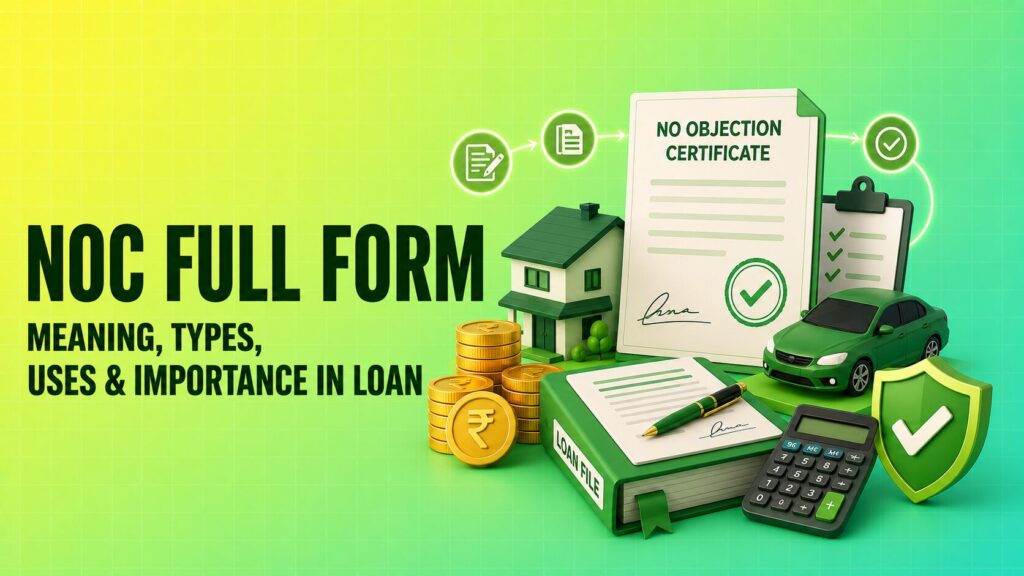
The NOC full form is No Objection Certificate. In loan closure, it is issued by a bank, NBFC or financial institution to confirm that the borrower has cleared the applicable dues and the lender has no objection to closing the account or releasing its claim over the financed asset.
However, simply receiving an NOC is not enough. You must verify the document, check your credit report and complete any property or vehicle-related formalities separately.
What Is a Loan NOC?
A loan NOC is a written or digitally issued confirmation from the lender that the repayment obligation mentioned in the certificate has been completed. It acts as evidence that the lender does not have a pending claim against the borrower for that loan.
Depending on the financial institution, the document may be called:
- No Objection Certificate
- No-Dues Certificate
- Loan Closure Certificate
- Loan Clearance Certificate
- Repayment Completion Certificate
These names are sometimes used interchangeably. Instead of relying only on the title, check whether the document clearly confirms that:
- The outstanding loan amount is zero.
- All applicable dues have been paid.
- The loan account has been closed.
- The lender has no further financial claim.
- The lender’s charge over the financed asset can be removed, where applicable.
NOC vs No-Dues Certificate vs Loan Closure Certificate
There is no universal format followed by every lender. However, the documents generally serve the following purposes:
| Document | Main purpose | What you should verify |
|---|---|---|
| NOC | Confirms that the lender has no objection to closure or release of its claim | No pending claim or objection remains |
| No-Dues Certificate | Confirms that the borrower has cleared the stated dues | Outstanding balance is shown as zero |
| Loan Closure Certificate | Confirms that the loan account has been formally closed | Account number and closure date are correct |
A document that only confirms receipt of the final EMI may not be sufficient. It should clearly mention the loan account details and confirm that no further amount is payable.
What Details Should You Check in a Loan NOC?
An incorrect NOC can create problems when you try to sell a vehicle, transfer a property or correct your credit report. Check the document as soon as you receive it.
It should normally contain:
- Borrower’s full name
- Loan account number
- Name of the lender
- Type of loan
- Date of loan closure
- Confirmation that all applicable dues have been cleared
- Statement that the lender has no further claim
- Vehicle, property or collateral details, where relevant
- Authorised signature, seal or digital verification
- Certificate or reference number
Make sure that the spelling of your name matches the loan records. For secured loans, also verify the registration number, property details, chassis number or other asset information.
Do not manually edit an incorrect NOC. Ask the lender to issue a corrected copy.
Types of NOC Used in Loan Closure
The purpose of an NOC changes depending on the type of loan. Home, vehicle, personal and property-backed loans are all common types of retail loans, but their closure formalities are not always the same.
Home Loan NOC
A home loan NOC confirms that the applicable home loan dues have been cleared. It helps the borrower collect original property documents and remove the lender’s registered charge over the property.
After receiving it, verify that:
- Original property documents have been returned.
- The lender’s charge has been removed from the relevant registry.
- The loan is reported as closed in the credit report.
- The property documents returned match the list originally submitted.
For property-backed loans, you may also need to complete MODT cancellation and mortgage release after repayment. An NOC alone does not prove that every registry entry has been updated, so these records should be checked separately.
Car or Bike Loan NOC
A vehicle loan NOC confirms repayment to the financier, but hypothecation does not disappear automatically from the registration certificate.
After receiving the NOC, the vehicle owner generally needs to apply for termination of hypothecation with the relevant registering authority. Form 35 is used for recording the termination of a hire-purchase, lease or hypothecation agreement.
Documents and procedures can vary by state, but they may include:
- Form 35
- Registration certificate
- Financier’s NOC or due-clearance certificate
- Valid insurance certificate
- Pollution under control certificate
- Identity and address documents
- Applicable fee
Complete this process before selling or transferring the vehicle.
Personal Loan NOC
A personal loan is generally unsecured, so there may be no lien or hypothecation to remove. Still, collecting an NOC or closure certificate is important because it provides proof that the account was fully repaid.
It can help when:
- The loan continues to appear active.
- An incorrect overdue amount appears in the credit report.
- The lender raises a future payment dispute.
- Another lender asks for proof of closure.
Business Loan or Loan Against Property NOC
For a secured business loan or loan against property, the NOC supports the release of the lender’s claim over the pledged asset.
The borrower should also confirm that:
- Original documents have been returned.
- Registered charges have been satisfied or removed.
- The lender has updated the account with credit bureaus.
- Business and asset records reflect the closure.
Why Is an NOC Important After Loan Closure?
The NOC is not merely a completion letter. It can protect the borrower in several practical situations.
It provides proof of full repayment
If a lender later raises an incorrect demand, the NOC, final loan statement and payment receipts can help establish that the account was closed.
It helps correct credit-report errors
The lender must separately report the updated account status to credit bureaus. If the account remains active or shows an outstanding amount, the NOC becomes useful supporting evidence when contacting the lender or raising a dispute.
It supports the release of collateral
For secured loans, the NOC may be required when collecting original documents, removing a lien or satisfying a registered charge.
It makes asset transfer easier
A vehicle or property with an active lender charge can be difficult to sell, refinance or transfer. Completing the closure formalities helps establish clear ownership.
It supports future loan applications
An incorrectly reported active or settled loan can affect how a future lender evaluates your repayment obligations. A proper closure record reduces this risk.
How to Get an NOC After Closing a Loan
Some lenders issue the NOC automatically, while others require a formal request. The exact process may differ, but borrowers can generally follow these steps:
- Confirm the final payable amount: Check whether any interest, delayed-payment charge, foreclosure fee or other approved amount remains.
- Make the final payment: Keep the receipt, transaction reference and updated loan statement.
- Request formal closure: Submit the request through the branch, lender’s app, customer portal or official email channel.
- Provide the required details: Mention your name, registered contact details, loan account number and date of final payment.
- Collect the NOC: It may be provided as a physical certificate or digitally generated document.
- Verify the details: Check the account number, closure date, borrower name and asset information.
- Ask for correction immediately: Do not wait until you need the document for a sale, transfer or new loan.
- Preserve multiple copies: Keep the original, a scanned copy and the final loan statement together.
Avoid closing a loan using only verbal confirmation from a branch representative. Always obtain documentary proof.
How Long Does It Take to Receive an NOC?
There is no single NOC-processing period that applies to every lender and loan product. The lender’s internal procedure, loan type and closure method can affect the time taken.
For personal loans secured by movable or immovable property, RBI directions require applicable regulated lenders to release original property documents and remove registered charges within 30 days after full repayment or settlement.
If the delay is attributable to the regulated lender, compensation of ₹5,000 per day may apply after the permitted period. These directions apply to eligible cases where the release of documents became due on or after 1 December 2023.
This rule deals specifically with releasing original movable or immovable property documents and removing charges. It should not be treated as a universal timeline for every unsecured-loan NOC.
What Should You Do After Receiving the NOC?
Receiving the certificate is only one stage of the closure process. The next action depends on the loan.
| Loan type | Action after receiving the NOC |
|---|---|
| Personal loan | Check whether the credit report shows the account as closed |
| Home loan | Collect all original documents and confirm charge removal |
| Car or bike loan | Apply for termination of hypothecation from the RC |
| Loan against property | Verify the release of documents and registered charge |
| Business loan | Update relevant financial, asset and charge records |
You should also:
- Retain the final account statement.
- Preserve all repayment receipts.
- Check that the account status says Closed, not Settled.
- Confirm that no overdue balance remains.
- Store the NOC permanently with other important financial documents.
A closed loan may continue to appear in your credit report as part of your credit history. The important point is that its status, balance and payment record should be accurate.
Loan Closure vs Loan Settlement
Loan closure and loan settlement do not have the same meaning.
| Point | Loan closure | Loan settlement |
|---|---|---|
| Amount paid | Full applicable amount is repaid | Lender accepts less than the total amount due |
| Account status | Usually reported as closed | May be reported as settled |
| Credit impact | Generally reflects completed repayment | May affect future credit assessment |
| Certificate | Confirms full closure where issued | May only confirm the settlement terms |
| Future borrowing | Usually viewed more favourably | May raise concerns for new lenders |
A settlement letter should not automatically be treated as a full loan-closure NOC. Borrowers facing repayment difficulties should first understand how loan settlement in India works and why a “settled” status can affect future borrowing.
If you previously settled an account and later paid the remaining amount, ask the lender to update the status based on its policy and issue revised closure documentation.
What If the Loan Still Appears Active in Your Credit Report?
Credit institutions do not always update credit bureaus immediately after the final payment. Lenders generally submit data within a reporting cycle, so the change may not appear immediately.
To understand who maintains these records and how lenders share borrower information, read about how credit information companies update loan records.
If the loan still appears active:
- Check the report’s “date reported” or last updated date.
- Compare the outstanding balance with the final loan statement.
- Contact the lender and share the NOC and payment proof.
- Ask the lender to report the corrected status.
- Raise an online dispute with the credit bureau if the error remains.
- Keep the dispute number and lender’s acknowledgement.
- Check the report again after the correction is processed.
Also check whether the report contains incorrect DPD entries in your CIBIL report. A wrong overdue marker can remain visible even after the loan has been closed and may require a separate correction request.
A credit bureau cannot independently change lender-reported information without confirmation from the concerned credit institution. Therefore, contacting the lender is an important part of the process.
Do not ask for a properly closed loan to be removed from the report merely because it is visible. Closed accounts can remain as part of your credit history.
What If the Lender Does Not Issue the NOC?
Start with a written complaint instead of relying on repeated calls.
Your request should mention:
- Loan account number
- Date of final payment
- Amount paid
- Closure request reference
- Document required
- Any problem caused by the delay
Escalate the matter through the lender’s grievance-redressal process and keep the complaint number.
For a complaint against an RBI-regulated entity, you must generally approach the lender first. If the lender rejects the complaint, provides an unsatisfactory reply or does not respond within 30 days, an eligible complaint may be filed under the Reserve Bank–Integrated Ombudsman Scheme through RBI’s Complaint Management System.
The Ombudsman route is not a substitute for first complaining to the lender.
What If the NOC Is Incorrect or Lost?
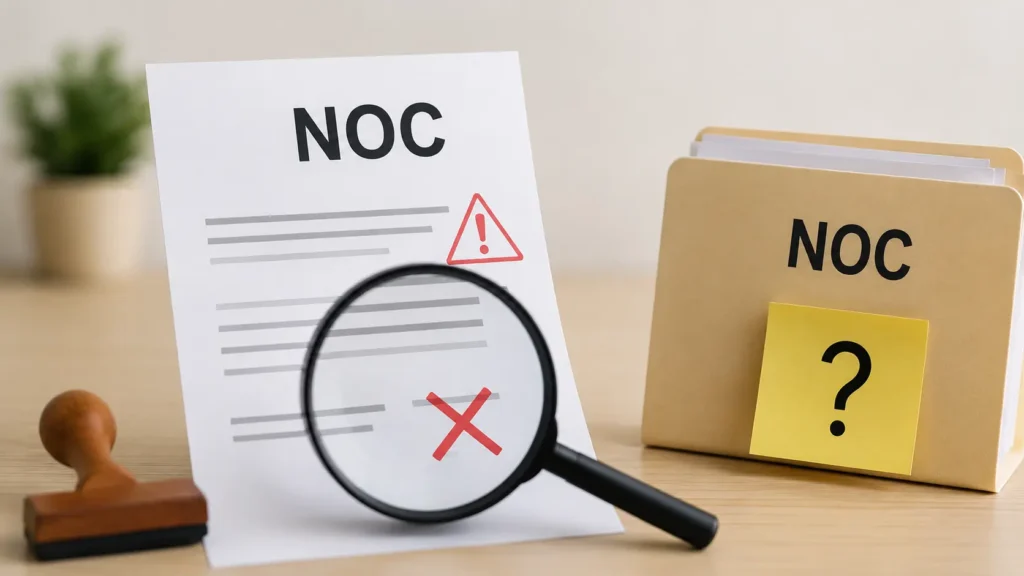
Request a revised document when the NOC contains an incorrect:
- Borrower name
- Loan account number
- Closure date
- Vehicle registration number
- Property description
- Outstanding balance
- No-dues statement
Send a copy of the incorrect certificate along with identity proof and the final repayment record.
If the NOC is lost, ask the lender for a duplicate or digitally reissued copy. Requirements differ among lenders, so an FIR or indemnity should not be described as compulsory in every case.
Keep the replacement in cloud storage as well as in physical form, especially for home, vehicle and other secured loans.
Conclusion
The final EMI does not always complete the loan-closure process. A properly issued and verified NOC confirms that the lender has no remaining claim under the closed account, but borrowers must still check the credit report and complete any lien, charge or hypothecation-removal process.
Collect the NOC, final account statement and payment receipts together. For a secured loan, also confirm that the original documents have been returned and the lender’s charge has been removed. These steps can prevent future disputes and make it easier to sell, transfer or refinance the financed asset.
FAQs
Does receiving an NOC automatically update the CIBIL report?
No. The lender must separately report the account status to the credit bureau. Check the report after the lender’s reporting cycle and raise a dispute if the information remains incorrect.
Can a loan account remain in the CIBIL report after receiving an NOC?
Yes. A closed loan can remain in the credit report as part of your credit history. The account does not necessarily need to disappear. Check that it is marked closed, the outstanding balance is accurate and no incorrect overdue amount appears.
What should I do if the account shows “settled” despite full repayment?
Contact the lender with the NOC, final payment proof and account statement. Ask it to verify the repayment and submit the correct status to the credit bureau. If the information is not corrected, raise a formal credit-report dispute.
Is a digital NOC valid for closing a loan?
A digitally issued NOC obtained through the lender’s official app, portal or email system can serve as closure evidence. Verify its reference number, account details and digital authentication. For an RTO, property registry or another authority, check whether additional signed forms or physical documents are required.
Can a lender demand more money after issuing an NOC?
An accurate NOC stating that all dues have been cleared is strong evidence in the borrower’s favour. However, retain the final statement and payment receipts as well. If the lender raises a later demand, ask for a written calculation and use the lender’s grievance process to dispute an incorrect claim.