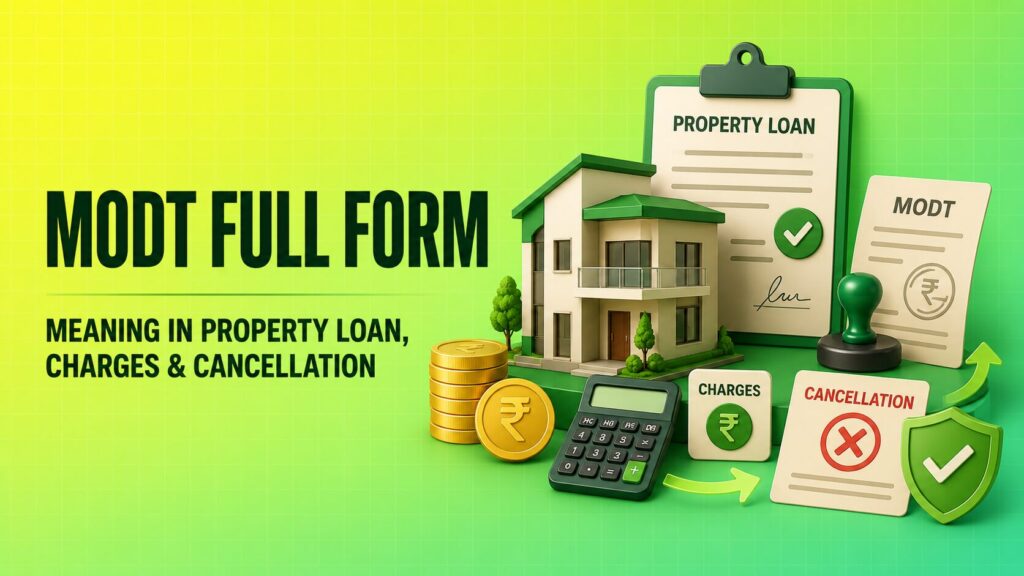
MODT full form is Memorandum of Deposit of Title Deeds. It is a security document used by banks and housing finance companies when you take a property-backed loan, such as a home loan or a loan against property. In simple terms, it records that you have deposited the original title deeds of the property with the lender as security for the loan.
This document matters because it helps the lender create a legal charge on the property without always going through a full registered mortgage deed. For many borrowers, that makes the process simpler and less expensive. For the bank, it gives an added layer of security if the borrower does not repay the loan as agreed.
If you are seeing this term during loan processing, do not treat it as a minor paper. MODT is a legal document, and the bank’s legal team or counsel usually checks the property papers before the document is executed. You should always read it carefully, keep a copy for your records, and never sign blank papers.
What is MODT Full Form and Meaning?
MODT stands for Memorandum of Deposit of Title Deeds. It is commonly linked to an equitable mortgage, which is a mortgage created by depositing the property’s title deeds with the lender in a notified place or city, along with a written memorandum recording that deposit.
In practical terms, the borrower gives the bank the original title documents of the property as collateral. The MODT document confirms that the borrower has done so against the loan. This creates a legal interest in the property in favour of the lender.
Under Indian property law, this concept is connected to the Transfer of Property Act, 1882. In many cases, the lender does not need a full sale-style registration for every loan because the deposit of title deeds itself creates the security interest, subject to the applicable state rules and local registration requirements.
That said, MODT is not the same as ownership transfer. You remain the property owner, but the property becomes charged to the lender until the loan is fully repaid and the mortgage is released.
Why Do Banks Require MODT?
 Banks require MODT to protect their interest in the property-backed loan. Since the loan is given against the value of the property, the lender wants a legal mechanism that makes recovery easier if the borrower defaults.
From the lender’s point of view, MODT helps in three important ways:
- It shows that the original title deeds are already with the bank.
- It creates a charge on the property, so the borrower cannot freely sell or re-mortgage it without clearance.
- It gives the bank evidence of security if there is a repayment dispute later.
This is why lenders often use the equitable mortgage route for home loans and loan against property products. It is practical, faster than a fully registered mortgage deed in many cases, and widely used in retail lending across India.
For the borrower, this also means a clear discipline: the property remains locked as security until the loan is closed. If you plan to sell or refinance the property later, the bank’s lien or charge must first be cleared.
The MODT Process: Step-by-Step
The MODT process usually follows a standard bank-borrower workflow. The exact steps can vary slightly by lender and by state, but the broad process is similar.
- Submission of original title deeds
The borrower submits the original property documents to the bank. These may include the sale deed, allotment letter, chain documents, Khata or mutation records, and other property papers depending on the property type. - Legal verification by the bank
The bank’s legal counsel or panel advocate verifies the title documents, checks ownership chain, and confirms that the property is acceptable as security. This is a critical stage because incomplete or defective title papers can delay the loan. - Execution of the MODT document
After verification, the borrower signs the MODT or related mortgage memorandum. This confirms that the title deeds have been deposited with the lender for the loan. - Registration, where applicable
In some states or for some loan structures, registration or additional stamping may be required. State rules are important here, so the bank usually guides the borrower on the correct process and the applicable office, such as the sub-registrar office. - Issuance of the acknowledgement or copy
The borrower should receive an acknowledgement or copy of the executed memorandum. Keep this safely with the loan papers. It may be needed later when the loan is closed or if you request a loan statement or mortgage release.
A simple checklist before signing the MODT document:
- Confirm your name and property details are correct.
- Check that the loan account number and property address match the bank records.
- Ensure the document is properly stamped, if stamping applies.
- Keep a signed copy or acknowledgement safely.
- Do not sign any blank or incomplete page.
MODT Charges: Stamp Duty and Registration Fees
MODT charges are usually borne by the borrower. These charges are not uniform across India because stamp duty is a state subject. That means the cost can differ from one state to another, and the exact treatment may also depend on the lender’s process and local registration rules.
In many cases, the main cost components are:
- Stamp duty on the MODT or mortgage memorandum
- Registration fee, if registration is applicable in that state or for that document type
- Incidental documentation or administrative charges, depending on the bank
The borrower should always ask the lender for a clear fee breakup before execution. Some banks collect these charges upfront during loan processing, while others may guide you to pay them at the registration office or through the relevant state process.
Stamp duty rates are subject to change by state governments. Always verify with your bank or local sub-registrar office.
| State / Region | Approximate MODT Stamp Duty | Notes |
|---|---|---|
| Maharashtra | Varies by location and document type; often quoted as a percentage of loan amount or fixed fee under local practice | Check current local rules and bank guidance |
| Delhi | Varies by applicable mortgage registration/stamp treatment | State-specific verification is necessary |
| Karnataka | Varies by instrument and local procedure | Ask the bank for the latest charge estimate |
| Tamil Nadu | Varies by document and registration requirement | Confirm whether registration is needed |
| West Bengal | Varies by applicable mortgage memorandum rules | Stamping method may differ by case |
| Gujarat | Varies by local stamp and registration norms | Always verify before signing |
The table above is only a practical guide to show that costs are not fixed nationwide. The exact amount depends on the state, the property location, the lender’s loan structure, and the current legal rules. If you are calculating affordability, include these charges in your upfront loan cost estimate.
Can You Cancel MODT?

Yes, MODT can be cancelled, but only after the loan is fully repaid and the lender issues a loan closure confirmation or No Objection Certificate (NOC). It is not something you cancel midway just because you want to. The property remains mortgaged until the outstanding dues are fully cleared.
After closure, the process is usually called release of mortgage, mortgage discharge, or reconveyance of property, depending on the lender and state procedure. The bank confirms that it no longer has any claim over the property and returns the original title deeds to the borrower.
The cancellation or release process generally involves these steps:
- Repay the full loan amount, including any final dues.
- Collect the loan closure letter or NOC from the lender.
- Submit any required application for mortgage release or discharge.
- Register the release document if the local law requires it.
- Collect your original property documents from the bank.
This step is important because the title record must be clear for future sale, refinance, or legal verification. If the mortgage is not properly released, it may create problems when you try to sell the property or get another loan against it.
If the lender asks for a fee for release or discharge, ask for the official breakup. The
process and charges can differ based on state law and bank policy.
MODT vs. Registered Mortgage Deed
Borrowers often confuse MODT with a registered mortgage deed, but the two are not the same.
| Point | MODT | Registered Mortgage Deed |
|---|---|---|
| Meaning | Memorandum recording deposit of title deeds | Formal deed creating and registering mortgage |
| Cost | Usually lower | Usually higher due to full registration and stamp duty |
| Process | Quicker and simpler in many cases | More formal and documentation-heavy |
| Borrower convenience | More convenient for standard retail loans | Less convenient due to higher compliance |
| Bank preference | Commonly preferred for home loans and LAP | Used when state law or lender structure requires it |
For standard retail lending in India, MODT is generally preferred because it is more cost-effective and operationally simpler. The lender still gets a valid security interest, while the borrower usually pays lower charges than a full registered mortgage deed.
Which is Better for the Borrower?
For most borrowers, MODT is the more practical option because it is typically cheaper and faster. That is one reason it is the industry standard for many home loans and loans against property.
However, “better” depends on the state, the lender’s policy, and the property documentation. In some places, the law or local registration practice may require a specific formality that changes the process. So while MODT is usually borrower-friendly on cost and convenience, you should still check the actual document structure before signing.
The balanced view is simple: MODT is not something to fear, but it is also not a paper to ignore. It is a standard legal step that helps the bank secure the loan and helps the borrower obtain credit against immovable property with a simpler process than a full mortgage deed in many situations.
Common Mistakes and Safety Tips for Borrowers
Because MODT is a legal security document, small mistakes can cause unnecessary trouble later. These practical checks can help you stay safe.
- Do not lose the acknowledgement receipt. Keep it with your loan file, EMI statements, and sanction letter.
- Check the stamp and execution details. The document should reflect the correct loan amount, borrower name, property address, and date.
- Ask for the NOC after closure. A closed loan should not leave a pending charge on your property record.
- Be careful if title deeds are lost. Missing original property papers can make the mortgage process and future release much more complicated.
- Never sign blank papers. Fill all details first and keep a full copy of what you signed.
- Store all property documents safely. After release, verify that the bank returns the original set of papers in full.
If you are dealing with a lost title deed or an incorrect MODT entry, contact the lender immediately. In such cases, the bank’s records, the local sub-registrar process, and state law may matter, so do not rely on verbal assurances alone.
Also remember that MODT rules can differ from one state to another. For example, the registration treatment in Maharashtra may not be identical to that in Delhi or Karnataka. Always verify the latest practice with your bank, the sub-registrar office, or a qualified legal professional before acting on a property document.
FAQs
What is the difference between MODT and a Sale Deed?
A Sale Deed transfers ownership of the property from seller to buyer. MODT does not transfer ownership. It only creates a security interest in the property for the lender after title deeds are deposited for a loan.
Is MODT registration mandatory in all Indian states?
No. MODT registration is not treated the same in every state. Some states have specific stamping or registration requirements, while others follow the equitable mortgage process with different compliance steps. Always verify the local rule.
What happens if I lose my copy of the MODT document?
If you lose your copy, ask the bank for a duplicate acknowledgement or certified copy, if available. Also check whether any registration office record exists. Keep the loan closure and mortgage release papers safely for future use.
Do I need to pay stamp duty again when I close the loan?
No, not for closing the same loan. You may need to pay a separate fee or charge for mortgage release or discharge in some states or banks, but that is different from paying stamp duty again on the original MODT.
Does MODT affect my property’s market value?
MODT does not change the property’s market value by itself, but it does create a lender’s charge on the property until the loan is closed. That charge can affect saleability and refinancing until the mortgage is formally released.