LIC Jeevan Labh Plan 936 is a limited premium-paying, non-linked, participating endowment plan. If you are trying to estimate the premium or maturity value, the key thing to understand is that the final maturity amount is not a fixed figure. It depends on the basic sum assured plus bonuses declared by LIC over time. That is why an LIC Plan 936 maturity calculator is best used as an estimate tool, not as a guaranteed payout calculator.
This guide explains how LIC Jeevan Labh works, what drives the premium, how maturity is built up, and how to use the calculation logic correctly. If you are checking this policy for savings, family protection, or long-term planning, it is worth reading the policy brochure and bond carefully before buying.
Understanding LIC Jeevan Labh (Plan 936) Benefits
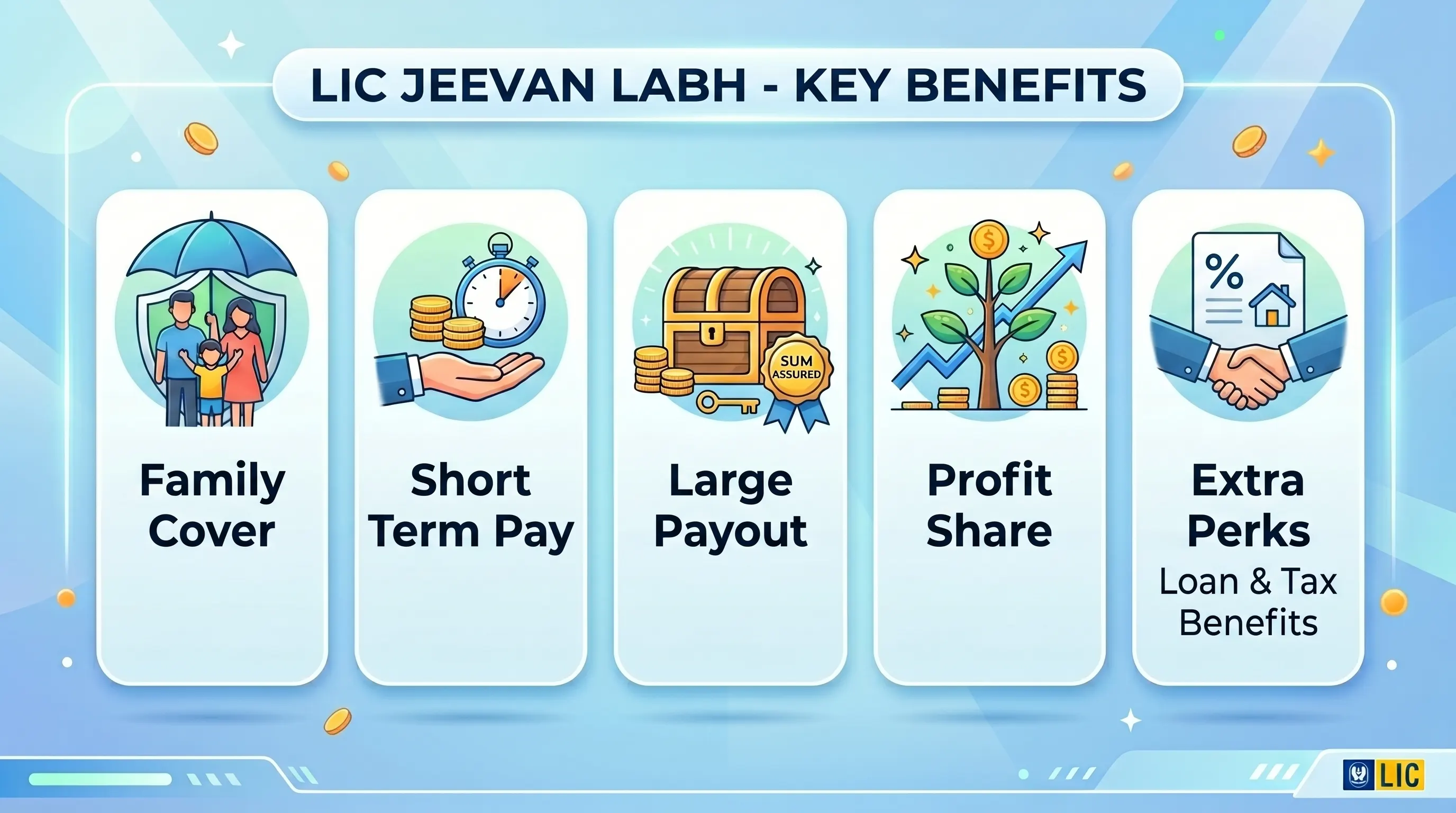
LIC Jeevan Labh is designed as a saving-cum-protection policy. That means you pay premiums for a limited period, stay covered for the full policy term, and receive maturity benefits if the policy continues till the end. It is called a participating plan because it participates in LIC’s profits through bonuses, subject to declaration by LIC.
The structure usually has three important parts:
- Sum Assured on Death: The amount payable to the nominee if the life assured dies during the policy term, subject to policy terms.
- Maturity Benefit: The amount payable at the end of the policy term if all premiums are paid and the policy survives till maturity.
- Participation in profits: This comes through bonuses, which can increase the final payout over time.
Because this is a non-linked plan, the policy is not tied to market movements like mutual funds or ULIPs. However, the bonus component is still not fixed in advance. Readers should treat the bonus-based portion as indicative and verify the latest declarations from LIC’s official website or brochure.
How Maturity Benefit is Calculated
The basic idea behind LIC Jeevan Labh maturity calculation is simple:
Maturity Amount = Basic Sum Assured + Vested Simple Reversionary Bonuses + Final Additional Bonus, if any
Here is how each part works:
- Basic Sum Assured: The base amount chosen when you buy the policy. This part is known at the start.
- Simple Reversionary Bonus: Bonus declared by LIC each year and added to the policy, subject to eligibility and declaration.
- Final Additional Bonus (FAB): An extra bonus, if declared by LIC at maturity, generally applicable to eligible policies.
The important distinction is this: the basic sum assured is contractually defined, but the bonuses are not guaranteed in advance. So if someone calls the maturity value a fixed number, that is usually incomplete. A calculator can estimate the payout only by using current or assumed bonus rates.
For example, if a policy has a basic sum assured of ₹10 lakh, the maturity amount could be significantly higher after adding vested bonuses and any final additional bonus. But the exact figure will depend on the policy term, premium payment term, age at entry, and the bonus rates declared by LIC over the years.
Key Factors Influencing Your Premium
Your premium under Plan 936 is not one-size-fits-all. LIC calculates it based on a mix of policy features and the insured person’s profile. That is why two buyers with different ages or policy choices can see different premium amounts even when the basic sum assured looks similar.
The main factors are:
- Entry age: Younger applicants generally have lower premiums because the risk cover period begins earlier.
- Policy term: You can choose a term of 16, 21, or 25 years, subject to eligibility.
- Premium paying term: Premiums are paid for a shorter period than the full policy term, which is the key feature of this limited-premium plan.
- Basic sum assured: A higher sum assured usually means a higher premium.
- Premium mode: Annual, half-yearly, quarterly, or monthly mode can affect how the premium is paid, and modal factors may apply.
If you are using an online calculator, make sure you enter the correct sum assured and policy term. A wrong entry age or incorrect premium mode can make the estimate misleading.
Premium Payment Term Options
LIC Jeevan Labh offers limited premium payment structures tied to the policy term. The table below gives a simple view of the available combinations.
| Policy Term | Premium Paying Term | Age Eligibility |
|---|---|---|
| 16 years | 10 years | 8 to 59 years |
| 21 years | 15 years | 8 to 54 years |
| 25 years | 16 years | 8 to 50 years |
These age ranges should always be verified against the latest LIC brochure before purchase, because policy features and eligibility rules can change over time. If you are close to the upper age limit, checking the official document becomes even more important.
Helpful Maturity Estimation Guide
If you want to estimate the outcome of your policy, think of the LIC Jeevan Labh maturity calculator as a logic-based tool rather than a final quote generator. The tool should use three inputs:
- Basic Sum Assured
- Premium Paying Term
- Policy Term
LIC Jeevan Labh Maturity Estimator Logic
Step 1: Choose your basic sum assured. This is the base policy amount you want covered.
Step 2: Select the correct policy term and premium paying term. For Plan 936, these combinations are tied together.
Step 3: Apply bonus assumptions using current LIC bonus declarations or brochure-based estimates.
Step 4: Add any assumed final additional bonus, if applicable.
Step 5: Read the result as an estimate only, not as a guaranteed maturity value.
Estimated Formula: Maturity Amount = Basic Sum Assured + Estimated Vesting Bonuses + Estimated Final Additional Bonus
Important: This calculator provides an estimate based on current bonus rates or assumed bonus logic. Actual maturity may vary depending on future bonus declarations by LIC, policy status, and eligibility conditions.
In practice, the calculator is useful for comparison. For example, if you are deciding between different sum assured levels, the estimator helps you understand how the premium and maturity value may move. But it cannot predict the exact future bonus rate because that is declared by LIC from time to time.
Steps to Calculate LIC Jeevan Labh Maturity Effectively

To calculate LIC Jeevan Labh maturity in a sensible way, follow a process instead of relying only on an online number.
- Identify your basic sum assured. This is the first and most important input because all benefits are built around it.
- Check your policy term and premium paying term. For Plan 936, these are linked to eligibility and the plan structure.
- Look up the latest bonus declarations from LIC. LIC generally publishes participating plan bonus information on its official website and in policy-related documents.
- Use the estimate logic. Combine the sum assured with estimated bonuses to understand the possible maturity range.
- Verify the numbers from official documents. Your policy bond, sales brochure, and LIC portal are the best places to confirm how your policy is structured.
If you are already a policyholder, the policy bond matters more than any third-party calculator. The bond shows the exact terms of your contract, and the brochure explains how benefits are calculated. That is the right place to confirm whether your policy is eligible for a vested bonus and how maturity will be paid.
You can also compare the plan details on LIC of India’s official website or through the official customer portal. If a third-party website shows a calculator, use it only as a convenience tool and cross-check the assumptions.
Important Risks and Considerations
LIC Jeevan Labh is a long-term commitment, so it is important to understand the limitations before you buy. A participating endowment plan is not the same as a bank FD or a guaranteed-return deposit. The policy can offer protection and savings discipline, but the final payout depends partly on bonus declarations.
Here are the main points to keep in mind:
- Bonuses are not guaranteed in advance: The maturity value is partly dependent on LIC’s future bonus declarations.
- Early exit can reduce value: If the policy is surrendered or discontinued early, the amount you receive may be much lower than the expected maturity value.
- Inflation can affect real value: A long-term maturity amount may look large in nominal terms, but its purchasing power can be lower in the future.
- Premium commitment matters: Missing premiums can impact the policy status and benefits, depending on the grace period and revival rules.
- Tax treatment can change: Tax benefits under Section 10(10D) depend on policy conditions and current tax rules, which should be checked separately.
It is also worth remembering that policy features, age limits, charges, and bonus terms can change over time. Before buying, read the sales brochure, policy wording, and current rules on LIC’s official website. If you are unsure, confirm the details directly with LIC or a licensed insurance professional.
For a fair expectation, focus on the policy’s protection cover, limited premium structure, and bonus participation rather than assuming a fixed return percentage. That is the most accurate way to approach an LIC plan 936 maturity calculator.
FAQs
Is the maturity amount in LIC Jeevan Labh guaranteed?
No, not fully. The basic sum assured is defined by the policy, but the final maturity amount also includes bonuses such as vested simple reversionary bonus and final additional bonus, if declared by LIC. Those bonus parts are not guaranteed in advance.
Can I change my premium paying term after buying the policy?
Generally, no. The premium paying term is part of the contract when you buy the policy. If you want to change it, you should check the policy bond and contact LIC, but most policy terms do not allow free changes after issuance.
Where can I find the official LIC calculator?
You should check LIC of India’s official website and customer portal. LIC brochures and policy product pages are the safest sources for current plan features, eligibility, and benefit logic. Third-party calculators should only be used for rough estimates.
Does the maturity amount change if I pay annually vs monthly?
The maturity formula does not change, but the way you pay the premium can affect the instalment amount because modal factors may apply. The total premium outgo over the policy year can differ by mode, so check the exact premium table before choosing monthly, quarterly, half-yearly, or annual payment.
Are the returns from LIC Jeevan Labh tax-free?
Tax treatment depends on the policy conditions and the Income Tax Act provisions in force, including Section 10(10D) where applicable. The tax outcome can depend on premium levels, policy date, and current tax rules, so you should verify the latest position with official tax sources or a qualified tax adviser.