Buying health insurance is a long-term decision, not just a premium comparison. The cover amount and monthly or yearly premium are visible on day one, but the real test comes later when you file a claim. That is why many Indian buyers look for the top 10 claim settlement ratio health insurance companies in india before they choose a policy.
Still, claim settlement ratio alone does not tell the full story. A company may settle many claims, but that does not automatically mean every claim will be approved. To compare insurers properly, you need to understand Claim Settlement Ratio (CSR), Incurred Claim Ratio (ICR), and a few other practical checks such as hospital network, waiting periods, exclusions, and service quality.
This guide breaks those terms down in simple language and shows you how to read the numbers without falling into the “CSR trap.”
Understanding Health Insurance Metrics: CSR vs. ICR

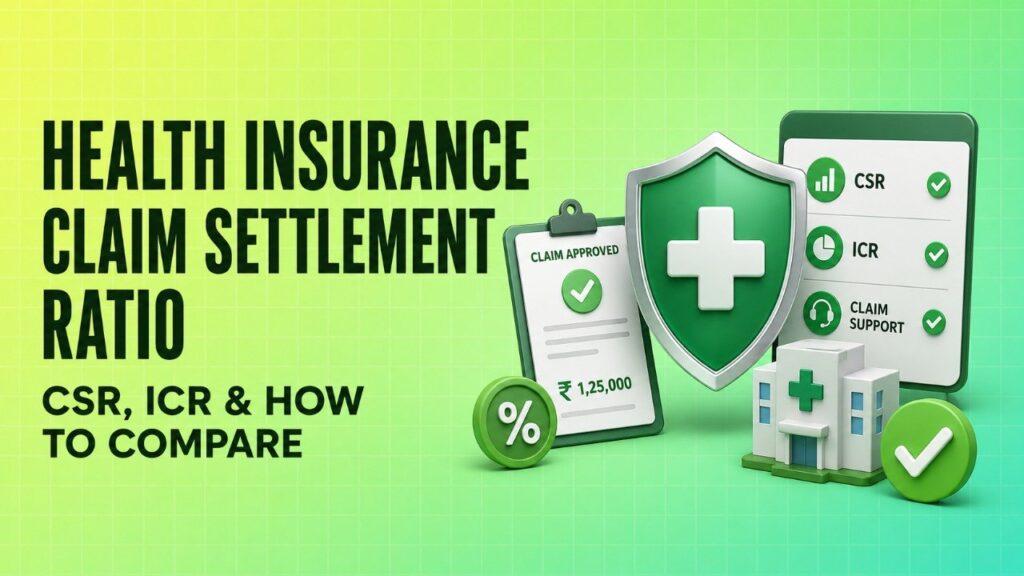
When people compare health insurers, two metrics come up again and again: Claim Settlement Ratio (CSR) and Incurred Claim Ratio (ICR). They sound similar, but they measure different things.
CSR tells you how many claims an insurer settled compared with how many claims it received. It is a service-efficiency metric.
ICR tells you how much the insurer paid in claims compared with how much premium it collected. It is more of a financial sustainability metric.
In simple terms:
- CSR = number of claims
- ICR = value of claims paid versus premiums collected
Both matter, but neither should be used alone. A company with a very high CSR may still reject your claim because of policy exclusions, waiting periods, missing disclosures, or non-compliance with hospital procedures. Likewise, an insurer with a very low ICR may be under pressure on pricing or claims payout trends.
What is Claim Settlement Ratio (CSR)?
Claim Settlement Ratio shows the percentage of claims an insurer settled during a given period. The basic formula is:
(Total Claims Paid / Total Claims Received) × 100
Example: If an insurer received 10,000 claims and paid 9,600, the CSR would be 96%.
For buyers, CSR is useful because it gives a broad idea of how efficiently the insurer processes and settles claims. A consistent CSR over several years is usually a better sign than a one-year spike.
But CSR has limits. It does not tell you how many claims were rejected, how many were pending, or why a claim was denied. It also does not reveal whether the insurer paid many small claims but struggled with large hospital bills.
Why Incurred Claim Ratio (ICR) Matters
 ICR is the other side of the comparison. It measures the claims cost burden on the insurer relative to the premium it collected. In general terms, if an insurer collects premium and pays out a very high share of it in claims, the ICR will be high.
This matters because ICR helps you understand whether the insurer has priced its products sensibly for the risk it is taking. A very low ICR may mean the company is collecting a lot more premium than it is paying out, which can be fine in some cases, but it may also indicate strict claim control or underpayment patterns. A very high ICR may indicate heavy claim costs, which can put pressure on pricing and profitability.
ICR is not a direct promise of claim approval. It is a context metric. For a beginner, it helps answer a practical question: is this insurer stable enough to continue paying claims without strain?
Health Insurance Metric Decoder
The table below is a simple way to interpret CSR and ICR. These ranges are indicative, not absolute. A very high CSR might reflect strong claim processing, but it can also happen when the insurer has a smaller pool of claims or a product mix with simpler claims. An extremely low ICR may suggest the company is struggling to pay claims or is charging premiums that do not match the risk.
| Metric | Ideal Range | What it tells you | What it misses |
|---|---|---|---|
| CSR | High and consistent over multiple years | How many claims the insurer settled | Reasons for rejection, pending claims, and claim size |
| ICR | Reasonable and stable across years | How much of premium income is going into claims | Policy exclusions, service quality, and settlement speed |
| Solvency Ratio | Should stay above regulatory minimum | Whether the insurer has enough capital buffer | How quickly claims are processed or how customer-friendly the policy is |
Use this table as a screening tool, not a final buying rule. Claim settlement depends on many policy-level details, not just company-level ratios.
Top Claim Settlement Ratio Health Insurance Companies in India
IRDAI publishes annual insurance data, and claim settlement performance can change every year. The list below should be read as a snapshot based on the latest available IRDAI annual reporting trend, not as a permanent ranking. Always verify the most recent figures from the IRDAI annual report or the insurer’s published disclosures before buying.
These insurers have historically appeared among the stronger performers on claim settlement consistency. The exact percentages may differ by year, product type, and reporting method.
| Insurer Name | CSR (%) | ICR (%) | Key Observation |
|---|---|---|---|
| Insurer A | Very high, often above 95% | Moderate to stable | Usually shows strong settlement consistency, but policy checks still matter |
| Insurer B | High and consistent | Balanced | Often seen as steady on claims and pricing discipline |
| Insurer C | High | Reasonable | Useful to compare with hospital network and exclusions before deciding |
| Insurer D | High but variable by year | Needs year-wise review | Good reminder that one year’s CSR is not enough for comparison |
| Insurer E | High | Stable | Check service reviews and cashless claim turnaround time |
| Insurer F | Strong on claim count | Watch the trend | Compare premium pricing with claim experience |
| Insurer G | Consistently competitive | Moderate | Review waiting periods and room rent limits |
| Insurer H | High | Balanced | Good to inspect hospital tie-ups in your city |
| Insurer I | Solid settlement record | Stable | Read exclusion clauses carefully, especially for pre-existing conditions |
| Insurer J | Good but not the only factor | Needs context | Compare with co-payment and sub-limit terms |
If you are searching for the claim settlement ratio of health insurance companies, remember that the raw percentage is only a starting point. A policy that looks strong on paper can still be weak for your family if your preferred hospitals are not in the network or if the policy has strict sub-limits.
The CSR Trap: Why High Isn’t Always Better
Many buyers assume that a higher CSR automatically means a better insurer. That is not always true.
A 99% CSR looks impressive, but it does not mean every claim will pass. Claims can still be rejected for reasons such as:
- Non-disclosure of pre-existing diseases
- Waiting period not completed
- Treatment outside policy coverage
- Missing documents
- Fraud or false information
- Hospital billing or pre-authorisation issues
It is also worth remembering that a 100% CSR is rare. In some cases, an unrealistically perfect ratio can be less informative than a slightly lower but more realistic number. Very high figures can sometimes reflect product mix, claim volume, or strict filtering of what counts as a claim in the reporting period.
A high CSR does not guarantee your individual claim will be approved. Approval depends on your policy terms, disclosure of pre-existing diseases, and adherence to hospital protocols.
This is why you should never buy health insurance based only on a big CSR number. Read the policy wording first, then judge the ratio.
Other Critical Factors to Check Before Buying
Once you have checked CSR and ICR, move to the practical details that affect real-life claim experience.
Network hospital list
Cashless treatment becomes easier when your preferred hospital is part of the insurer’s network. Before buying, check whether the insurer has tie-ups with good hospitals near your home, office, and parents’ city. In a medical emergency, hospital convenience matters a lot.
Waiting periods
Every policy has waiting periods for certain conditions, especially pre-existing diseases, maternity benefits, and specific treatments. A lower waiting period is generally more convenient, but always check the exact wording. Do not assume all illnesses become covered immediately.
Sub-limits and co-payment
Some policies cap expenses for room rent, modern treatment, or certain procedures. Others require you to pay a fixed share of the bill through co-payment. These can reduce your usable cover even if the sum insured looks large on paper.
For example, a policy with a ₹10 lakh cover can still feel restrictive if it has room rent limits or mandatory co-payment on every claim.
TPA efficiency
TPA, or Third Party Administrator, often handles claim paperwork and cashless processing on behalf of the insurer. Good TPA handling can speed up claim approval, while poor coordination can delay settlement. Check whether the insurer has a smooth digital claim process, fast document review, and responsive customer support.
How to Evaluate an Insurer Like an Expert
If you want a practical method instead of guesswork, use this four-step checklist before buying health insurance.
- Check the latest IRDAI annual report. Look at CSR, ICR, and solvency information together. Do not rely on a single year or a single metric.
- Verify the network hospitals in your city. A strong ratio is less useful if your preferred hospitals are missing from the cashless network.
- Read the exclusions and waiting periods page. This is where many claim disappointments begin. Policy wording matters more than marketing brochures.
- Look at real claim experience reviews. Search for claim timelines, cashless approval speed, and document issues. Ignore generic star ratings with no details. Look for specific experiences from policyholders.
Also compare the insurer’s solvency ratio with the mandatory regulatory requirements. This is different from CSR. Solvency ratio is about whether the insurer has enough capital to meet its future obligations, while CSR is about how many claims it settled in a period. Both are useful, but they answer different questions.
If you are comparing health insurance for parents, a family floater for a spouse, or an individual policy for yourself, the safest approach is to shortlist insurers using CSR and ICR, then test the policy terms against your real needs.
Official insurer websites and the IRDAI portal are the best places to verify current numbers. Rates, benefits, exclusions, and network hospitals can change. Always check the latest policy brochure and wording before making a final decision.
FAQ
Is a 100% claim settlement ratio possible?
It is unlikely for a large Health Insurance over a full year. A perfect 100% CSR can happen in small samples or specific reporting periods, but it is not the norm for a large claim portfolio.
Where can I find the official claim settlement ratio of an insurance company?
Check the IRDAI annual report and the insurer’s official disclosures. Those are the most reliable sources for CSR-related data in India.
Does a high CSR mean my claim won’t be rejected?
No. A high CSR does not guarantee approval of your individual claim. Rejection can still happen due to exclusions, non-disclosure of pre-existing diseases, waiting periods, documentation gaps, or hospital protocol issues.
Should I prioritize CSR over the premium cost?
Do not look at premium alone or CSR alone. Compare both together, along with network hospitals, exclusions, waiting periods, co-payment, and service quality. The cheapest policy may not give the best usable cover.
What is the difference between CSR and ICR?
CSR measures the percentage of claims settled out of claims received. ICR measures the value of claims paid compared with premiums collected. CSR shows service efficiency, while ICR shows financial context and sustainability.