The largest stockbroker in India may not be the best broker for you.
A beginner may prefer a simple investing app. An active trader may need fast execution, advanced charts, and options tools. A long-term investor may value research, banking integration, and customer support more than the lowest brokerage.
This guide compares the top stock brokers in India using the latest available NSE active-client ranking for May 2026. It also evaluates their brokerage structure, platforms, investment products, research support, and suitability for different users.
Active client numbers indicate how widely a broker is used. They do not prove that the broker has the best platform, the lowest charges, or the most suitable overall offering.
Top 10 Stock Brokers in India 2026
The ranking below is based on NSE active-client data as of May 30, 2026.
| Rank | Stock Broker | Type | Best Suited For | Equity Delivery Brokerage | Intraday/F&O Brokerage |
|---|---|---|---|---|---|
| 1 | Groww | Discount broker | Beginners and simple investing | ₹20 or 0.1%, whichever is lower; minimum ₹5 | Intraday: ₹20 or 0.1%, whichever is lower; F&O: ₹20 per order |
| 2 | Zerodha | Discount broker | Self-directed investors and traders | ₹0 | Intraday and futures: ₹20 or 0.03%, whichever is lower; options: ₹20 |
| 3 | Angel One | Hybrid broker | Investors seeking research and digital tools | ₹20 or 0.1%, whichever is lower; minimum ₹5 | Intraday: ₹20 or 0.1%, whichever is lower; F&O: ₹20 |
| 4 | ICICI Direct | Full-service broker | Existing ICICI Bank customers | Depends on selected plan | Depends on selected plan |
| 5 | Upstox | Discount broker | Mobile-first investors and traders | Up to ₹20 per order, subject to plan conditions | Usually up to ₹20 per order under the basic plan |
| 6 | Kotak Securities | Full-service/hybrid broker | Bank-linked users and active traders | Depends on selected plan | Selected plans offer ₹10 intraday and F&O orders |
| 7 | HDFC Securities | Full-service/hybrid broker | Long-term investors and HDFC Bank customers | Depends on platform and plan | HDFC SKY offers flat-fee pricing; full-service plans differ |
| 8 | SBI Securities | Full-service broker | SBI customers and branch-oriented investors | Depends on selected plan | Several plans charge ₹20 per intraday order |
| 9 | Dhan | Discount broker | Active, options and API traders | ₹0 | Intraday: ₹20 or 0.03%, whichever is lower; F&O: ₹20 |
| 10 | Motilal Oswal | Full-service broker | Research-led investors | Plan-dependent | Plan-dependent |
Brokerage plans, promotional offers, and account charges can change. Check the broker’s current tariff sheet before opening an account.
How We Selected These Stock Brokers
The inclusion and order of brokers are based on the latest NSE active-client positions.
An active client is a registered client who has completed at least one transaction during the relevant period. This metric indicates broker size and popularity, but does not fully reflect quality.
Each broker has also been assessed using the following factors:
- Active-client position
- Brokerage and account-related charges
- Investing and trading platforms
- Available products and market segments
- Research and educational support
- Customer service model
- Banking integration
- Suitability for different users
MoneyMoksh does not consider the broker with the highest client count as the automatic winner.
1. Groww – Best for Beginners and Simple Investing
Groww was the largest stockbroker in India by NSE active clients in May 2026, with more than 1.30 crore active users.
A key advantage is its simple interface, which allows users to access stocks, mutual funds, ETFs, IPOs, futures, and options on a single platform.
Investors deciding between exchange-traded products and mutual funds should understand the differences between ETFs and mutual funds.
Main strengths
- Clean and beginner-friendly app
- Stocks, mutual funds, IPOs and ETFs in one place
- Simple digital account-opening process
- Easy portfolio tracking
- Suitable for investors starting with mutual funds or shares
Brokerage
Groww charges the lower of ₹20 or 0.1% of the trade value per stock order, with a minimum brokerage condition of ₹5. F&O trades generally carry a flat charge of ₹20 per order.
This means equity delivery is not brokerage-free.
Important limitations
Groww may suit beginners, but experienced traders may find its tools less specialized than those on platforms designed mainly for active or options trading.
Users should also consider DP charges and interest costs when selling delivery shares before using the Margin Trading Facility.
Who should consider Groww?
Groww may suit:
- First-time investors
- Mutual fund investors
- Users who want a simple interface
- Investors who prefer managing different products in one app
Active traders who need detailed options analysis, APIs, or advanced desktop tools should also compare Dhan, Zerodha, and Upstox.
2. Zerodha – Best for Self-Directed Investors and Traders
Zerodha remained India’s second-largest broker by active clients in May 2026.
It helped popularise the discount-broking model in India and is widely used by long-term investors and active traders.
Its main platforms include Kite for trading and Coin for direct mutual funds.
Main strengths
- Zero brokerage on genuine equity-delivery investments
- Clear and relatively simple pricing
- Kite web and mobile trading platform
- Direct mutual funds through Coin
- Varsity educational content
- Suitable for investors and traders
Brokerage
Zerodha charges:
- Equity delivery: ₹0
- Equity intraday: ₹20 or 0.03% per executed order, whichever is lower
- Equity futures: ₹20 or 0.03%, whichever is lower
- Equity options: ₹20 per executed order
Statutory, exchange and DP charges still apply.
Important limitations
Zerodha mainly follows a self-service model. Investors looking for stock recommendations, relationship managers, or extensive branch support may prefer a full-service broker.
Some specialized tools or market-data services may also operate through separate platforms or integrations.
Who should consider Zerodha?
Zerodha may suit:
- Long-term equity investors
- Direct mutual fund investors
- Self-directed traders
- Users who value transparent pricing
- Investors who use educational resources to make their own decisions
3. Angel One – Best for Research and Digital Features
Angel One ranked third by NSE active clients in May 2026.
It operates as a digital-first broker while also providing research, investment ideas, and a wider range of support than a basic execution-only platform.
Main strengths
- Research and stock-analysis content
- Stocks, mutual funds, IPOs, commodities and F&O
- Digital investing and trading tools
- Suitable for both new and experienced users
- API and technology-based features
Brokerage
Angel One currently charges:
- Equity delivery: ₹20 or 0.1% per executed order, whichever is lower, with a minimum of ₹5
- Equity intraday: ₹20 or 0.1%, whichever is lower, with a minimum of ₹5
- F&O: ₹20 per executed order
Its current introductory offer may provide limited-period brokerage benefits, subject to terms.
Important limitations
Users should not assume that delivery investing is free. They should also check whether a research or advisory feature is included free or linked to a particular product or plan.
Who should consider Angel One?
Angel One may suit:
- Beginners who want investment ideas
- Investors interested in research support
- Traders who want digital tools
- Users looking for more guidance than an execution-only broker provides
Research reports should be treated as information, not guaranteed recommendations.
4. ICICI Direct – Best for ICICI Bank Customers
ICICI Direct was the largest traditional full-service broker by active clients in May 2026.
Its strongest advantage is its three-in-one account, which connects an ICICI Bank account, trading account and demat account.
This can make fund transfers and investment transactions easier for existing ICICI Bank customers.
Main strengths
- Three-in-one banking, trading and demat integration
- Stocks, IPOs, bonds, FDs, mutual funds and other products
- Research reports and investment ideas
- Established full-service support
- Convenient for ICICI Bank customers
Brokerage and account costs
ICICI Direct offers multiple pricing plans. Brokerage can differ according to:
- Selected plan
- Equity delivery or intraday trade
- Trading volume
- Subscription package
- Product segment
Its regular demat account may also carry annual maintenance charges after the introductory period. DP charges may apply when securities are sold.
Important limitations
Its overall cost can be higher than that of discount brokers, especially when the user selects a percentage-based plan or trades frequently.
Users should compare the plan tariff instead of relying on one advertised brokerage figure.
Who should consider ICICI Direct?
It may suit:
- Existing ICICI Bank customers
- Long-term investors
- Users who want banking integration
- Investors seeking research and multiple products
- People who value convenience over the lowest possible cost
5. Upstox – Best for Mobile-First Active Traders
Upstox is a technology-driven discount broker offering investments and trading through its mobile and web platforms.
It ranked fifth by NSE active clients in May 2026.
Main strengths
- Mobile-first investing and trading experience
- Stocks, mutual funds, IPOs, commodities and F&O
- Charting and market-analysis tools
- Digital account opening
- Suitable for investors and active traders
Brokerage
Under its basic pricing structure, Upstox generally charges:
- Equity delivery: up to ₹20 per order, subject to the regulatory limit
- Equity intraday: ₹20 or 0.1%, whichever is lower
- Futures and options: generally up to ₹20 per order
Upstox Plus can have higher per-order charges than the basic plan in exchange for additional features.
Important limitations
Users must check which plan is active in their account. Comparing the basic plan with a premium plan without considering the additional features can be misleading.
Upstox may also offer less personalised advisory support than a traditional full-service broker.
Who should consider Upstox?
Upstox may suit:
- Mobile-first traders
- Intraday traders
- Investors who want one app for stocks, mutual funds and IPOs
- Users who prefer flat-fee digital broking
6. Kotak Securities – Best for Bank-Linked Investing and Lower-Cost Trading Plans
Kotak Securities, now commonly accessed through Kotak Neo, ranked sixth by active clients in May 2026.
It combines the backing and banking integration of a traditional financial group with newer flat-fee trading plans.
Main strengths
- Integration with the Kotak banking ecosystem
- Research and investment support
- Stocks, IPOs, mutual funds and derivatives
- Plans for young and active traders
- API-based trading facilities
Brokerage
Kotak offers several plans.
Its Trade Free and Trade Free Youth plans may provide:
- Equity intraday: ₹10 or 0.05% per executed order, whichever is lower
- F&O: ₹10 per executed order
- Zero brokerage on selected API orders
- Limited introductory delivery-brokerage benefits
Account-opening fees and delivery charges depend on the selected plan.
Important limitations
Kotak does not have one brokerage structure for every customer. Charges may vary according to age, subscription plan and service selected.
Read the exact pricing terms instead of choosing based only on an introductory “free” offer.
Who should consider Kotak Securities?
Kotak may suit:
- Existing Kotak Bank customers
- Investors seeking banking integration
- Traders looking for ₹10 order-based plans
- Users who want research along with digital trading
7. HDFC Securities – Best for Long-Term Investors and HDFC Bank Customers
HDFC Securities ranked seventh by active NSE clients in May 2026.
It now serves different customer profiles through both full-service facilities and HDFC SKY, its lower-cost digital investing platform.
Main strengths
- Integration with HDFC Bank
- Research reports and investing ideas
- Stocks, mutual funds, IPOs, ETFs and F&O
- Full-service and discount-style platform choices
- Suitable for long-term investors
Brokerage
The brokerage depends on the account and platform selected.
HDFC SKY promotes flat ₹20-per-order pricing for supported segments, while traditional HDFC Securities plans may use different rates, subscription packages or percentage-based charges.
Important limitations
Users must clearly distinguish between HDFC SKY and traditional HDFC Securities pricing.
The cheapest advertised charge may not apply to all accounts or products. Demat, DP and account-maintenance charges should also be checked.
Who should consider HDFC Securities?
It may suit:
- Existing HDFC Bank customers
- Long-term investors
- Users seeking institutional-style research
- Investors who want banking and investing services together
- Traders willing to compare SKY with full-service plans
8. SBI Securities – Best for SBI Customers and Branch-Oriented Investors
SBI Securities is part of the State Bank of India financial ecosystem. It ranked eighth among the largest brokers by active clients in May 2026.
It is often considered by customers who already use SBI for banking and prefer a familiar financial institution.
Main strengths
- Connection with the SBI ecosystem
- Stocks, ETFs, mutual funds, IPOs and derivatives
- Research-based recommendations
- Banking integration
- Support suitable for traditional investors
Brokerage
SBI Securities has multiple plans, so delivery brokerage can vary.
Several plans charge around ₹20 per intraday order, while equity-delivery charges may be percentage-based. Futures, options and call-and-trade costs also depend on the selected plan.
Important limitations
Its pricing structure can be more complicated than that of a basic discount broker.
Some plans include subscription costs or higher delivery charges. Users should compare total annual costs before opening an account.
Who should consider SBI Securities?
It may suit:
- Existing SBI customers
- Investors who want a bank-backed broker
- Users seeking research and service support
- People comfortable with plan-based pricing
9. Dhan – Best for Active, F&O and API Traders
Dhan crossed 10 lakh active clients in 2026 and ranked ninth in the May 2026 NSE list.
Unlike many beginner-first apps, Dhan has built several tools specifically for serious traders, especially options and technical-analysis users.
Its charting facilities may suit experienced users who understand indicators and order flow. Traders can also learn how a tick chart in trading differs from a regular time-based chart before choosing a platform.
Main strengths
- TradingView integration
- Dedicated Options Trader platform
- Strategy builder and payoff tools
- Advanced option chain
- DhanHQ trading APIs
- Stocks, ETFs, mutual funds, commodities and F&O
- Zero account-opening and AMC charges for eligible retail accounts
Brokerage
Dhan charges:
- Equity delivery: ₹0
- Equity intraday: ₹20 or 0.03% per executed order, whichever is lower
- Equity futures and options: ₹20 per executed order
- Account opening: ₹0 for eligible individual accounts
- AMC: ₹0 for eligible individual accounts
Other charges, including DP, call-and-trade, auto-square-off and MTF-related costs, may apply.
Important limitations
The number of trading tools can feel complex to a complete beginner who only wants to buy a few shares or start a mutual fund SIP.
Dhan is also a broker featured in this ranking, so its self-published comparisons should not be treated as independent recommendations.
Who should consider Dhan?
Dhan may suit:
- Active equity traders
- F&O and options traders
- TradingView users
- Algorithmic and API users
- Traders who require advanced analysis tools
10. Motilal Oswal – Best for Research-Led Investors
Motilal Oswal ranked tenth by NSE active clients in May 2026.
It is a full-service financial-services company known for equity research, advisory support and a broad investment-product range.
Main strengths
- Detailed equity research
- Investment and market-analysis tools
- Stocks, mutual funds, IPOs and wealth products
- Advisory and relationship-based services
- Suitable for fundamental investors
Brokerage
Motilal Oswal’s charges can depend on the selected account and brokerage plan.
Its published standard structure has historically included percentage-based delivery and intraday brokerage, while options may carry per-lot or plan-based charges. Customers should check the current tariff directly before opening an account.
Important limitations
It may not be the lowest-cost option for frequent traders.
Some services, advisory features or account plans may involve charges that are not present with basic discount brokers.
Who should consider Motilal Oswal?
It may suit:
- Fundamental investors
- Users who value equity research
- Investors seeking advisory support
- Customers comfortable paying more for full-service facilities
Which Stock Broker Is Best for Your Needs?
There is no single best stock broker for every investor.
| User Type | Brokers Worth Comparing | What to Prioritise |
|---|---|---|
| Complete beginner | Groww, Zerodha, Angel One | Simple interface, education and transparent fees |
| Long-term investor | Zerodha, ICICI Direct, HDFC Securities, Motilal Oswal | Delivery costs, research and available products |
| Intraday trader | Zerodha, Upstox, Dhan | Execution, charts and total trading cost |
| F&O trader | Dhan, Zerodha, Upstox, Angel One | Options tools, APIs, stability and risk controls |
| Bank-linked account user | ICICI Direct, Kotak Securities, HDFC Securities, SBI Securities | Banking integration and fund movement |
| Research-focused investor | Motilal Oswal, ICICI Direct, Angel One, HDFC Securities | Research quality and advisory support |
| Low-cost delivery investor | Zerodha and Dhan | Delivery brokerage, DP charges and AMC |
| API or algorithmic trader | Dhan, Zerodha, Kotak Neo | API features, cost and platform compatibility |
Long-term investors interested in building an income-oriented portfolio can also understand how a dividend investing strategy works before selecting a broker.
Use this table only as a starting point. Test the platform and read the tariff sheet before making a decision.
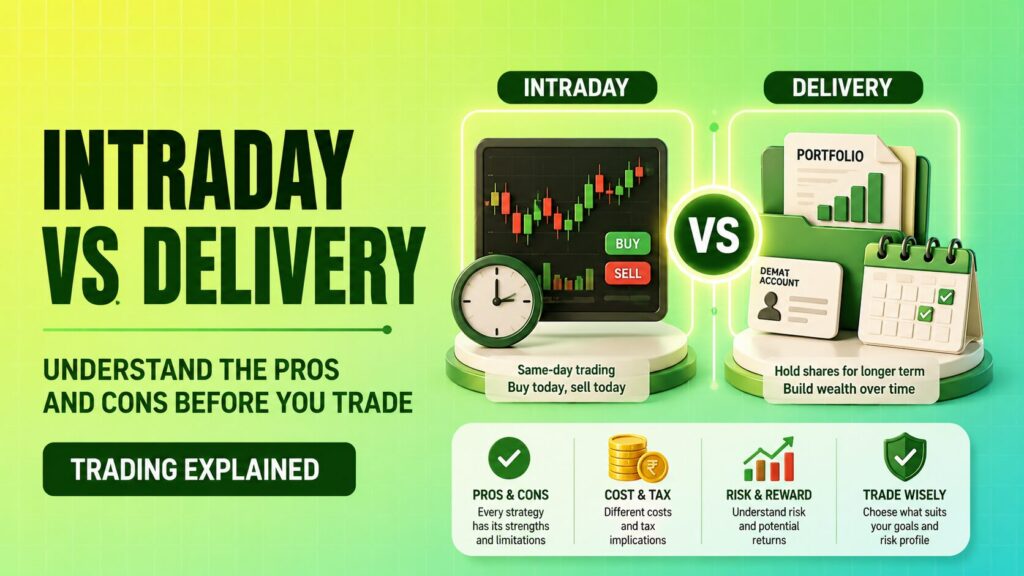
Read Also: Intraday vs Delivery: Understand the Pros and Cons Before You Trade
Discount Broker vs Full-Service Broker
| Factor | Discount Broker | Full-Service Broker |
|---|---|---|
| Brokerage | Usually flat or relatively low | May be flat, plan-based or percentage-based |
| Research | Limited or general | Research reports may be included |
| Advisory | Usually limited | May offer advisory or relationship support |
| Branch network | Generally limited | More likely to offer branches |
| Banking integration | Usually separate | Often available with bank-backed brokers |
| Trading tools | Often technology-focused | Varies by broker |
| Suitable for | Self-directed investors and traders | Users seeking guidance and integrated services |
A discount broker is not automatically cheaper in every situation. For example, frequent delivery sell transactions can create DP charges even when delivery brokerage is zero.
Similarly, a full-service broker is not automatically better. Research and relationship support are useful only when you actually use them and find the total cost reasonable.
How to Choose the Best Stock Broker in India
Identify Whether You Are an Investor or Trader
A long-term investor may need a simple platform, low delivery costs and access to mutual funds, ETFs and IPOs.
An active trader may prioritise:
- Fast order placement
- Advanced charts
- Option-chain tools
- APIs
- Stable execution
- Risk-management features
Calculate the Total Cost
Estimate the cost based on your actual activity.
Include:
- Brokerage
- AMC
- DP charges
- MTF interest
- Platform subscriptions
- API charges
- Call-and-trade fees
- Auto-square-off fees
A broker with low intraday brokerage may still be expensive for a delivery investor because of AMC or DP charges.
Test the Platform
Check whether the app or website is:
- Easy to understand
- Stable during active market hours
- Suitable for your screen size
- Equipped with the required order types
- Clear about profit, loss and charges
Do not open an account only because an app has a high download count.
Check the Available Products
Confirm whether the broker offers the products you require, such as:
- Equity shares
- ETFs
- Mutual funds
- IPOs
- Bonds
- Commodities
- Currency derivatives
- Futures and options
- Margin Trading Facility
Advanced long-term investors can also check whether the broker supports SLBM in the stock market, which allows eligible securities to be lent through the regulated lending mechanism.
Read Also: IPO Investing Guide: Should Beginners Apply in 2026?
Review Customer Support
Check the availability of:
- Ticket support
- Email assistance
- Telephone support
- Branch service
- Dealer-assisted trading
- Grievance escalation
The cheapest broker may not suit someone who regularly needs personal support.
Verify Registration
Use the NSE broker locator or SEBI intermediary database to verify the broker’s registration and official contact details.
Avoid downloading trading applications from links received through unknown messages or social-media groups.
Is It Safe to Keep Investments With a Stock Broker?
Opening an account with a large broker does not make investing risk-free.
Your demat account holds securities electronically through the depository system. The broker provides the trading interface and may also act as a Depository Participant.
Money temporarily kept in the trading account is different from shares held in the demat account.
To improve account safety:
- Use only a SEBI-registered broker
- Download the app from an official source
- Enable two-factor authentication
- Never share passwords, PINs or OTPs
- Check contract notes
- Review ledger and demat statements
- Keep your mobile number and email updated
- Do not transfer money to personal bank accounts
- Report unauthorised activity immediately
Investors should also understand that broker registration does not protect them from market losses.
Final Verdict: Which Is the Best Stock Broker in India?
- Best for beginners: Groww
- Best for self-directed investing: Zerodha
- Best for research with digital access: Angel One
- Best for ICICI Bank customers: ICICI Direct
- Best for mobile-first trading: Upstox
- Best bank-linked trading plan: Kotak Securities
- Best for HDFC Bank customers: HDFC Securities
- Best for SBI customers: SBI Securities
- Best for options and advanced trading tools: Dhan
- Best for research-led investing: Motilal Oswal
These are editorial suitability categories, not guarantees that one broker will perform better for every user.
Compare at least two brokers based on your expected trades, preferred products, and required support. The right broker is the one whose platform, total cost, and service model match how you actually invest.
FAQs
Which Is the No. 1 Stock Broker in India by Active Clients?
Which Stock Broker Is Best for Beginners in India?
Groww is suitable for beginners who want a simple interface, while Zerodha may suit those seeking zero delivery brokerage and detailed educational content. Angel One can be considered by users seeking research and investment ideas.
Which Broker Is Suitable for Long-Term Investing?
Zerodha and Dhan offer zero equity-delivery brokerage for eligible retail users. ICICI Direct, HDFC Securities, and Motilal Oswal may suit long-term investors who value research, advisory support, or banking integration.DP, AMC, and other charges should also be compared.
Which Broker Has the Lowest Brokerage Charges in India?
There is no single cheapest broker for every user. Zerodha and Dhan currently charge zero brokerage on equity delivery, while several brokers offer flat-fee intraday and F&O pricing. The cheapest option depends on your trading frequency, order size, AMC, DP charges, and use of additional services.
Can I Open Demat Accounts With Two Different Brokers?
Yes, you can open demat accounts with multiple brokers using the same PAN. Each account may have separate maintenance charges, login credentials, and records. Managing multiple accounts may be useful for separating investments and trading, but it can also increase complexity and cost.