In the modern stock market, most investors focus only on buying and holding shares. However, very few are aware that their idle shares can also generate additional income without being sold. One such mechanism is the Securities Lending and Borrowing Mechanism (SLBM).
SLBM is a regulated system that allows investors to lend their shares to other market participants in exchange for a lending fee. This mechanism is operated under regulated exchange frameworks such as the National Stock Exchange (NSE) in India and supervised under SEBI (Securities and Exchange Board of India) guidelines.
This article explains SLBM in a structured, practical, and EEAT-compliant way so investors can understand not just the concept, but also its real-world usage, benefits, and risks.
What is SLBM (Securities Lending and Borrowing Mechanism)?
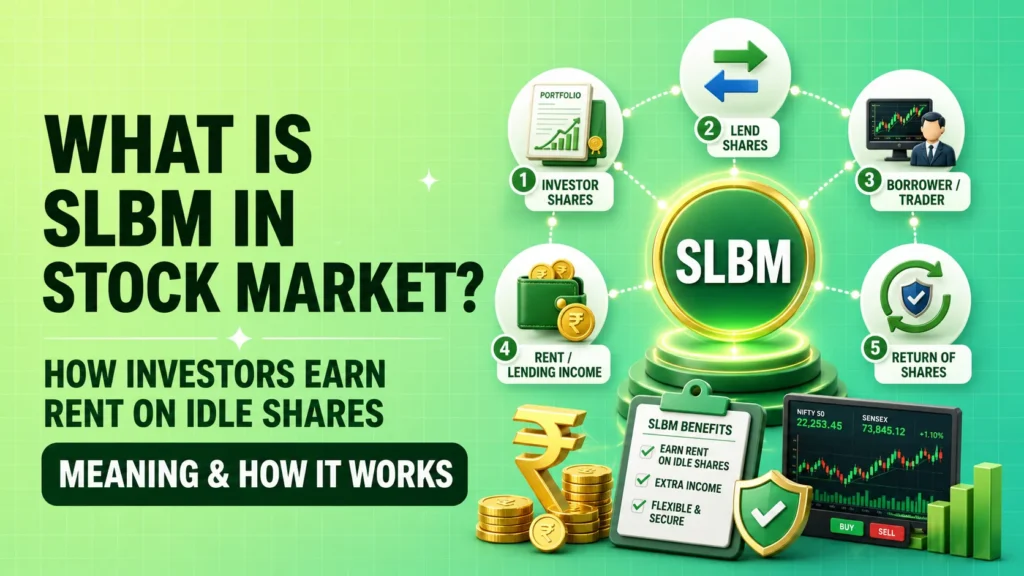
SLBM stands for Securities Lending and Borrowing Mechanism, a system where:
- A lender (investor holding shares) lends securities
- A borrower (trader/institution) borrows those shares
- A lending fee is paid for using those shares
- Ownership of shares temporarily transfers but is returned later
In simple terms:
Your idle shares work like a rented asset, generating passive income.
SLBM is fully regulated in India and operates through approved stock exchanges such as NSE under SEBI supervision, ensuring transparency and risk controls.
How SLBM Works in Real Market Conditions
SLBM operates through a structured exchange-based system. It is not an informal or off-market transaction.
Step-by-Step Process
1. Registration with Broker
Investors must activate SLBM facilities through a registered brokerage platform.
2. Listing Shares for Lending
Eligible shares from the investor’s portfolio are marked for lending.
3. Borrower Demand
Borrowers (often institutional traders) request shares for:
- Short selling
- Arbitrage strategies
- Settlement requirements
4. Collateral Deposit
Borrowers must provide collateral (cash or approved securities) to reduce risk.
5. Lending Transaction Execution
Shares are lent for a fixed tenure (daily, weekly, or monthly contracts).
6. Return of Securities
At the end of the contract, shares are returned to the original owner.
7. Income Generation
The lender earns a lending fee, depending on demand and stock availability.Example of SLBM in Action
Let’s understand with a realistic scenario:
- Investor holds: 100 shares of Company ABC
- Market price: ₹500 per share
- Total value: ₹50,000
- Lending fee: 1% per month
Earnings:
₹50,000 × 1% = ₹500 passive income
After the lending period:
- Shares are returned to investor
- Investor still benefits from price appreciation + dividends (if applicable)
This makes SLBM a dual-benefit strategy:
Passive income + Capital appreciation potential
Key Features of SLBM
SLBM is designed as a transparent exchange-based system with strict controls.
1. Exchange-Regulated System
Operated through NSE-approved infrastructure.
2. Collateral Protection
Borrowers must deposit margin to reduce default risk.
3. Defined Tenure
Contracts are time-bound (daily to monthly).
4. Eligible Securities Only
Only selected stocks are available for lending.
5. Transparent Pricing
Lending fees are determined by market demand and supply.
Benefits of SLBM for Investors
1. Passive Income from Idle Shares
Investors earn income without selling their holdings.
2. Portfolio Efficiency
Improves overall return on long-term holdings.
3. Retained Ownership Benefits
Investors may still receive:
- Corporate actions (where applicable rules allow)
- Capital appreciation potential
4. Market Liquidity Improvement
SLBM supports efficient market functioning by enabling borrowing for trading strategies.
5. Low Effort Income Strategy
Once enabled, the system works with minimal manual intervention.
Risks and Limitations of SLBM
Like all financial instruments, SLBM also carries risks that investors must understand.
1. Market Risk
If share prices fall, the investor still bears the loss.
2. Liquidity Risk
Not all shares may have borrowing demand.
3. Opportunity Cost
Lent shares may not be immediately sellable during contract duration.
4. Counterparty Risk (Mitigated)
Although collateral reduces risk, regulatory systems cannot eliminate it completely.
5. Regulatory Changes
SEBI guidelines may evolve over time.
Important Regulatory Framework
SLBM in India operates under:
- SEBI (Securities and Exchange Board of India) regulations
- NSE (National Stock Exchange) SLBM segment rules
These frameworks ensure:
- Investor protection
- Transparent pricing
- Risk mitigation through collateral
- Controlled participation
This makes SLBM a regulated passive income mechanism, not a speculative product.
Who Should Consider SLBM?
SLBM is suitable for:
Ideal Investors:
- Long-term equity holders
- Low portfolio churn investors
- Passive income seekers
- Institutional investors
Not Suitable For:
- Short-term traders needing liquidity
- High-frequency traders
- Investors unfamiliar with derivatives or stock lending concepts
Real-World Use Cases of SLBM
1. Institutional Short Selling
Hedge funds borrow shares to execute short positions.
2. Arbitrage Trading
Traders use borrowed shares to exploit price differences.
3. Settlement Support
Borrowing helps avoid settlement failures in certain cases.
This shows SLBM is not just a retail investor tool but a core institutional market mechanism.
How to Start SLBM in India
Step 1: Choose a Registered Broker
Use SEBI-registered brokers offering SLBM access.
Step 2: Activate SLBM Facility
Complete KYC and enable SLBM trading segment.
Step 3: Select Eligible Stocks
Check which holdings are available for lending.
Step 4: Set Lending Preferences
Some platforms allow auto-lending features.
Step 5: Monitor Returns
Track lending fees and contract duration.
SLBM vs Traditional Investing
| Feature | SLBM | Normal Holding |
|---|---|---|
| Income Source | Lending fee | Dividends only |
| Ownership | Retained | Retained |
| Risk | Market + counterparty | Market risk only |
| Liquidity | Limited during lending | Full liquidity |
| Purpose | Passive income | Capital growth |
Common Misconceptions About SLBM
Shares are sold when lent”
False — ownership is retained and returned.
It is risky like derivatives”
False — SLBM is exchange-regulated and collateral-backed.
Only institutions can use it”
Partially false — retail investors can also participate via brokers.
Expert Insight (EEAT Enhancement)
Financial experts often view SLBM as a low-risk yield enhancement tool, not a primary investment strategy. It is best used as a supplementary income source rather than a core wealth-building method.
Important Disclaimer
SLBM returns are not fixed or guaranteed. Earnings depend on:
- Market demand for borrowing
- Stock availability
- Lending duration
Investors should evaluate risk tolerance before participating.
Conclusion
SLBM (Securities Lending and Borrowing Mechanism) is a regulated financial system that allows investors to earn passive income from idle shares while still maintaining ownership. Backed by SEBI regulations and operated through NSE infrastructure, it provides a structured way to improve portfolio efficiency.
However, like all financial instruments, SLBM should be used with proper understanding of risks, liquidity constraints, and market conditions.
For long-term investors, SLBM can be a valuable addition to a diversified financial strategy—but not a replacement for core investing principles.
FAQs
What is SLBM in the stock market?
SLBM is a mechanism where investors lend their shares to borrowers in exchange for a fee under a regulated exchange system.
Is SLBM safe in India?
Yes, it is regulated by SEBI and operated through NSE with collateral protection mechanisms.
Can retail investors use SLBM?
Yes, retail investors can participate through eligible brokers offering SLBM facilities.
Do I lose ownership in SLBM?
No, ownership is retained and shares are returned after the lending period.
How much can I earn from SLBM?
Returns vary depending on demand; they are not fixed and change based on market conditions.