Not all business loan interest rates work the same way. Two lenders may both quote 10% interest, but your EMI and total repayment can be very different depending on whether the rate is calculated on a flat basis or a reducing balance basis.
Understanding Flat vs Reducing Rate is one of the most practical steps a business owner can take before signing a loan offer. It helps you compare loan offers fairly, avoid misleadingly low-looking rates, and estimate the real cost of borrowing.
For small business owners, shopkeepers, traders, professionals, and MSME borrowers in India, this difference matters because business loans often involve larger amounts and shorter decision timelines. A rate that looks cheaper on paper can become expensive once you check the EMI schedule, processing fee, foreclosure conditions, and total interest outgo.
This guide explains how flat and reducing rates work, why a flat rate is usually costlier, what to ask your lender, and how to read the loan offer or sanction letter more carefully.
What is a Flat Interest Rate?
A flat interest rate means interest is calculated on the full original loan amount for the entire tenure, even though you repay a part of the principal every month through EMIs.
In simple terms, the lender does not reduce the interest calculation base as your outstanding loan balance comes down. The calculation keeps using the original principal amount until the loan ends.
For example, assume a business owner takes a loan of ₹10 lakh at a flat rate of 10% per year for 3 years. The interest calculation will be:
Flat interest = Principal × Interest Rate × Tenure
So, the total interest will be ₹10,00,000 × 10% × 3 = ₹3,00,000. The borrower repays ₹13,00,000 in total over 36 months, excluding other charges such as processing fee, documentation charges, insurance, or GST where applicable.
The important point is this: even after the borrower repays part of the principal in the first few months, the interest is still calculated as if the entire ₹10 lakh is outstanding for all 3 years.
Flat rates are sometimes seen in short-term loans, equipment finance, consumer durable finance, small-ticket business funding, micro-loan products, or informal lending arrangements. They may also be used in marketing because a flat rate appears lower and easier to understand.
However, a flat rate is not the same as a reducing balance rate. A 10% flat rate is not equal to a 10% reducing rate. In most cases, the flat rate has a much higher effective cost when converted into a reducing balance equivalent.
What is a Reducing Balance Interest Rate?
A reducing balance interest rate means interest is calculated only on the outstanding principal after each EMI payment. As you repay the loan, your principal balance reduces, and the interest for the next period is calculated on the lower balance.
This is also called a reducing rate, diminishing balance rate, or reducing principal method. It is the standard method used by many reputable banks and NBFCs for term loans, working capital term loans, home loans, vehicle loans, and many formal credit products.
In a reducing balance loan, your EMI usually has two parts:
- Interest component: Charged on the outstanding principal for that month.
- Principal component: The portion of EMI that reduces your loan balance.
At the beginning of the loan, the outstanding principal is high, so the interest part of the EMI is higher. As months pass and the principal reduces, the interest part comes down and the principal repayment portion increases. This month-wise breakup is shown in the amortization schedule.
The amortization schedule is one of the most useful documents for a borrower. It shows how much of each EMI goes towards interest, how much goes towards principal, and what balance remains after each payment. Before accepting a business loan, ask for this schedule and match it with the sanction letter or loan agreement.
Because interest is charged only on the unpaid balance, the reducing method is generally more transparent and usually cheaper than a flat rate when the quoted annual rate is the same.
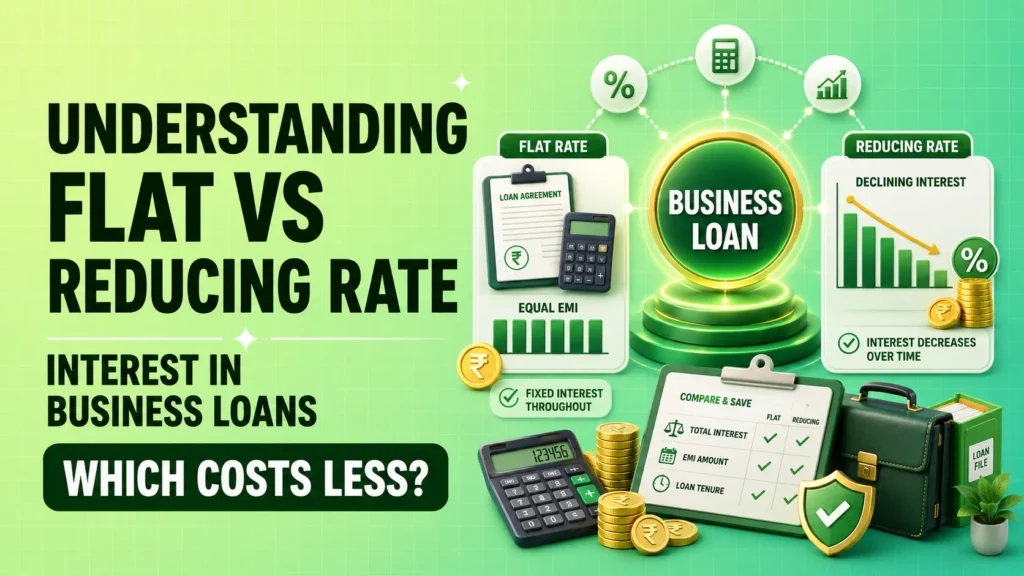
Flat vs Reducing Rate: A Practical Comparison
The biggest mistake borrowers make is comparing only the quoted percentage. A 10% flat rate and a 10% reducing rate do not create the same repayment burden.
Let us use a simple example for understanding. Suppose a business loan of ₹10 lakh is taken for 3 years at 10% per year. The following table shows how the result may differ under the two calculation methods. This is a representative example and actual lender calculations may vary based on EMI rounding, fees, repayment frequency, and loan terms.
| Loan Detail | Flat Rate Example | Reducing Rate Example |
|---|---|---|
| Loan amount | ₹10,00,000 | ₹10,00,000 |
| Interest rate quoted | 10% per year | 10% per year |
| Tenure | 3 years | 3 years |
| Interest calculation base | Original principal for full tenure | Outstanding principal after each EMI |
| Approximate total interest | ₹3,00,000 | About ₹1,61,600 |
| Approximate total repayment | ₹13,00,000 | About ₹11,61,600 |
| Approximate EMI | About ₹36,111 | About ₹32,267 |
This example shows why the calculation method matters. The same-looking 10% rate creates a much higher interest outgo under the flat method.
Here is a broader comparison:
| Feature | Flat Rate | Reducing Rate |
|---|---|---|
| Basis of calculation | Interest is calculated on the original loan amount throughout the tenure. | Interest is calculated on the outstanding principal after repayments. |
| Interest cost | Usually higher for the same quoted rate. | Usually lower and closer to the true cost of borrowing. |
| Popularity | May appear in some small-ticket, short-term, equipment, or informal loan products. | Common in formal bank and NBFC loans. |
| Transparency | Can make the rate look lower than the real cost. | More transparent when supported by an amortization schedule. |
| Comparison difficulty | Difficult to compare unless converted to an effective rate. | Easier to compare across lenders when fees and terms are also checked. |
As a practical rule, if a lender quotes a flat rate, ask for the Effective Interest Rate or the reducing balance equivalent. This helps you compare it with another lender quoting a reducing rate.
For example, a flat rate of 10% for a 3-year EMI loan may translate to a much higher reducing balance equivalent, often close to the high teens depending on tenure and repayment structure. The exact figure should be calculated using the lender’s repayment schedule or a reliable EMI calculator.
Helpful Interactive Tool or Visual to Add
A simple comparison box can help borrowers understand the cost difference before they speak to a lender. On WordPress, this can be created as a calculator using loan amount, interest rate, and tenure as inputs. The output should show total interest under the flat method and approximate total interest under the reducing balance method.
For educational use, the logic can be:
- Flat interest: Principal × Annual Rate × Tenure in years.
- Reducing balance EMI: Calculated using the standard EMI formula based on monthly interest rate and number of months.
- Reducing balance total interest: Total EMIs paid minus original principal.
| Input or Output | Example Value | What it Means |
|---|---|---|
| Loan amount | ₹10,00,000 | Original principal borrowed by the business. |
| Interest rate | 10% per year | Use the same quoted annual rate for comparison. |
| Tenure | 3 years | Repayment period for the loan. |
| Total interest under flat method | ₹3,00,000 | Calculated on the original principal for all 3 years. |
| Total interest under reducing method | About ₹1,61,600 | Calculated on reducing outstanding balance through EMIs. |
| Difference in interest | About ₹1,38,400 | Extra interest in this example under the flat method. |
Safety note: This type of tool is only for educational comparison. Always rely on the final amortization schedule, sanction letter, Key Fact Statement where applicable, and loan agreement provided by your bank or NBFC.
Also remember that the total loan cost is not only interest. Processing fee, documentation fee, valuation charges, insurance, penal charges, cheque bounce charges, prepayment charges, foreclosure charges, and GST on certain fees can affect the final cost.
Why Lenders Prefer One Over the Other
Lenders may choose a calculation method based on product type, borrower segment, tenure, internal policy, and how they want to present the loan cost.
Reducing balance interest is generally more transparent because it reflects the actual outstanding loan balance. When a borrower pays EMI every month, the unpaid principal reduces. Charging interest on that reduced balance is easier to understand and fairer for comparison.
This is why many formal lenders use the reducing balance method for standard term loans. It also allows borrowers to review the amortization schedule and see the monthly breakup of principal and interest.
Flat rates, on the other hand, may appear simpler at first. A lender can say “10% flat” and calculate the total interest quickly. This simplicity can be useful for certain short-tenure or fixed repayment products, but it can also hide the actual cost if the borrower does not understand the difference.
For example, a small manufacturer buying machinery may be offered equipment finance at a low-looking flat rate. The EMI may look manageable, but the effective cost could be higher than another loan quoted at a reducing balance rate. Without converting both offers into the same basis, the comparison is incomplete.
This is why borrowers should not judge a loan only by the headline rate. A lower flat rate can be more expensive than a higher reducing rate. The right comparison is based on total interest outgo, annualised effective cost, fees, repayment flexibility, and penalties.
In India, borrowers should also be aware that regulated lenders are expected to follow fair lending and transparency practices. The Reserve Bank of India’s fair practices guidance for banks and NBFCs focuses on clear communication of loan terms, charges, and borrower obligations. Since rules and formats can change, check the latest communication from RBI and the lender’s official documents before making a decision.
Questions to Ask Your Lender Before Signing
Before accepting a business loan, do not rely only on a verbal quote or a marketing brochure. Ask for the loan offer letter, sanction letter, repayment schedule, and a clear list of charges.
Here is a practical checklist:
- Is the quoted interest rate flat or reducing balance? Ask this directly. Do not assume.
- If it is flat, what is the reducing balance equivalent? This helps compare it with other loan offers.
- Can I see the amortization schedule? Check the EMI breakup month by month.
- What is the total interest payable over the full tenure? Compare this amount, not just the percentage rate.
- What is the processing fee? Ask whether it is fixed or a percentage of the loan amount.
- Are there prepayment or foreclosure charges? Business cash flows can change, and early repayment rules matter.
- Are there penal charges for delayed EMI? Understand the cost of missed or late payments.
- Is any insurance bundled with the loan? If yes, ask whether it is optional or mandatory and what it covers.
- Will the EMI change if the rate is floating? If the loan has a floating rate, ask how rate changes will affect EMI or tenure.
- Will repayment history be reported to credit bureaus? Timely repayment can support your credit profile, while delays can hurt it.
Also ask the lender to share the final terms in writing. A proper loan document should clearly mention the loan amount, interest calculation method, repayment tenure, EMI amount, due date, charges, collateral or guarantee details where applicable, and default consequences.
If any term is unclear, take time to understand it before signing. For a large business loan, it may be wise to consult a qualified financial adviser, accountant, or legal professional. This article is for education and should not be treated as personalised financial, tax, or legal advice.
Common Pitfalls and Risks
The most common pitfall is assuming that the lower quoted rate is always cheaper. In reality, a low flat rate can cost more than a higher reducing balance rate.
For example, a lender quoting 12% flat may look cheaper than another lender quoting 18% reducing. But depending on tenure and repayment structure, the 12% flat loan may have a similar or even higher effective cost. You need the amortization schedule and effective rate to compare properly.
Another mistake is ignoring the Effective Interest Rate, also called EIR in many contexts. EIR tries to show the annualised cost of borrowing after considering repayment timing and, in some cases, charges. If a lender uses flat rate language, ask for the EIR or annual percentage cost in writing.
Borrowers also overlook fees. A loan with a slightly lower reducing rate but a high processing fee may not always be cheaper for a short tenure. Similarly, strict foreclosure charges can matter if your business expects seasonal cash inflows and may want to close the loan early.
Some borrowers do not read the sanction letter carefully. The sanction letter or loan offer letter is not a formality. It is where you check the exact loan amount, interest rate type, EMI, tenure, security, guarantees, charges, and conditions. If the document says flat rate while you assumed reducing rate, your repayment cost may be very different from expectation.
Another risk is taking an EMI based only on current cash flow. Business income can be seasonal. If your shop, trading business, manufacturing unit, or professional practice has uneven cash flow, keep a repayment buffer. Missing EMIs can lead to penal charges, collection follow-up, and negative credit bureau reporting.
Also remember that loan approval, final rate, and charges depend on lender policy, credit profile, income, business vintage, bank statements, GST or income documents where applicable, collateral, repayment history, and overall risk assessment. No lender can be assumed to offer the same rate to every borrower.
The key warning is simple: Flat rate is almost always more expensive than reducing balance rate when the quoted rate is the same. Do not compare flat and reducing rates at face value. Convert them into the same basis before deciding.
FAQ
Which interest rate is better for a business loan?
A reducing balance interest rate is almost always better when the quoted rate is the same because interest is calculated only on the outstanding principal. It is also more transparent when the lender provides an amortization schedule.
Can I ask my bank to switch my flat rate loan to reducing?
You can ask, but the answer depends on the loan product, contract terms, lender policy, and whether refinancing or restructuring is allowed. If switching is not possible, you may compare foreclosure costs and other loan options before deciding.
Why does the EMI differ for the same interest rate?
The EMI differs because the calculation method is different. In a flat rate loan, interest is calculated on the original principal for the full tenure. In a reducing balance loan, interest is calculated on the outstanding principal after each EMI.
Is flat rate ever good?
A flat rate may be simple to understand and may be useful only when comparing two loans that both use the flat method. But when compared with reducing balance loans, it is rarely advantageous unless the effective cost, fees, and terms are clearly lower.
How do I check if my loan is reducing balance?
Check the loan offer letter, sanction letter, repayment schedule, or amortization schedule. If the principal outstanding reduces after each EMI and interest is charged on that reduced balance, the loan is on a reducing balance basis.