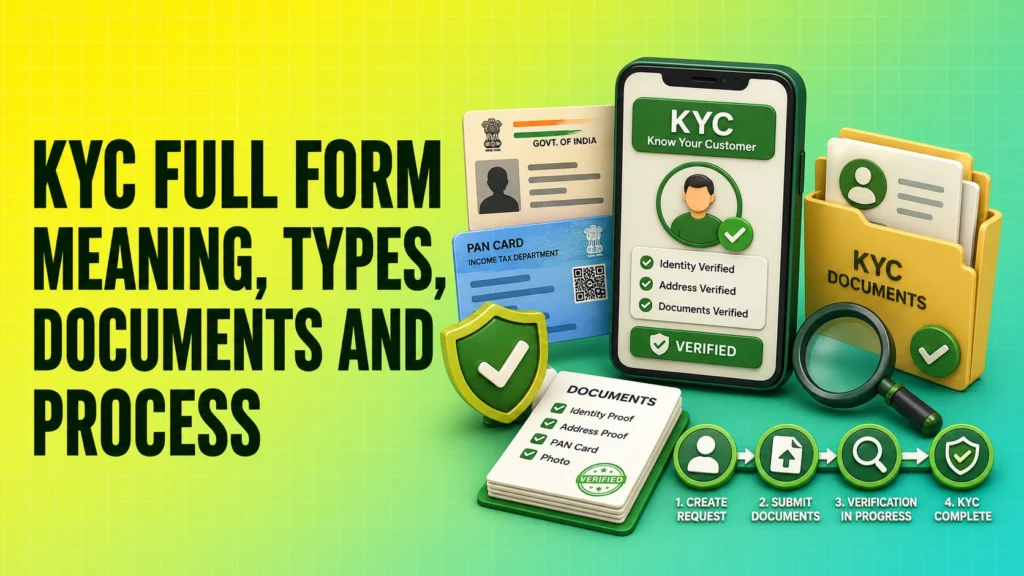
KYC is required when you open a bank account, apply for a loan, invest in mutual funds or use other financial services. It helps financial institutions confirm that the person using the service is genuine.
KYC can be completed online or offline. The documents and verification process may differ depending on the bank, lender or financial product.
KYC Full Form
KYC stands for Know Your Customer.
It is a process used by banks and other regulated financial institutions to verify a customer’s identity, address and other important details.
KYC helps prevent fraud, identity theft, money laundering and misuse of financial accounts.
What Is KYC?

KYC is a customer-verification process. It allows a financial institution to confirm who the customer is before providing a service.
During KYC, the institution may verify:
- Your name and date of birth
- Identity and current address
- PAN or Form 60
- Photograph
- Occupation or business
- Source of income, where required
For businesses, the institution may also verify registration details, authorised persons and beneficial owners.
Why Is KYC Important?
KYC makes financial transactions safer. It reduces the chances of someone opening an account or applying for a loan using another person’s identity.
It also helps financial institutions:
- Detect suspicious customers or transactions
- Prevent money laundering
- Follow regulatory requirements
- Keep customer information updated
- Understand the risk linked to an account
KYC protects both the institution and genuine customers.
Where Is KYC Required?
KYC is commonly required when you:
- Open a savings or current account
- Apply for a loan or credit card
- Invest in mutual funds
- Open a demat or trading account
- Purchase an insurance policy
- Open a fixed deposit
- Use certain wallets or payment services
The exact KYC process depends on the institution and the financial product.
Types of KYC
KYC can be completed through different methods. Customers may be offered online, video or in-person verification.
1. Aadhaar OTP-Based eKYC
Aadhaar OTP-based eKYC is an online verification process.
An OTP is sent to the mobile number linked with your Aadhaar. After you provide consent and enter the OTP, the permitted institution can verify the required Aadhaar information.
This method usually requires:
- An active Aadhaar number
- A mobile number linked with Aadhaar
- Access to the registered mobile number
Aadhaar authentication is available only where the institution is authorised to use it.
2. Video KYC
Video KYC allows customers to complete identity verification through a live video call.
During the call, an authorised official may ask you to:
- Show your face clearly
- Display your PAN or another document
- Answer basic personal questions
- Confirm your address and occupation
The video call must be completed through the institution’s official website, app or authorised platform.
3. Aadhaar Paperless Offline eKYC
Aadhaar Paperless Offline eKYC allows you to share verified Aadhaar information without sharing the complete Aadhaar number.
You can download a digitally signed file or QR-based record from the official UIDAI service. The file may contain your name, address, photograph and masked Aadhaar details.
The file is protected using a share code created by you. This code is required when the file is shared with a service provider.
4. Digital KYC
In Digital KYC, an authorised official uses an approved application to capture your live photograph and KYC document.
The application may also record the location where verification is completed.
Digital KYC is different from uploading a scanned document on a regular website. It must follow the approved verification process.
5. Offline or In-Person KYC
Offline KYC is completed by visiting a bank branch, office or authorised KYC centre.
You need to fill in a KYC form and submit the required identity and address documents. The official may verify the original documents or accepted copies.
This method is useful for people who cannot complete KYC online or do not have access to an Aadhaar-linked mobile number.
6. Central KYC or CKYC
CKYC stands for Central Know Your Customer.
It is a central system where customer KYC records are stored electronically. After registration, a unique 14-digit KYC identifier may be generated.
This identifier can be shared with participating financial institutions. They may retrieve the available KYC record with your consent instead of asking for the same documents again.
Additional documents may still be required if your information has changed or the existing record is incomplete.
7. DigiLocker KYC
DigiLocker allows customers to share electronic documents issued by authorised organisations.
If supported by the institution, documents such as PAN, driving licence or other eligible records can be verified through DigiLocker.
Always share documents through the institution’s official process. A screenshot may not be accepted as a verified electronic document.
How to Complete KYC Online
The online KYC process may differ across institutions, but the basic steps are usually similar.
Step 1: Visit the Official Website or App
Open the bank, lender or financial institution’s official website or mobile application.
Avoid using links received from unknown numbers or email addresses.
Step 2: Enter Your Details
Provide your name, date of birth, mobile number, address and other requested information.
The information should match your official documents.
Step 3: Submit the Required Documents
Upload the accepted identity and address documents. You may also need to provide PAN or Form 60.
Step 4: Complete Verification
Depending on the method, verification may involve:
- Aadhaar OTP
- Live video call
- Digital document verification
- CKYC record retrieval
- Live photograph
Step 5: Save the Reference Number
After submission, save the acknowledgement, application number or KYC reference number.
You can use it to check the status of your application.
Documents Required for KYC
The exact documents depend on the institution and account type.
Common officially valid documents include:
- Passport
- Driving licence
- Voter ID
- Proof of possession of Aadhaar number
- NREGA job card signed by an authorised official
- National Population Register letter containing name and address
You may also be asked to provide:
- PAN or Form 60
- Recent photograph
- Mobile number
- Email address
- Occupation or income details
PAN is commonly required for financial and tax identification, but it should not be treated as a universal address proof.
If your current address is different from the address on your main document, the institution may ask for an additional accepted address document.
What Is the Difference Between KYC and eKYC?
KYC is the complete customer-verification process.
eKYC means completing this verification electronically instead of using only physical documents and branch visits.
eKYC may use:
- Aadhaar OTP
- Video KYC
- Digital KYC
- DigiLocker documents
- Aadhaar Offline eKYC
- CKYC records
Both methods have the same main purpose: confirming the customer’s identity and address.
What Is the Difference Between KYC and CKYC?
KYC is the verification process completed by a financial institution.
CKYC is a central system used to store verified KYC records. A registered customer may receive a 14-digit CKYC identifier.
The CKYC number can reduce repeated document submission, but it does not guarantee that every institution will complete verification without asking for additional information.
Is KYC Required Only Once?
KYC is completed when you begin a financial relationship, but it may need to be updated later.
This is known as periodic KYC updation or re-KYC.
An update may be required when:
- Your address changes
- Your name changes
- Your mobile number changes
- An identity document expires
- Your occupation or business changes
- The institution asks for periodic verification
The frequency of periodic KYC can depend on the customer’s risk category.
Where there is no change in information, the institution may allow a self-declaration through its app, website, branch, email or another approved channel.
What Happens If KYC Is Not Updated?
The institution may send reminders when your KYC update becomes due.
If you do not complete the update, you may face:
- Delays in using certain services
- Requests for additional verification
- Restrictions allowed under applicable rules
- Problems while applying for another financial product
Do not ignore a genuine KYC request. First verify it through the institution’s official customer-care number, website, app or branch.
Benefits of KYC
KYC provides several benefits to customers and financial institutions.
It helps:
- Confirm the customer’s identity
- Prevent fraudulent accounts
- Reduce money-laundering risks
- Improve account security
- Keep financial records accurate
- Make future verification easier through CKYC
A completed KYC record can also make it easier to access loans, investments, banking and insurance services.
How to Avoid KYC Fraud
Fraudsters often send fake KYC-update messages and claim that your account will be blocked immediately.
Follow these safety rules:
- Never share an OTP, PIN or password
- Do not install screen-sharing apps
- Avoid clicking unknown KYC links
- Do not upload documents on unverified websites
- Use only the official app, website or branch
- Check the sender’s email address
- Do not pay an unknown agent to update KYC
A genuine bank employee will not ask for your card PIN, internet-banking password or OTP.
Conclusion
The KYC full form is Know Your Customer. It is used by banks and other regulated financial institutions to verify a customer’s identity, address and relevant details.
KYC can be completed through Aadhaar OTP, Video KYC, Digital KYC, CKYC, DigiLocker or an in-person visit.
The process may need to be updated when your personal details change or when periodic verification becomes due. Always complete KYC through an official channel and never share sensitive information with unknown callers.