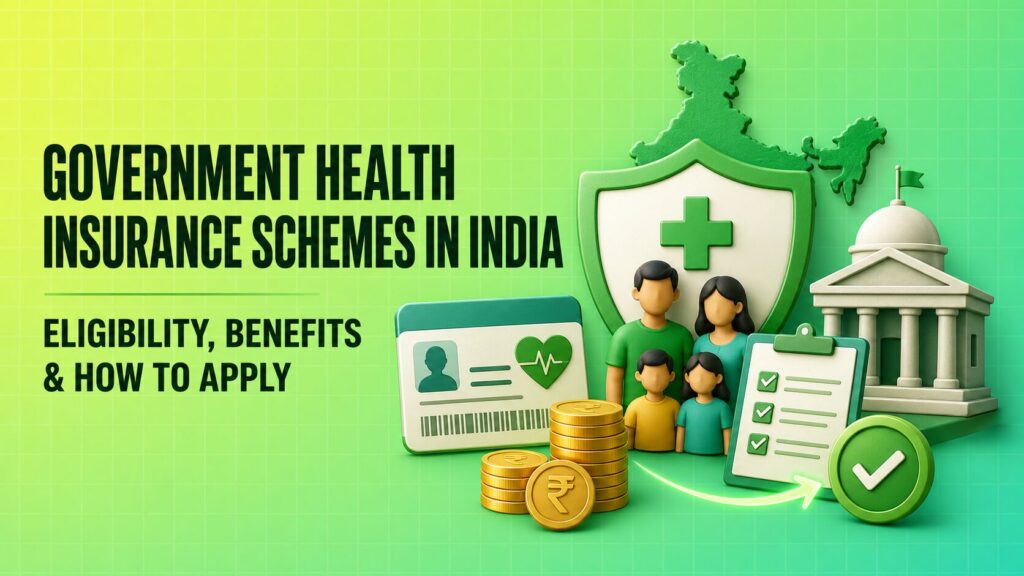
Government health insurance scheme options in India are designed to reduce the stress of hospital bills for families that cannot afford large out-of-pocket medical expenses. These schemes are different from private insurance plans and are usually funded, supported, or run by the government for eligible households.
If you are trying to understand whether you qualify, what treatment is covered, and how to use the benefit without confusion, this guide will help you check the official route before applying.
Understanding Government Health Insurance Schemes in India
The main goal of a government health insurance scheme is to reduce out-of-pocket spending on hospitalization and serious medical treatment. In India, many families still pay a large share of medical costs directly from savings, which can become a burden during an emergency. These schemes aim to make hospital care more accessible and more affordable.
At the central level, the Ministry of Health and Family Welfare supports major health protection programmes, while state governments also run their own schemes based on local needs, budgets, and policy decisions. That is why the scheme names, eligibility rules, and hospital lists can vary from one state to another.
One important point: these schemes are not the same as life insurance, pension schemes, or savings plans. They are meant for medical protection, usually through cashless treatment at listed hospitals or reimbursement in some cases. Always verify details on the official portal before relying on social media posts or informal advice.
Major Government Health Insurance Schemes to Know

There are two broad categories you should know about: central schemes and state-specific schemes. The central schemes cover eligible citizens across India or in many parts of the country, while state schemes are designed and managed by individual state governments.
Ayushman Bharat PM-JAY (Pradhan Mantri Jan Arogya Yojana)
Ayushman Bharat PM-JAY is the best-known government health insurance scheme in India. It is meant to provide cashless hospitalization cover to eligible families at empanelled hospitals. The widely known coverage amount is up to ₹5 lakh per family per year, but readers should always confirm the latest policy terms on the official portal because scheme rules can change.
Under PM-JAY, beneficiaries can get treatment at hospitals that are part of the empanelled network. An empanelled hospital is one that has been approved under the scheme and can provide cashless services if the treatment is covered and eligibility is verified.
For official details, beneficiaries should check the PM-JAY portal and the Ayushman Bharat information available through the National Health Authority and the official PM-JAY website.
State-Specific Health Initiatives
Many states run their own government insurance or health protection programmes. These may work alongside PM-JAY or operate as separate state-funded initiatives. Some states support family health coverage for economically weaker sections, while others extend benefit to selected income groups, workers, or residents with specific documents.
Examples include state-run health schemes such as Aarogyasri in Telangana and Andhra Pradesh, and Mahatma Jyotirao Phule Jan Arogya Yojana in Maharashtra. The exact benefits, hospital network, and coverage rules depend on the state portal and current government notifications.
If you are unsure which scheme applies to you, search for your state health department portal or the official state health scheme website. Do not rely only on third-party websites, because hospital lists and eligibility rules may be outdated.
Eligibility Criteria: Who Can Apply?
Eligibility for a government health insurance scheme is usually targeted rather than universal. Many schemes are designed for low-income or vulnerable families, workers in informal sectors, or households identified through government databases. In some cases, you may qualify automatically if your name appears in the official beneficiary list. In other cases, you may need to apply through the state portal or a Common Service Centre.
The exact criteria can differ by scheme. Some of the common indicators include income level, socio-economic category, family database records, occupation, and state residency. Do not assume that being a ration card holder automatically makes you eligible for every scheme. Likewise, do not assume that a BPL card alone guarantees approval everywhere.
Use the quick-check table below as a starting point, but always confirm on the official portal before applying. These are general indicators only.
| Scheme Name | Target Audience | Primary Benefit | Official Portal |
|---|---|---|---|
| Ayushman Bharat PM-JAY | Eligible low-income and vulnerable families identified through official databases | Cashless hospitalization cover, commonly up to ₹5 lakh per family per year | PM-JAY / National Health Authority official portal |
| RSBY (historical context) | Earlier designed for BPL families and informal workers | Old cashless hospitalization support; largely replaced by newer schemes in many areas | Check only for historical reference; verify current status on official government sources |
| State-specific health schemes | Residents who meet state rules, income criteria, or category-based eligibility | State-funded or subsidized hospital cover, often cashless in empanelled hospitals | Respective state health department or state scheme portal |
If you are checking a family member’s eligibility, keep documents ready such as Aadhaar, ration card, income proof where required, and any state-issued beneficiary details. Some schemes may also verify mobile number, residence, or family ID records.
Benefits and Coverage Details
Most government health insurance scheme benefits focus on hospitalization expenses. This usually means treatment costs that arise when a patient is admitted to a hospital. Commonly covered services may include:
- In-patient hospitalization expenses
- Surgeries and procedures listed under the scheme
- Doctor consultation during hospitalization
- Medicines and consumables used during the approved treatment
- Diagnostic tests linked to the treatment episode
- Room charges as per scheme rules
Some schemes also cover pre-hospitalization and post-hospitalization expenses for a limited period, but the exact number of days and rules depend on the programme. Always check the official scheme guideline before assuming coverage.
There are also common exclusions. Many schemes do not cover routine OPD visits, cosmetic surgery, non-medical items, or treatment that is not included in the approved package list. In some cases, certain consumables, transport, or extra room upgrades may not be covered. This is one reason why reading the scheme’s package list matters before treatment starts.
If you compare government insurance with private health insurance, the main difference is that government schemes are targeted and cashless at specific hospitals, while private policies usually depend on premium payment and policy terms. For many families, the government route works best for major hospitalization expenses, not day-to-day doctor visits.
How to Apply and Get Registered
The application process depends on the scheme and the state. Still, the usual flow is similar across many government health schemes. Follow these steps carefully to avoid wasted time.
- Check eligibility on the official portal. Search your name or family details on the PM-JAY portal or your state’s official scheme portal.
- Visit a Common Service Centre (CSC) if needed. Many beneficiaries use CSCs for assistance with e-KYC, registration, and document verification.
- Go to an empanelled hospital help desk. If the scheme allows hospital-based enrolment or verification, the hospital’s Ayushman desk can guide you.
- Carry identity and family documents. Aadhaar is commonly used, and some schemes may also accept ration card, income certificate, family ID, or state-specific documents.
- Complete the verification process. The official system will check whether your name appears in the beneficiary database and whether your documents match.
- Collect your beneficiary ID or gov health card details. In many cases, the card or e-card is generated after verification and can be used for future treatment.
If you are applying for the first time, make sure your Aadhaar details, mobile number, and family records are updated. Small mismatches in spelling or date of birth can delay verification.
Do not pay any “registration fee” to unofficial agents. Most genuine government health schemes are free or heavily subsidized for eligible beneficiaries. If someone asks for a payment to “activate” the scheme, treat it as a warning sign and verify directly through the official portal or helpline.
The Claim Process: How to Avail Treatment
The claim process under a government health insurance scheme is usually designed to be cashless at the time of hospitalization. Here is the common sequence:
- Visit an empanelled hospital listed under the scheme.
- Show your Ayushman card, beneficiary ID, or other approved identification.
- The hospital help desk checks your eligibility in the official system.
- If the treatment is covered, the pre-authorization or approval process begins.
- After verification, the hospital starts treatment under the scheme rules.
In many cases, the patient does not need to pay upfront for covered services. However, if you choose services outside the package, request treatment at a non-empanelled hospital, or ask for items not covered by the scheme, you may have to pay separately.
Always confirm whether the hospital is empanelled for the exact scheme you want to use. A hospital may be a good hospital, but that does not automatically mean it accepts your specific government scheme.
Common Mistakes to Avoid
Many people face problems not because they are ineligible, but because they miss a simple step. Avoid these common mistakes when using a government health insurance scheme:
- Paying middlemen or agents. Use the official portal, CSC, or hospital help desk instead.
- Assuming every hospital is covered. Cashless treatment usually works only at empanelled hospitals.
- Ignoring Aadhaar or family record mismatches. Small errors in name, age, or mobile number can block verification.
- Expecting OPD coverage. Most schemes focus on hospitalization, not routine outpatient care.
- Skipping official verification. Do not rely on old screenshots, forwarded messages, or unverified websites.
- Forgetting state-specific rules. A scheme in one state may not work the same way in another state.
A practical tip: before visiting a hospital, call the official help line or check the scheme portal to confirm the hospital name, required documents, and current coverage rules. This can save time during a medical emergency.
Government health schemes can be extremely useful when used correctly, but the key is official verification. If you are eligible, use the scheme exactly as directed by the portal or hospital desk, and keep your documents updated so the cashless process does not get delayed.
FAQs
Are these schemes free for everyone?
No. A government health insurance scheme is usually free or heavily subsidized only for eligible beneficiaries. Eligibility depends on the scheme, income category, family database, occupation, or state rules.
Can I use these schemes at private hospitals?
Yes, but only if the private hospital is empanelled under the specific scheme. You must check the official hospital list before treatment.
Do I need to pay a premium?
Usually no premium is required for most major government health schemes for eligible beneficiaries. These programmes are government-funded or subsidized, but you should still verify the latest scheme rules on the official portal.
Is OPD covered under these schemes?
Usually not. Most government health schemes mainly cover hospitalization, surgeries, diagnostics linked to admission, and other approved in-patient expenses.
How can I check if my name is in the beneficiary list?
Check the official PM-JAY portal or your state scheme portal using your Aadhaar, family details, ration card, or other required identifiers. If needed, visit a CSC or empanelled hospital help desk for verification.