What Is a Passport?
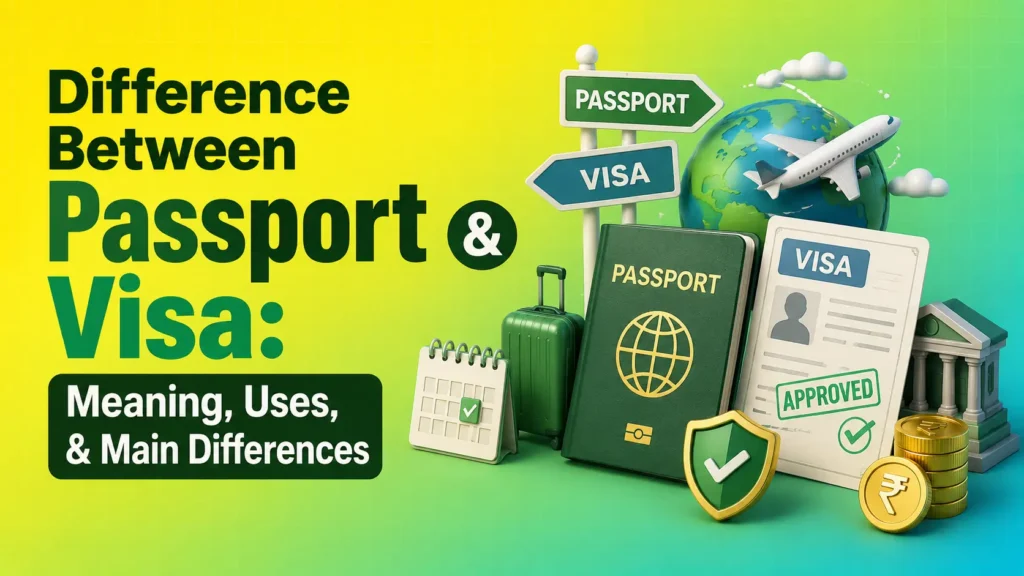
A passport is an official government-issued travel document that confirms a person’s identity and nationality. It allows citizens to travel internationally and return to their home country.
A passport typically contains:
- Full name
- Date of birth
- Photograph
- Nationality
- Passport number
- Date of issue
- Expiry date
- Signature
Without a valid passport, international travel is generally not possible.
Also Read: Best Travel Medical Insurance Plans
Main Purpose of a Passport
A passport is used to:
- Verify your identity
- Confirm your citizenship
- Travel to foreign countries
- Return to your home country
- Apply for visas
What Is a Visa?
A visa is an official authorization issued by a foreign country that allows eligible travelers to enter, stay, study, work, or transit through that country for a specific purpose and duration.
Unlike a passport, a visa does not prove your identity. Instead, it indicates that the destination country has granted permission for travel under certain conditions.
Depending on the country, a visa may be:
- A sticker placed inside your passport
- A digital approval (e-Visa)
- An electronic travel authorization (for countries that use ETA systems)
Also Read: What Is Saving Account vs Current Account? Difference & Benefits
Difference Between Passport and Visa
| Feature | Passport | Visa |
|---|---|---|
| Purpose | Proves identity and nationality | Grants permission to enter another country |
| Issued By | Your country’s government | Government of the destination country |
| Required For | International travel | Entry into countries that require visas |
| Validity | Usually several years | Depends on visa type and country |
| Number of Uses | Can be used for multiple trips until expiry | May be single-entry, double-entry, or multiple-entry |
| Format | Booklet with personal details | Sticker, stamp, or electronic approval |
| Ownership | Belongs to the traveler | Permission issued by another country |
Passport vs Visa: Simple Example
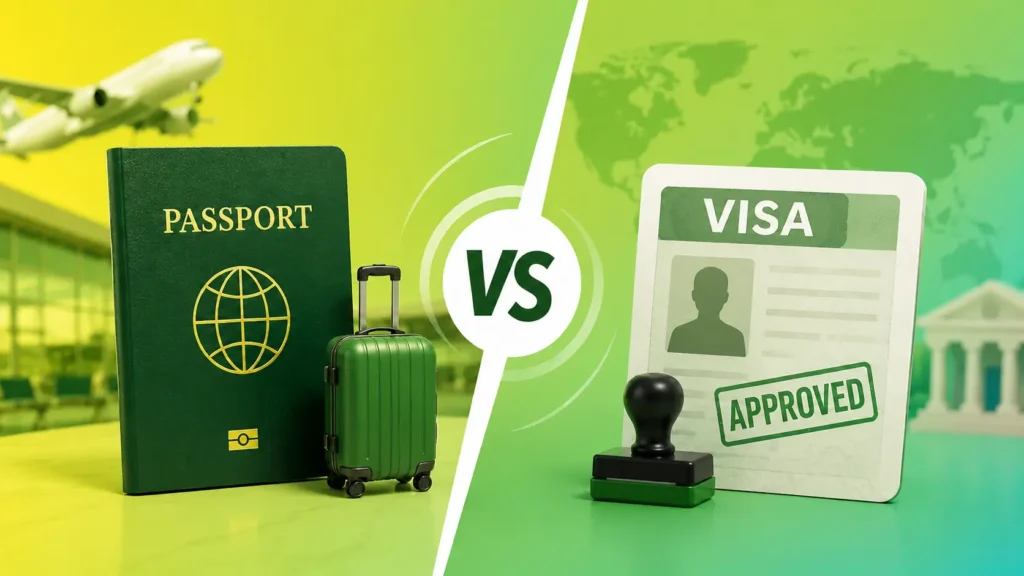
Imagine you are an Indian citizen traveling to Australia.
- Your Indian passport proves that you are an Indian citizen.
- Your Australian visa allows you to legally enter Australia for tourism, study, work, or another approved purpose.
Without a passport, you cannot travel internationally.
Without a required visa, the airline or immigration authorities may refuse your entry even if you have a valid passport.
Types of Passports
Different countries issue different passport categories depending on the traveler’s role.
1. Ordinary Passport
Issued to regular citizens for tourism, family visits, education, or business travel.
2. Diplomatic Passport
Issued to diplomats and senior government officials traveling for official government work.
3. Official or Service Passport
Given to government employees traveling abroad for official assignments.
4. Emergency Passport
Issued in urgent situations when immediate international travel is necessary, subject to the issuing country’s rules.
Types of Visas
Countries issue different visas depending on the purpose of travel.
Tourist Visa
For vacations, sightseeing, and visiting friends or family.
Business Visa
For attending business meetings, conferences, negotiations, or other commercial activities.
Student Visa
For studying at approved educational institutions.
Work Visa
Allows foreign nationals to work legally in another country.
Transit Visa
Issued for travelers passing through a country while traveling to another destination.
Medical Visa
For people seeking medical treatment in another country.
e-Visa
An electronic visa that can often be applied for online without visiting an embassy or consulate, depending on the destination country’s rules.
How to Apply for a Passport
The passport application process varies from country to country, but the basic steps are generally similar.
Step 1: Complete the Application Form
Visit your country’s official passport authority website and fill out the application form with accurate personal information.
Step 2: Submit Required Documents
You may need to provide documents such as:
- Proof of identity
- Proof of address
- Date of birth proof
- Passport-sized photographs
- Any additional documents required by your country’s passport authority
Step 3: Pay the Application Fee
Passport fees depend on the passport type, processing speed, and country.
Step 4: Verification Process
Many countries conduct identity or address verification before issuing a passport.
Step 5: Receive Your Passport
Once approved, your passport is printed and delivered according to the country’s passport issuance process.
How to Apply for a Visa
Unlike a passport, a visa is issued by the country you want to visit.
Although the process differs between countries, it usually includes the following steps.
Choose the Correct Visa Type
Select the visa based on your travel purpose, such as:
- Tourist
- Business
- Student
- Work
- Medical
- Transit
Applying for the wrong visa category may result in delays or rejection.
Complete the Visa Application
Most countries now allow online applications, while some still require paper forms.
Always provide accurate information that matches your passport details.
Submit Supporting Documents
Depending on the visa type, authorities may ask for:
- Valid passport
- Passport-size photographs
- Travel itinerary
- Hotel booking
- Financial documents
- Invitation letter (if applicable)
- Additional documents requested by the destination country
Pay the Visa Fee
Visa fees vary depending on:
- Country
- Visa type
- Processing speed
- Number of entries
Attend an Interview (If Required)
Some countries may ask applicants to attend a visa interview or provide biometric information.
Wait for Processing
Processing time depends on the destination country and visa category.
e-Visa vs Regular Visa
Many travelers now use e-Visas because they simplify the application process.
| e-Visa | Regular Visa |
|---|---|
| Applied online | Often requires embassy or visa center visit |
| Digital approval | Physical visa sticker may be issued |
| Faster in many cases | Processing may take longer |
| Available only for eligible countries | Available for most visa categories |
Remember that not every country offers an e-Visa, and eligibility depends on your nationality and destination.
Visa-Free Travel Explained
Some countries allow citizens of specific nations to enter without obtaining a visa before travel.
This is known as visa-free travel.
In other cases, travelers may receive:
- Visa on Arrival
- Electronic Travel Authorization (ETA)
- e-Visa
Entry rules are based on agreements between countries and may change over time. Always check the latest official immigration requirements before booking international travel.
Common Passport and Visa Mistakes
Many travelers face delays because of avoidable mistakes.
1. Confusing Passport With Visa
A passport proves your identity.
A visa grants permission to enter another country.
They are not the same document.
2. Applying Too Late
Passport renewals and visa approvals can take time.
Apply well before your planned travel date.
3. Ignoring Passport Validity
Many countries require passports to remain valid for several months beyond the planned stay.
Always check the destination country’s passport validity requirement before traveling.
4. Choosing the Wrong Visa Type
Using a tourist visa for work or study is not allowed.
Always apply for the visa that matches your travel purpose.
5. Providing Incorrect Information
Even small errors in names, passport numbers, or dates can delay processing.
Double-check every detail before submitting your application.
Conclusion
Understanding the difference between a passport and a visa is essential for anyone planning an international trip.
A passport identifies you as a citizen of your country, while a visa gives you permission to enter another country under specific conditions.
Although they work together, they serve completely different purposes. Before traveling internationally, always ensure your passport is valid and check whether your destination requires a visa, an e-Visa, Visa on Arrival, or allows visa-free entry.
Being aware of these requirements can help you avoid travel delays and make your international journey smoother.