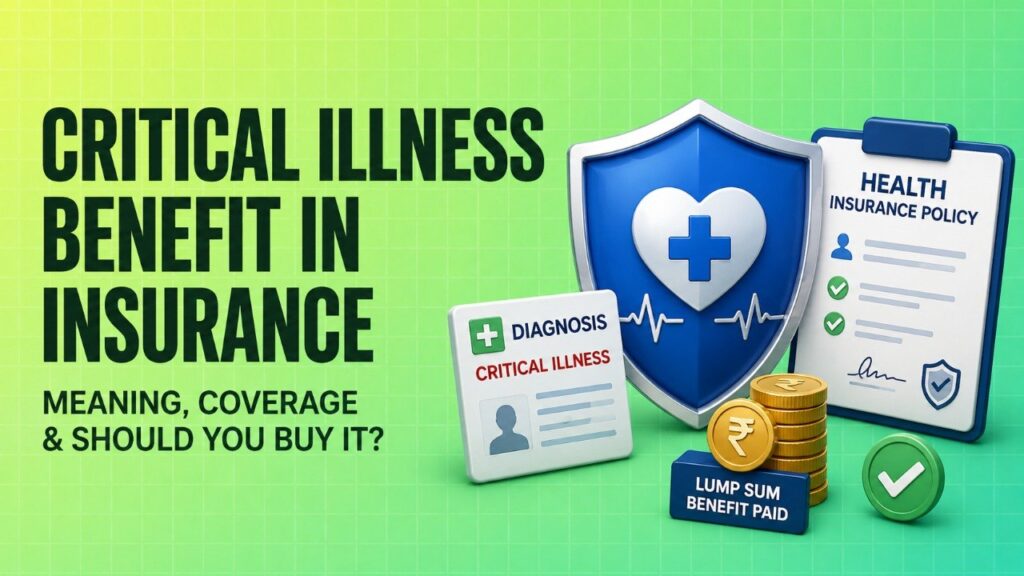
Medical treatment costs in India can rise quickly, but the bigger financial shock from a serious illness is often not the hospital bill alone. A long recovery can affect your income, savings, EMIs, and daily household expenses. That is where critical illness insurance can help as a financial back-up.
Unlike regular health insurance, which mainly pays hospital expenses, a critical illness benefit is designed to pay a lump sum when you are diagnosed with a covered illness. That money can be used in any way you need, whether it is for treatment support, loan payments, home care, or replacing lost income during recovery.
What is Critical Illness Benefit in Insurance?
 A critical illness benefit is a defined-benefit insurance cover. This means the insurer pays a fixed lump sum amount if you are diagnosed with a listed critical illness and meet the policy conditions. The payout does not depend on your actual hospital bill.
This is different from an indemnity cover like standard health insurance, where the insurer reimburses or settles eligible medical expenses up to the sum insured. In a critical illness policy, the trigger is usually the diagnosis of a specified illness, not the amount spent in the hospital.
For example, if your policy covers cancer and pays Rs. 10 lakh on diagnosis, the amount is payable according to the policy terms even if your hospital bill is lower or higher. The exact claim approval will depend on the policy wording, waiting periods, exclusions, and diagnosis definitions mentioned by the insurer.
People often buy critical illness insurance as an add-on to health insurance or as a standalone protection plan. It is meant to reduce the financial stress that can follow a severe medical event, especially when recovery takes months and income falls.
Difference Between Base Health Insurance and Critical Illness Cover
Many buyers assume health insurance is enough for every medical problem. In reality, base health insurance and critical illness cover solve different financial problems. One protects against hospital bills, while the other protects against the wider money impact of a serious diagnosis.
| Feature | Base Health Insurance | Critical Illness Benefit | Why It Matters |
|---|---|---|---|
| Type of cover | Indemnity cover | Benefit cover | Indemnity pays actual eligible expenses; benefit pays a fixed amount |
| Trigger for claim | Hospitalisation or medical treatment | Diagnosis of a covered critical illness | The claim event is different in both products |
| Payment mode | Reimbursement or cashless settlement | Lump-sum payout | The CI amount can be used for any need |
| Main purpose | Pay hospital and treatment bills | Support financial impact after diagnosis | CI helps with non-medical expenses too |
| Coverage style | Broader medical cover for many illnesses and procedures | Only listed critical illness insurance conditions | CI is narrower but more targeted |
| Use of payout | Restricted to eligible medical bills | Flexible use | Useful for EMIs, income gaps, travel, and home care |
Why does this difference matter? Because a serious illness can create costs that health insurance does not fully solve. These may include lost salary, regular household bills, caregiver expenses, nutrition costs, travel to treatment centres, and repayment pressure from loans. A critical illness policy is designed to help with those gaps.
How Does the Payout Help You?
The real value of a critical illness benefit is the flexibility of the lump-sum payout. Once the claim is approved, you can use the money based on your immediate financial needs instead of waiting for reimbursement of bills.
Here are the most practical ways the payout can help:
- Out-of-pocket expenses: Even with health insurance, you may still pay for medicines, diagnostics, follow-up visits, and items not fully covered.
- EMI and debt support: If you have a home loan, personal loan, car loan, or education loan, the lump sum can help you continue repayments during recovery.
- Income replacement: If you cannot work for weeks or months, the payout can bridge salary loss or reduced business income.
- Home care and recovery support: You may need nursing care, physiotherapy, special diet, or home modifications after treatment.
- Travel and accommodation: If treatment is in another city, the payout can support transport, lodging, and food expenses for the patient and family.
Example: Suppose a salaried person is diagnosed with a covered cancer and the policy pays Rs. 15 lakh. The person may use part of it to repay EMIs, part to cover household expenses, and part for post-treatment care. This is different from health insurance, which would mainly handle eligible medical bills under the policy terms.
This is why many Indian families see critical illness insurance as an income-protection tool rather than just a medical bill cover.
Key Terms You Must Understand Before Buying
Before buying a critical illness policy, do not focus only on the premium or the sum insured. The policy wording matters a lot because the claim conditions are usually stricter than in regular health insurance.
What is the Survival Period?
The survival period is the number of days an insured person must survive after the diagnosis of a covered critical illness to become eligible for the claim. In many Indian policies, this is often around 30 days, but the exact period can vary by insurer and policy type.
This means the diagnosis alone may not be enough. The policy may require the insured person to be alive for the specified survival period after diagnosis before the lump-sum benefit is paid. Always verify this in the policy wording because survival period rules can affect claim eligibility.
Example: If a policy has a 30-day survival period and a claimable illness is diagnosed today, the benefit may be payable only if the insured survives those 30 days as defined in the document. This is one of the most important parts of the claim process to understand before purchase.
Common Exclusions to Watch Out For
Every critical illness policy has exclusions. These are situations where the insurer will not pay, or will pay only if specific conditions are met. Reading exclusions carefully is one of the best ways to avoid surprises later.
- Pre-existing diseases: Conditions that existed before the policy started may be excluded initially or for a waiting period.
- Waiting period claims: Some illnesses may not be covered during the initial waiting period after policy purchase.
- Self-inflicted injury or attempted self-harm: This is commonly excluded across many insurance products.
- Alcohol or drug-related conditions: Some policies exclude claims linked to intoxication or substance misuse.
- Specific severity definitions: Some illnesses are covered only if they meet a particular medical stage or severity, such as a certain cancer stage or heart attack definition.
- Minor procedures or non-listed conditions: If the illness is not in the covered critical illness list, the claim will usually not be payable.
Also check whether the policy covers all forms of the illness you are worried about. For example, “cancer” may be covered only if it meets the insurer’s exact definition in the policy document. The wording matters more than the common name of the disease.
Factors to Consider Before Buying a Critical Illness Plan
 A critical illness policy is not for everyone, but it can be very useful for the right buyer. Before choosing one, check these practical factors:
- Family medical history: If certain serious illnesses run in the family, a CI cover may be worth reviewing carefully. This does not mean a claim is guaranteed, but it helps assess your risk awareness.
- Existing debt obligations: If you have EMIs for a home loan, education loan, or business loan, a lump-sum payout can reduce repayment stress during recovery.
- Monthly income dependency: If your family depends heavily on your salary or business income, the income-replacement feature becomes more relevant.
- Age and health stage: Premiums and eligibility can depend on age and medical history. Buying earlier is often easier than waiting until health issues appear.
- Current health cover: If your regular health insurance is small or your employer cover is limited, a critical illness benefit may fill part of the gap.
- Savings buffer: If you already have a strong emergency fund, you may need less CI coverage than someone with low liquid savings.
Also review the list of covered illnesses. A larger list is not always better if the definitions are weak or the exclusions are strict. Compare the policy wording, not just the brochure.
Critical Illness vs. Standard Health Insurance: A Quick Visual Guide
| Point | Critical Illness Benefit | Standard Health Insurance |
|---|---|---|
| What it pays | Fixed lump sum on diagnosis of a covered illness | Eligible hospital and medical expenses |
| Payment purpose | Flexible use for treatment support, income loss, EMIs, and recovery costs | Medical bill reimbursement or cashless settlement |
| Main trigger | Specific diagnosis and policy conditions | Hospitalisation or covered medical treatment |
| Coverage breadth | Only listed critical illnesses | Wider hospital-related medical coverage |
| Common gap filled | Lost income and non-medical expenses | Hospitalisation expenses |
Note: This comparison is for educational purposes. Always refer to your specific policy document for exact coverage terms, exclusions, waiting periods, and claim conditions.
Is Critical Illness Insurance Right for You?
A critical illness policy can be useful, but it should be chosen for the right reason. Think of it as a supplement, not a replacement, for regular health insurance.
Yes, it may suit you if:
- You are the sole or main breadwinner in the family.
- You have financial responsibilities such as home loan EMIs or other debts.
- Your family would struggle if your income stopped for a few months.
- You want a lump-sum buffer for non-medical costs during recovery.
- Your employer health insurance is limited and may not fully protect you if you change jobs.
No, or lower priority, if:
- You already have a strong emergency fund and enough liquid savings to handle months of income loss.
- You are trying to use insurance as an investment or savings product.
- You have very limited budget and still do not have a basic health insurance policy.
- You are depending on it to cover every medical cost, which it will not do.
One practical way to look at it is this: first build adequate health insurance, then consider a critical illness benefit if your income, debt load, or family responsibilities make a lump-sum payout valuable. For many households, the CI cover works best as an added layer of protection.
FAQs
Does critical illness insurance cover all diseases?
No. It covers only the specific list of illnesses mentioned in the policy. The exact definition of each covered critical illness also matters, so read the policy wording carefully.
Do I need a CI plan if I have corporate health insurance?
Often, yes, if you depend on that employer cover for full protection. Corporate health insurance can change when you switch jobs or lose employment, so a separate critical illness benefit can reduce portability risk.
Is the payout taxable?
Tax treatment can vary based on policy structure and current law. In many cases, insurance benefits are treated differently from regular income, but you should verify the latest rules with a tax professional or the Income Tax Department guidance before assuming any tax outcome.
What happens if I don’t use the cover?
Then the policy simply acts as protection. A critical illness policy is not a savings or investment product, so not claiming it does not mean you lose “returns.”
Can I claim both health insurance and CI benefits for the same illness?
Yes, in many cases you can claim both if you meet each policy’s terms. Health insurance may pay hospital bills, while the critical illness benefit may pay the lump sum separately, subject to policy conditions.
Does the claim get rejected if I survive only a few days after diagnosis?
It may, if the policy has a survival period and that condition is not met. Check the exact number of days in the policy document before buying.
Should I read the full policy wording even if the brochure looks simple?
Yes. The brochure gives a summary, but the policy wording controls the actual claim. Read the covered illnesses, exclusions, waiting period, survival period, and claim process before purchase.