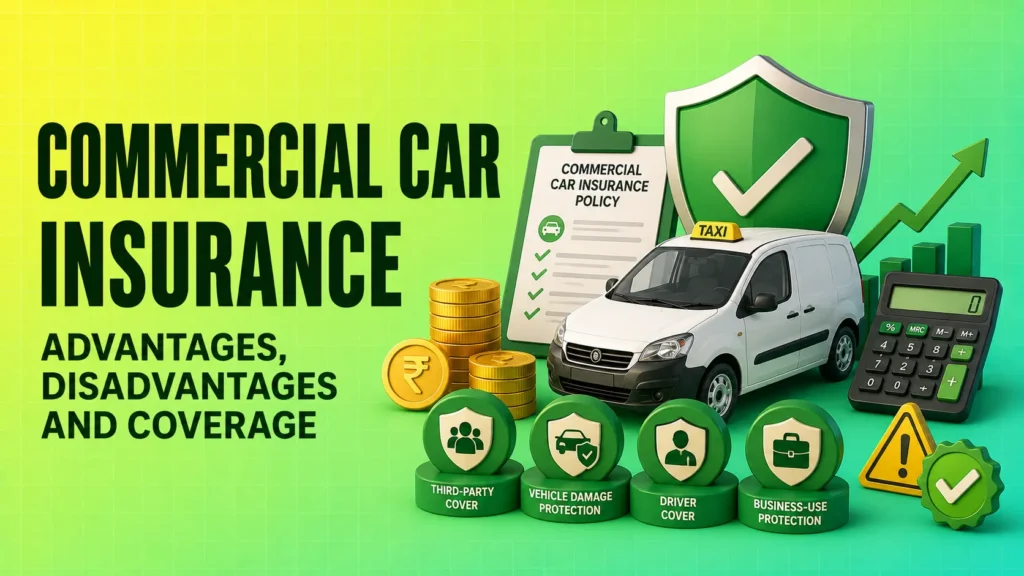
A commercial car is more than a mode of transport—it is often an income-generating business asset. Whether the vehicle is used as a taxi, tourist cab, employee transport car or part of a commercial fleet, an accident, theft or major repair can interrupt operations and create a significant financial loss.
Commercial car insurance is designed for vehicles that are registered or used for business purposes. Depending on the policy selected, it can cover third-party liabilities, accidental damage, theft, natural disasters and certain risks linked to commercial operations.
However, broader protection usually comes with higher premiums, stricter documentation requirements and several policy conditions. Understanding commercial car insurance coverage, exclusions and genuine drawbacks can help vehicle owners choose a policy that protects both the car and the income connected to it.
Who Needs Commercial Car Insurance?

Commercial car insurance is generally suitable for cars used to earn income or support business activities. It may be required for:
- Taxi and cab owners
- App-based cab operators
- Tourist vehicle operators
- Employee transportation providers
- Car-rental businesses
- Companies operating passenger cars for official use
- Fleet owners with multiple commercial passenger cars
- Individuals converting a private car for authorised commercial use
The vehicle’s registration certificate, permit and declared purpose should match its actual use. A privately insured car should not be used for commercial operations without completing the required registration, permit and insurance changes.
Using the wrong policy type may create problems during claim assessment, particularly when the insurer finds that the vehicle was being used for hire, reward or another undeclared commercial purpose.
Types of Commercial Car Insurance
Commercial car owners usually choose between third-party and comprehensive insurance. To understand how these options differ from standalone own-damage cover, read this detailed guide on third-party and comprehensive car insurance.
Third-Party Commercial Car Insurance
A third-party policy mainly covers legal liabilities arising from:
- Injury caused to another person
- Death of a third party
- Damage caused to another person’s property
This policy does not cover accidental damage, theft or fire damage involving the insured commercial car itself.
Third-party insurance may satisfy the minimum legal requirement, but it leaves the vehicle owner responsible for repairing or replacing the insured car after an accident or other loss. Vehicle owners can also review the detailed third-party insurance coverage and claim rules before choosing a policy.
Comprehensive Commercial Car Insurance
A comprehensive policy combines third-party liability coverage with own-damage protection.
Depending on the policy wording, it may cover loss or damage caused by:
- Road accidents
- Fire or explosion
- Theft
- Floods, storms, cyclones and landslides
- Riots, strikes or malicious acts
- Damage during transit
- Total loss or constructive total loss
| Feature | Third-party policy | Comprehensive policy |
|---|---|---|
| Third-party liability | Covered | Covered |
| Damage to insured car | Not covered | Covered as per policy terms |
| Theft | Not covered | Generally covered |
| Natural disaster damage | Not covered | Covered as per policy terms |
| Add-on availability | Limited | Usually available |
| Premium | Lower | Higher |
A comprehensive policy is usually more suitable for newer, financed, high-value or heavily used commercial cars because the financial impact of own damage can be substantial.
What Does Commercial Car Insurance Cover?
The exact commercial car insurance coverage depends on the insurer, policy type, selected endorsements and add-ons.
Damage to the Insured Vehicle
A comprehensive policy may cover the commercial car against:
- Collision and accidental impact
- Fire, lightning or explosion
- Theft or burglary
- Flood, cyclone, storm and landslide
- Riot, strike and malicious damage
- Damage while the car is being transported, where included
The insurer generally settles an admissible claim after deducting depreciation, compulsory deductibles, voluntary deductibles and non-covered repair items.
Third-Party Liability
Third-party coverage protects the policyholder against certain legal liabilities arising from an accident involving the commercial car.
This may include:
- Bodily injury to another person
- Death of a third party
- Damage to third-party property
- Legal defence expenses where admissible
Third-party liability can be particularly important for taxis and passenger transport vehicles because they spend more time on the road and may operate in crowded areas.
Owner-Driver Personal Accident Cover
Eligible owner-drivers may receive personal accident protection according to applicable policy conditions and regulatory requirements.
Coverage can depend on factors such as:
- Ownership of the vehicle
- Valid driving licence
- Nature of the accident
- Existing personal accident cover
- Terms stated in the policy
It should not be assumed that every person driving the vehicle is automatically covered under the owner-driver section.
Add-On Covers
A comprehensive commercial car policy may be customised with add-ons. Availability differs between insurers and vehicle categories.
Common options may include:
- Zero depreciation cover
- Engine protection cover
- Roadside assistance
- Consumables cover
- Tyre protection
- Return-to-invoice cover
- No Claim Bonus protection
- Loss-of-income or downtime allowance
- Paid-driver or employee liability endorsements
Consumables such as engine oil, coolant, nuts, bolts and lubricants may not be paid under a standard claim. This guide explains how consumables cover can reduce some repair-related out-of-pocket costs.
For a newer commercial car, Return to Invoice cover may also be worth examining because it can help reduce the gap between the vehicle’s invoice value and its insured value in eligible theft or total-loss claims.
Commercial vehicle owners should select add-ons according to real operating risks instead of purchasing every available option.
For example, engine protection may be valuable for cars operating in flood-prone areas, while roadside assistance can be more relevant for vehicles covering long routes.
What Is Not Covered?
Policy exclusions should not be confused with the disadvantages of commercial car insurance. Exclusions are situations in which the insurer may not accept the loss.
Common exclusions include:
- Normal wear and tear
- Mechanical or electrical breakdown without an insured event
- Depreciation unless covered through an eligible add-on
- Driving without a valid licence
- Use outside the declared commercial purpose
- Violation of permit conditions
- Carrying passengers beyond the authorised capacity
- Driving under the influence of alcohol or drugs
- Use of the vehicle for illegal activities
- Consequential business loss unless specifically covered
- Damage occurring outside the permitted geographical area
- Fraudulent or staged claims
- Loss caused by war, nuclear risks or other standard exclusions
Claim eligibility can also be affected when the permit, registration, fitness certificate or other required documents have expired.
Policyholders should read the complete policy wording because exclusions can vary according to the insurer, vehicle category and selected endorsements.
Advantages of Commercial Car Insurance
Protects an Income-Generating Asset
A commercial car may generate daily income. When the vehicle is damaged, the owner faces both repair expenses and loss of operations.
Own-damage coverage can reduce the cost of repairing or replacing the vehicle after an admissible event. This is especially valuable for owners who depend on one or two cars for their primary income.
Covers Third-Party Legal Exposure
An accident involving a passenger, pedestrian or another vehicle can result in substantial legal and financial liability.
Commercial car insurance helps manage eligible third-party claims, reducing the risk that the vehicle owner must pay the entire liability personally.
Provides Protection Against Theft and Natural Events
Commercial cars often remain parked at different locations and may operate for long hours. This increases their exposure to theft, fire, floods and other risks.
A comprehensive policy can provide financial protection when the car is stolen or damaged by a covered natural or man-made event.
Supports Business Continuity
Cashless repairs, roadside assistance and certain downtime benefits may help reduce the disruption caused by an accident or breakdown-related incident.
A wide cashless garage network is especially important for taxis and fleet operators because delays directly affect the number of trips the car can complete.
However, lost income is not automatically covered under every policy. A specific downtime or loss-of-income add-on may be required.
Allows Risk-Based Customisation
Commercial car owners can customise coverage according to:
- Vehicle age and value
- Daily operating distance
- Route conditions
- Flood exposure
- Cost of spare parts
- Dependence on the vehicle for income
- Number of authorised drivers
This prevents owners from relying on a standard policy that may not match the actual operating risk.
Helps Manage Fleet Risk
For fleet operators, consistent insurance records can simplify:
- Renewal tracking
- Driver documentation
- Claims monitoring
- Vehicle-wise premium comparison
- Add-on selection
- Cashless repair coordination
Fleet insurance does not automatically guarantee a lower premium, but organised claims and renewal data can support better risk management.
Disadvantages of Commercial Car Insurance
Premiums Can Be Higher
Commercial cars may travel longer distances, remain on the road for more hours and be driven by multiple drivers. These factors can increase the probability of an accident or claim.
As a result, commercial car insurance premiums may be higher than private car insurance premiums for a similar vehicle.
The final cost can also increase when the owner selects multiple add-ons.
The Entire Repair Bill May Not Be Paid
Even under comprehensive insurance, the insurer may not pay the complete workshop invoice.
The policyholder may need to pay:
- Compulsory deductible
- Voluntary deductible
- Depreciation on parts
- Consumables
- Betterment charges
- Repairs unrelated to the insured accident
- Items excluded from the policy
A zero depreciation or consumables add-on may reduce some out-of-pocket expenses, but these covers are subject to limits and eligibility conditions.
Commercial Claims Require More Documents
Commercial car claims may require more documentation than private car claims.
Documents can include:
- Registration certificate
- Driving licence
- Insurance policy
- Commercial permit
- Fitness certificate
- Claim form
- Repair estimate
- Tax receipts where applicable
- FIR in theft, injury or major accident cases
Missing, expired or inconsistent documents can delay claim processing or affect claim admissibility.
Policy Conditions Can Be Restrictive
Commercial car insurance is issued according to the declared use of the vehicle.
Coverage may be affected when the vehicle:
- Operates outside its authorised permit
- Carries excess passengers
- Is driven by an unauthorised driver
- Is used for an undeclared activity
- Travels outside the policy’s geographical limits
- Violates route or fitness conditions
Business owners must therefore maintain both insurance compliance and transport-related documentation.
Claims May Affect Renewal Benefits
An own-damage claim may reduce or remove the applicable No Claim Bonus at renewal.
Repeated claims can also influence future premiums, deductibles or underwriting decisions. A small claim should therefore be evaluated against the repair cost, deductible and potential loss of renewal benefits.
This does not mean genuine claims should be avoided. The decision should be based on the financial impact rather than the number of claims alone.
Business Downtime May Remain Uncovered
Standard commercial car insurance primarily covers insured vehicle damage and third-party liability.
It may not automatically compensate for:
- Missed bookings
- Lost daily fares
- Driver salary during repairs
- Loan instalments
- Replacement vehicle expenses
- Business reputation loss
Some insurers may offer downtime or loss-of-income protection, but these benefits can have waiting periods, per-day limits and maximum claim durations.
Commercial Car Insurance vs Private Car Insurance
| Basis | Commercial car insurance | Private car insurance |
|---|---|---|
| Intended use | Business, passenger transport or hire and reward | Personal and family use |
| Common vehicle type | Taxi, tourist car or eligible business-use car | Privately registered car |
| Usage frequency | Generally higher | Usually lower |
| Driver exposure | May involve paid or multiple drivers | Mainly owner and permitted drivers |
| Permit requirement | Commercial permits may be required | Commercial permit not normally required |
| Premium calculation | Includes commercial operating risk | Based on private usage risk |
| Business downtime | Important consideration | Usually less relevant |
| Policy suitability | Designed for declared commercial use | Not suitable for unauthorised commercial use |
The key difference is not simply the premium. The policy must match the registration and actual use of the car.
Using private car insurance for a taxi or another commercial operation may result in serious claim complications.
Factors That Affect the Premium

The commercial car insurance premium is calculated using several risk factors.
These may include:
- Make and model of the car
- Vehicle age
- Insured Declared Value
- Registration location
- Passenger-carrying capacity
- Commercial usage pattern
- Operating route
- Claim history
- Policy type
- Selected add-ons
- Deductible amount
- Anti-theft devices
- Number and profile of drivers
- Fleet size
- Applicable third-party premium
A lower quote is not automatically the best option. It may come with a lower IDV, higher deductible, restricted garage network or fewer useful add-ons.
Quotes should be compared on equal coverage terms.
How to Choose the Right Policy
Before buying commercial car insurance in India, check the following:
- Confirm that the vehicle’s registration and permit match its actual use.
- Decide whether basic third-party coverage is sufficient or comprehensive protection is needed.
- Compare the IDV offered by different insurers.
- Review exclusions specific to taxis and commercial passenger cars.
- Check the cashless garage network on your regular operating routes.
- Confirm coverage for paid drivers and employees.
- Compare deductibles, depreciation rules and non-payable items.
- Select add-ons based on operating risks.
- Review claim-notification requirements.
- Check documentation needed for accidents, theft and third-party claims.
- Read the policy wording instead of relying only on a sales summary.
- Compare premiums only after matching the coverage and IDV.
You can also use this guide to compare vehicle insurance companies based on claim support, cashless garages, available add-ons and policy exclusions rather than premium alone.
Owners of multiple vehicles should also review fleet-level claim records and renewal dates to avoid accidental policy lapses.
How to File a Commercial Car Insurance Claim
The claim process generally involves the following steps:
- Inform the insurer immediately after the incident.
- Arrange emergency or medical assistance where necessary.
- Take photographs and videos of the car, accident location and third-party damage.
- Record the details of the other vehicle and involved persons.
- Contact the police and obtain an FIR where required.
- Submit the driving licence, RC, permit and policy documents.
- Move the car to an authorised or cashless garage.
- Allow the insurer’s surveyor to inspect the damage.
- Begin repairs only after following the insurer’s approval process.
- Pay the deductible and non-covered repair expenses.
- Keep the claim settlement and repair records for future reference.
Repairs completed before surveyor inspection may create difficulties unless emergency repairs were necessary and properly documented.
Common Reasons for Claim Rejection
A commercial car insurance claim may be rejected or reduced because of:
- An invalid or inappropriate driving licence
- Expired permit or fitness certificate
- Policy lapse at the time of the accident
- Undeclared commercial use
- Passenger overloading
- Drunk driving
- Delayed claim notification
- Repairs completed before inspection
- Incorrect or false information
- Use outside authorised conditions
- Loss falling under a policy exclusion
- Mismatch between documents and actual vehicle use
Owners should keep vehicle, driver and permit documents updated throughout the policy period, not only at renewal.
Is Commercial Car Insurance Worth It?
Commercial car insurance is generally valuable when the vehicle is closely linked to business income.
Third-party insurance addresses mandatory legal liabilities, while comprehensive coverage can protect the vehicle against accidents, theft and covered natural events.
Comprehensive protection may be particularly useful when:
- The car is new or financed
- Repair costs are high
- The vehicle travels long distances
- The owner depends on the car for daily income
- The vehicle operates in flood-prone or high-traffic areas
- Replacing the car would create financial pressure
The disadvantages—higher premiums, deductibles, documentation and policy restrictions—should be compared with the potential cost of repairing or replacing the vehicle without insurance.
The right policy is not necessarily the one with the lowest premium. It is the one that matches the commercial use of the car and provides meaningful protection against the owner’s most significant financial risks.
Conclusion
Commercial car insurance protects passenger cars used for business, taxi services, employee transport and other authorised commercial purposes.
Its main advantages include third-party liability protection, own-damage coverage, theft protection and support for business continuity. Its disadvantages include higher premiums, deductibles, stricter documentation and limited coverage for business downtime.
Before buying a policy, compare the IDV, cashless garage network, commercial-use exclusions, driver coverage and claim requirements. A suitable policy should protect both the vehicle and the income it helps generate.
FAQs
Can I use private car insurance for a taxi?
No. A private car policy is designed for personal use. A vehicle operated as a taxi or for hire and reward generally requires appropriate commercial registration, permits and commercial car insurance. Using an unsuitable private policy may create problems during claim settlement.
Is comprehensive commercial car insurance mandatory?
Third-party insurance is mandatory for vehicles used on public roads. Comprehensive insurance is generally optional, but it provides wider protection by covering eligible damage to the insured commercial car in addition to third-party liability.
Does commercial car insurance cover passenger injuries?
Passenger-related liability depends on the policy, vehicle category and applicable endorsements. Commercial passenger vehicle owners should verify whether passenger liability is included and whether any additional premium or endorsement is required.
Can commercial car insurance cover loss of daily income?
A standard policy may not automatically cover lost fares or business income. Some insurers may offer downtime or loss-of-income cover as an add-on. Such covers normally have daily limits, waiting periods and a maximum payment period.
Is a paid driver covered under commercial car insurance?
Coverage for a paid driver may require a specific endorsement and additional premium. The driver must also hold a valid licence suitable for the vehicle and comply with the policy and permit conditions.
What documents are required to buy commercial car insurance?
Commonly requested documents include the vehicle registration certificate, previous insurance policy, permit, fitness certificate, vehicle details and identity documents of the owner. Requirements may vary by insurer and vehicle category.