A car starts losing value almost as soon as it leaves the showroom. This fall in value is called depreciation. For regular accident repairs, this may not feel like a big issue. But if your car is stolen or damaged so badly that it cannot be repaired economically, depreciation can create a large financial gap.
This is where many car owners ask: what is return to invoice in car insurance and is it worth paying extra for? Return to Invoice, commonly called RTI, is a car insurance add-on that helps you recover an amount closer to the original invoice value of your car in case of theft or total loss. It is especially useful for new cars because the gap between the invoice value and the insured value can be significant in the first few years.
RTI is not a default feature of every car insurance policy. It is an optional add-on available with comprehensive car insurance or own damage car insurance, subject to the insurer’s rules. It increases your premium, but it can reduce your out-of-pocket loss in a severe claim situation.
As with any insurance add-on, you should read the policy wording carefully. Motor insurance products in India are regulated under the IRDAI framework, but exact coverage, eligibility, premium, and claim rules vary from insurer to insurer.
What is Return to Invoice (RTI) in Car Insurance?
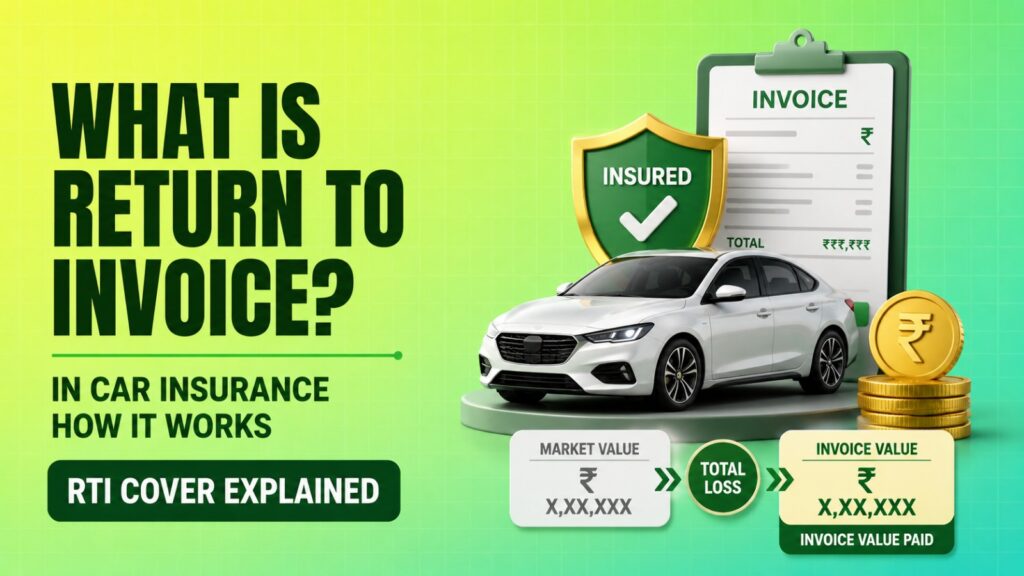
Return to Invoice in car insurance is an optional add-on cover that pays the invoice value of your car if the vehicle is stolen or declared a total loss. In simple words, it helps bridge the gap between the car’s depreciated insurance value and the original amount paid at the time of purchase.
In a standard comprehensive car insurance policy, the insurer usually settles a total loss or theft claim based on the car’s IDV, or Insured Declared Value. IDV is the estimated current market value of the car after depreciation. It is usually lower than the original invoice value.
With the RTI add-on, the payout may include components such as:
- Ex-showroom price of the car
- Registration charges
- Road tax
- Other invoice-related costs, if covered by the insurer’s policy wording
This means the claim payout can be higher than a standard IDV-based claim. However, RTI does not apply to every type of claim. It is meant only for extreme situations such as theft, total loss, or constructive total loss. It will not pay extra for a small dent, bumper repair, broken mirror, or minor accident.
Understanding IDV vs. Invoice Value
To understand RTI properly, you need to understand the difference between IDV and invoice value.
IDV stands for Insured Declared Value. It is the maximum sum insured under your car’s own damage cover. It represents the approximate current market value of the car after depreciation. Insurers use the IDV to calculate the premium and to settle total loss or theft claims under a standard policy.
Invoice value is the value shown in the original purchase invoice of the car. It usually includes the ex-showroom price and may include taxes and registration-related charges, depending on how the insurer defines RTI coverage in the policy document.
For example, suppose you bought a car for an on-road cost of Rs. 10 lakh. After one year, the IDV may reduce to around Rs. 8.5 lakh or Rs. 9 lakh, depending on the insurer’s depreciation grid and policy terms. If the car is stolen, a standard policy may settle the claim close to the IDV. With RTI, the insurer may pay an amount closer to the original invoice value, subject to deductibles, exclusions, and claim approval.
This distinction matters because many car owners assume their insurance will pay the full purchase price of the car in every major claim. That is not how a standard motor policy works. Without RTI, the insurer generally pays according to the depreciated IDV, not the original invoice price.
When Does the Return to Invoice Add-on Apply?
The Return to Invoice add-on applies only in limited and serious claim situations. It is not meant for routine repairs or partial damage claims.
RTI usually applies in the following cases:
- Theft of the vehicle: If your car is stolen and is not recovered after the required police and insurer process, the insurer may treat it as a total loss claim.
- Total loss: If the car is damaged beyond reasonable repair, it may be declared a total loss.
- Constructive total loss: This generally means the estimated repair cost is more than a specified percentage of the car’s IDV. In Indian motor insurance, constructive total loss is commonly linked to repair cost exceeding 75% of the IDV, but you should verify the exact wording in your policy.
Here is a simple way to understand it. If your car has a minor accident and the repair bill is Rs. 40,000, RTI will not increase your claim payout. Your normal own damage cover, along with any relevant add-ons such as zero depreciation, may apply based on policy terms.
But if the car is completely destroyed in a major accident or stolen and not recovered, RTI can make a meaningful difference. In such cases, the insurer does not repair the car. Instead, it settles the claim financially. RTI helps the settlement move closer to the invoice value rather than only the depreciated IDV.
Always check the insurer’s definition of theft, total loss, and constructive total loss. Claim settlement depends on surveyor assessment, policy wording, required documents, police reports in theft cases, and compliance with claim rules.
How Does RTI Change Your Claim Payout? (Comparison Table)
The easiest way to understand RTI is through a practical example. The figures below are only for illustration. Actual claim settlement depends on your insurer’s assessment, policy terms, deductibles, exclusions, and documents.
| Claim Component | Standard Policy Without RTI | Policy With RTI Add-on |
|---|---|---|
| Original ex-showroom price | Not fully considered for payout after depreciation | May be considered as part of invoice value |
| Road tax | Usually not paid separately in a standard IDV claim | May be covered if included in RTI wording |
| Registration charges | Usually not paid separately in a standard IDV claim | May be covered if included in RTI wording |
| Claim base | IDV, which is depreciated value | Invoice value or defined RTI value, as per policy |
| Suitable claim type | Theft, total loss, or constructive total loss | Theft, total loss, or constructive total loss |
| Example payout idea | If IDV is Rs. 8.8 lakh, payout may be around IDV after deductions | If invoice value is Rs. 10 lakh, payout may be closer to Rs. 10 lakh after terms and deductions |
This is a simplified illustration. Actual claim settlement depends on specific policy terms, insurer assessment, applicable deductibles, and exclusions.
Let us take a more detailed example. Suppose you purchased a new car at an on-road cost of Rs. 10 lakh. This includes an ex-showroom price of Rs. 8.7 lakh, road tax of Rs. 80,000, registration charges of Rs. 20,000, and other charges. After one year, assume the IDV is Rs. 8.6 lakh.
If the car is stolen and not recovered, a standard comprehensive policy may settle the claim near Rs. 8.6 lakh, after applicable deductions. You may still face a gap of around Rs. 1.4 lakh compared with your original on-road cost.
If you had an RTI add-on, the insurer may pay an amount closer to the invoice value or defined RTI value, depending on policy wording. This can reduce the financial gap when you need to buy another car.
The key point is simple: standard insurance focuses on current market value, while RTI focuses on the original invoice-linked value in total loss or theft cases.
Who Should Opt for the Return to Invoice Add-on?
RTI is not compulsory for every car owner. It is an add-on, so you pay an extra premium for it. Whether it is useful depends on your car’s age, risk exposure, budget, and comfort with financial loss in a worst-case situation.
You may consider the Return to Invoice add-on if:
- You have a new car: RTI is most useful for cars that are new or relatively new, usually within the first 3 to 5 years, depending on insurer rules.
- Your car has high on-road costs: If road tax, registration, and other charges are high, the gap between IDV and invoice value may be larger.
- You live in an area with higher theft risk: If your parking situation is open, unsecured, or in a theft-prone area, RTI may give added financial comfort.
- You have taken a car loan: If the car is stolen or declared a total loss, you may still have a loan outstanding. RTI can help reduce the gap, though it should not be treated as loan insurance.
- You want stronger protection against severe loss: If you do not want a large difference between the car’s purchase cost and claim payout in a total loss situation, RTI can be useful.
However, RTI may not be necessary for everyone. If your car is old, if the insurer does not offer RTI for your vehicle age, or if the extra premium does not fit your budget, you may choose to skip it. Compare the premium difference and the possible benefit before buying.
A practical approach is to check the IDV, original invoice value, RTI premium, and your vehicle’s age. If the gap between IDV and invoice value is meaningful, RTI may offer better value. If the gap is small, the benefit may be limited.
Limitations and Exclusions to Keep in Mind
Return to Invoice is useful, but it has clear limitations. It should not be seen as a cover for every type of vehicle-related loss.
Important limitations and exclusions usually include:
- Not available for very old cars: Most insurers offer RTI only for new or relatively new cars, often up to 3 to 5 years. The exact limit varies by insurer.
- Extra premium applies: RTI is an add-on. It increases your total car insurance premium.
- Not for partial loss claims: RTI does not apply to minor accidents, scratches, dents, glass damage, tyre damage, or regular repairs unless the vehicle is treated as total loss or constructive total loss.
- Policy wording controls the payout: Some insurers may include road tax and registration charges, while others may define the payout differently.
- Deductibles may apply: Compulsory deductibles and other applicable deductions may reduce the final payout.
- Accessories may not be covered: Non-standard accessories or items not included in the insured invoice may not be covered unless separately declared and insured.
- Personal belongings are not covered: Items such as laptops, bags, mobile phones, sunglasses, or documents inside the car are not covered under RTI.
- Wear and tear is not covered: RTI does not pay for normal wear and tear, ageing, mechanical breakdown, or depreciation of daily-use parts in normal repair claims.
You should also avoid common mistakes. Do not assume RTI and zero depreciation are the same. Do not assume the insurer will automatically pay the full on-road price without conditions. Do not delay theft reporting, because insurers usually require prompt intimation, a police FIR, and other documents.
Before buying RTI, check the policy schedule and wording for eligibility, covered components, vehicle age limit, claim process, deductibles, and exclusions. Rates, eligibility, and policy terms vary by insurer and can change over time.
Helpful Interactive Table: RTI vs. Standard Insurance
The table below gives a clear feature-wise comparison between a standard car insurance policy and a policy with the RTI add-on.
| Feature | Standard Car Insurance | Car Insurance With RTI Add-on |
|---|---|---|
| Coverage purpose | Covers own damage claims based on policy terms and IDV | Adds invoice-value protection for theft or total loss |
| Payout calculation in total loss | Usually based on IDV | Usually based on invoice value or RTI-defined value |
| Depreciation impact | Depreciation reduces IDV and claim value | Helps reduce the gap between IDV and invoice value |
| Premium impact | Lower than a policy with multiple add-ons | Higher because RTI is an extra paid add-on |
| Eligibility | Available for a wide range of vehicles, subject to insurer rules | Usually available only for newer cars, commonly up to 3 to 5 years |
| Applies to minor repairs | Yes, if covered under own damage terms | No extra RTI benefit for minor or partial damage |
| Applies to theft | Yes, claim usually based on IDV | Yes, claim may be closer to invoice value |
| Applies to constructive total loss | Yes, claim usually based on IDV | Yes, RTI may increase payout as per wording |
| Best suited for | Car owners who want basic own damage protection | New car owners who want stronger protection against severe financial loss |
This comparison is for understanding only. Always refer to the insurer’s official policy wording and schedule before purchasing or renewing a policy.
In practical terms, RTI is most valuable when the financial gap is large. For a brand-new car, the difference between invoice value and IDV can feel painful in a theft or total loss claim. For an older car, the insurer may not offer RTI, or the benefit may not justify the extra premium.
If you are comparing car insurance quotes, do not look only at the final premium. Check what each quote includes. A cheaper policy without important add-ons may not give the same protection as a slightly higher-priced policy with RTI, zero depreciation, engine protection, or other relevant covers. At the same time, do not buy every add-on blindly. Choose based on your car, usage, location, and budget.
Also remember that insurance claim approval is never automatic. It depends on policy validity, timely premium payment, correct disclosures, claim documents, surveyor assessment, exclusions, and insurer rules. Read the policy wording before making a decision.
FAQs
Is Return to Invoice mandatory in India?
No, Return to Invoice is not mandatory in India. It is an optional add-on that you can buy with a comprehensive car insurance policy or own damage policy, subject to insurer eligibility rules. Third-party car insurance is mandatory by law, but RTI is not.
Does RTI cover the loss of my personal belongings inside the car?
No, RTI does not cover personal belongings kept inside the car. Items such as laptops, mobile phones, bags, documents, cash, or accessories not insured under the policy are generally not covered by the Return to Invoice add-on.
Can I buy RTI for a 7-year-old car?
Usually, no. Most insurers offer RTI only for new or relatively new cars, commonly up to 3 to 5 years old. The exact eligibility limit depends on the insurer, vehicle type, and policy terms, so check before buying or renewing.
Is RTI the same as Zero Depreciation cover?
No, RTI and Zero Depreciation are different add-ons. Zero Depreciation helps reduce depreciation deductions on parts during repair claims. RTI applies mainly when the car is stolen or declared a total loss, and it helps bridge the gap between IDV and invoice value.
If I lose my car keys, does RTI cover it?
No, RTI does not cover lost car keys. Key loss is usually covered, if at all, under a separate key replacement add-on. RTI applies only in major cases such as theft of the vehicle, total loss, or constructive total loss as defined in the policy.
Bottom line: Return to Invoice can be a valuable add-on for new car owners who want better financial protection in case of theft or total loss. But it is not a substitute for reading your policy carefully. Check the IDV, invoice value, vehicle age limit, premium difference, exclusions, and insurer claim rules before you decide.