What Is Active Investing?
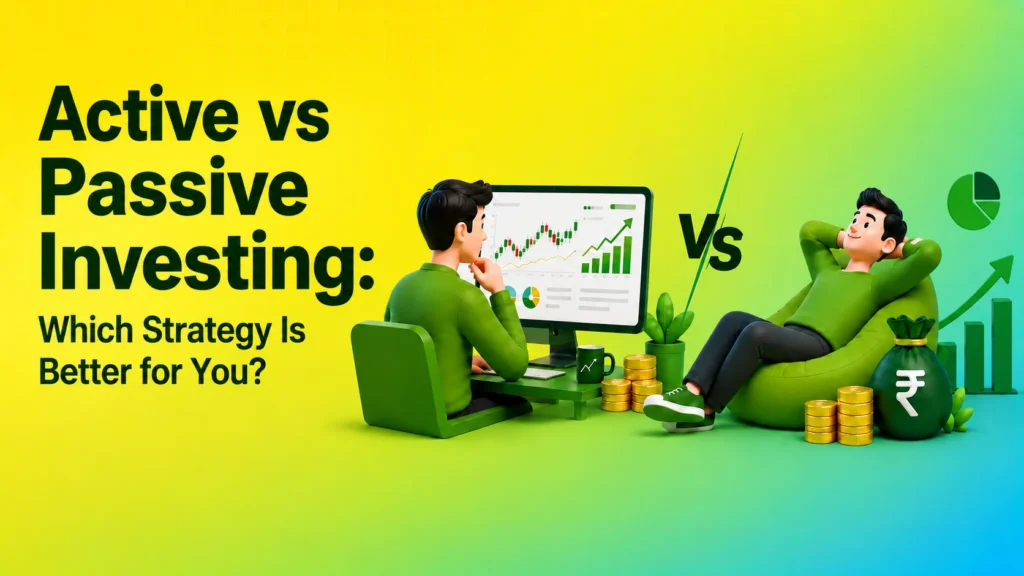
Active Investing is an investment strategy where professional fund managers—or individual investors—actively buy and sell securities with the goal of outperforming the market.
Instead of simply following an index like the Nifty 50 or S&P 500, active managers analyze:
- Company financial statements
- Industry trends
- Economic conditions
- Interest rate changes
- Corporate earnings
- Market opportunities
Based on this research, they decide which investments to buy, hold, or sell.
Example
Suppose an active fund manager believes that technology stocks will perform better than the overall market over the next year.
The manager may increase investments in technology companies while reducing exposure to slower-growing sectors.
The objective is to generate returns that exceed the benchmark index.
How Does Active Investing Work?
Active investing involves continuous decision-making.
Professional fund managers regularly:
- Research companies
- Analyze financial reports
- Monitor economic news
- Review market movements
- Adjust portfolio allocations
- Buy or sell investments based on changing conditions
Because of this hands-on management, actively managed funds usually have higher operating costs than passive funds.
Key Features of Active Investing
- Professional portfolio management
- Continuous market research
- Frequent buying and selling
- Flexibility to respond to market changes
- Goal of outperforming benchmark indices
- Higher expense ratios
- Potential for higher returns—but also greater risk
What Is Passive Investing?
Passive Investing is a long-term investment strategy that aims to match the performance of a market index rather than beat it.
Instead of selecting individual stocks, passive funds invest in the same companies that make up a chosen index.
Popular benchmark indices include:
- Nifty 50
- Sensex
- Nifty Next 50
- S&P 500
- Nasdaq-100
If the index changes, the fund adjusts its holdings accordingly.
Read Also: What Is Passive Income?
Key Features of Passive Investing
- Tracks a benchmark index
- Minimal buying and selling
- Lower management costs
- Broad diversification
- Long-term investment approach
- Lower portfolio turnover
- Reduced emotional decision-making
Active vs Passive Investing: Quick Comparison
| Feature | Active Investing | Passive Investing |
|---|---|---|
| Investment Goal | Beat the market | Match the market |
| Management Style | Actively managed | Index-based |
| Decision Making | Fund Manager | Tracks an Index |
| Trading Frequency | High | Low |
| Expense Ratio | Usually Higher | Usually Lower |
| Portfolio Changes | Frequent | Limited |
| Research Required | Extensive | Minimal |
| Suitable For | Investors seeking market outperformance | Long-term investors focused on simplicity and cost efficiency |
Which Strategy Should You Choose?
There is no one-size-fits-all answer.
The right choice depends on:
- Your investment goals
- Your risk tolerance
- Investment horizon
- Cost preferences
- Time available to manage investments
- Confidence in active management versus index investing
Active vs Passive Investing: Key Differences
| Feature | Active Investing | Passive Investing |
|---|---|---|
| Investment Objective | Beat the market | Match the market |
| Management | Professional fund manager | Tracks a benchmark index |
| Decision Making | Human decisions | Rule-based investing |
| Research | Extensive research | Minimal research |
| Portfolio Changes | Frequent | Limited |
| Trading Activity | High | Low |
| Expense Ratio | Higher | Lower |
| Risk Level | Moderate to High | Moderate |
| Tax Efficiency | Usually Lower | Generally Higher |
| Long-Term Approach | Depends on strategy | Strong long-term focus |
1.Investment Objective
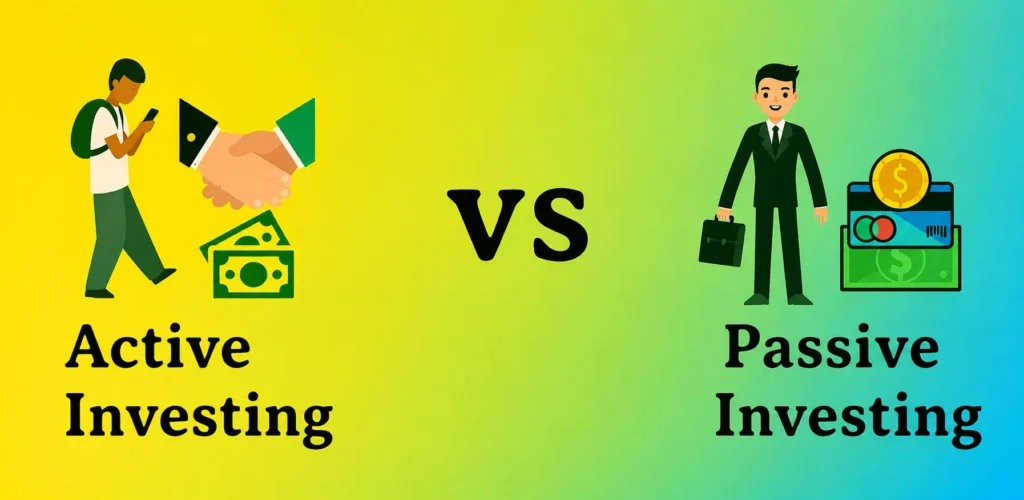
The biggest difference lies in the goal of each strategy.
Active Investing
The objective is to generate returns higher than the benchmark index. Fund managers continuously search for opportunities that they believe can outperform the market.
Passive Investing
The goal is not to beat the market but to replicate the performance of an index as closely as possible.
Example
If the Nifty 50 delivers a 14% annual return, a Nifty 50 Index Fund aims to achieve a similar return, after accounting for expenses and tracking differences.
2.Portfolio Management Style
Active Investing
Professional fund managers monitor the portfolio daily.
They may:
- Buy new stocks
- Sell underperforming holdings
- Increase sector allocation
- Reduce exposure to risky industries
Portfolio changes happen whenever the manager identifies new opportunities or risks.
Passive Investing
Passive funds follow predefined rules.
Changes generally occur only when the benchmark index changes, making the strategy more predictable and less dependent on individual decisions.
3.Cost of Investing
Investment cost is one of the most important factors because it directly affects your long-term returns.
Active Investing
Since fund managers conduct research, company visits, financial analysis, and regular portfolio reviews, actively managed funds typically have higher expense ratios.
These costs cover:
- Research teams
- Portfolio managers
- Trading expenses
- Operational management
Passive Investing
Passive funds simply track an index.
As a result:
- Research costs are lower.
- Trading activity is limited.
- Expense ratios are generally lower.
Lower costs allow a larger portion of your investment returns to remain invested over time.
4. Risk Level
Every investment carries some level of risk.
Active Investing
Potential risks include:
- Incorrect stock selection
- Poor market timing
- Manager underperformance
- Higher portfolio turnover
Although active managers aim to outperform the market, there is no guarantee they will do so consistently.
Read Also: ETF and Mutual Fund
Passive Investing
Passive investing still carries market risk because the portfolio moves with the benchmark index.
However, broad diversification across many companies may reduce company-specific risk compared to holding only a few individual stocks.
5. Diversification
Diversification means spreading investments across different companies or sectors.
Active Investing
The level of diversification depends on the fund manager’s investment strategy.
Some active funds may concentrate on a smaller number of high-conviction investments.
Passive Investing
Index funds automatically provide diversification because they invest in all or most of the companies included in the benchmark index.
6. Time Commitment
Active Investing
Suitable for investors who:
- Follow market news.
- Analyze financial reports.
- Monitor company performance.
- Review portfolios regularly.
Active investing requires more involvement.
Passive Investing
Ideal for investors who prefer a simple approach.
Once invested, the portfolio usually requires only periodic reviews and rebalancing based on personal financial goals.
7. Historical Performance
This is one of the most frequently asked questions by investors.
Can Active Investing Beat Passive Investing?
Yes, some actively managed funds outperform their benchmark over certain periods.
However, consistently outperforming the market over many years is challenging.
Performance depends on:
- Fund manager’s decisions
- Market conditions
- Investment style
- Costs
- Risk management
Does Passive Investing Always Win?
Not necessarily.
Passive investing is designed to mirror the market, not outperform it.
Its strength lies in:
- Lower costs
- Broad diversification
- Long-term consistency
- Simplicity
Advantages of Active Investing
Active investing may be suitable if you:
- Want professional portfolio management.
- Believe skilled managers can identify market opportunities.
- Are comfortable with higher costs in exchange for the possibility of higher returns.
- Prefer flexible investment decisions during changing market conditions.
Disadvantages of Active Investing
Consider these potential drawbacks:
- Higher expense ratios.
- No guarantee of outperforming the benchmark.
- Greater dependence on the fund manager’s expertise.
- Higher portfolio turnover.
- Potentially less tax-efficient due to more frequent trading.
Advantages of Passive Investing
Passive investing offers several benefits:
- Lower investment costs.
- Broad diversification.
- Simpler investment strategy.
- Minimal day-to-day management.
- Suitable for long-term wealth creation.
- Lower portfolio turnover.
Disadvantages of Passive Investing
Passive investing also has limitations:
- It cannot outperform the benchmark index by design.
- Returns move with the overall market.
- Limited flexibility during market downturns.
- Less opportunity to capitalize on short-term market trends.
Active vs Passive Investing: Which Strategy Is Better?
There is no universal winner. The better strategy depends on your financial goals, investment horizon, risk tolerance, and how involved you want to be in managing your investments.
Here’s a simple breakdown.
Choose Active Investing If You:
- Want the potential to outperform the market.
- Are comfortable taking higher investment risk.
- Prefer professional fund management.
- Can accept that returns may vary from year to year.
- Are willing to pay higher management fees for active decision-making.
Active investing may suit investors who believe skilled fund managers can identify opportunities that the broader market may miss.
Choose Passive Investing If You:
- Prefer a low-cost investment strategy.
- Want to build wealth over the long term.
- Don’t have time to monitor markets regularly.
- Value diversification and consistency.
- Want an investment approach that’s simple and disciplined.
Passive investing is often chosen by investors who believe that staying invested over many years can be more important than trying to time the market.
Factors to Consider Before Choosing an Investment Strategy
Before investing, ask yourself these questions:
1. What is your investment goal?
Examples include:
- Retirement planning
- Buying a house
- Children’s education
- Wealth creation
- Financial independence
Different goals may require different investment approaches.
2. What is your investment horizon?
Generally:
- Short-term (1–3 years): Focus on preserving capital and managing risk.
- Medium-term (3–7 years): A balanced approach may be appropriate.
- Long-term (10+ years): Investors often prioritize long-term growth while accepting market fluctuations.
3. How much risk can you handle?
Markets naturally rise and fall.
If short-term declines make you uncomfortable, a more diversified and disciplined strategy may be easier to stick with.
Choosing an investment strategy that matches your comfort level is just as important as choosing one with attractive return potential.
4. How Much Time Can You Dedicate?
If you enjoy:
- Reading market news
- Following company earnings
- Researching industries
Active investing may appeal to you.
If you prefer a “set it, review it periodically” approach, passive investing may be a better fit.
Common Mistakes Investors Should Avoid
Regardless of the strategy you choose, avoid these common mistakes:
Trying to Time the Market
Predicting short-term market movements consistently is difficult.
Instead of chasing perfect entry and exit points, many long-term investors focus on staying invested according to their financial plan.
Investing Without Clear Goals
Always know why you’re investing.
Goals help determine:
- Asset allocation
- Risk level
- Investment horizon
Ignoring Investment Costs
Expense ratios, brokerage charges, taxes, and other fees can reduce your long-term returns.
Understanding these costs before investing is essential.
Chasing Past Performance
A fund that performed well in the past may not necessarily deliver similar results in the future.
Evaluate investments based on multiple factors, not just historical returns.
Lack of Diversification
Putting all your money into one stock, sector, or asset class increases concentration risk.
Diversification helps spread risk across different investments.
Making Emotional Decisions
Fear during market declines and excitement during rallies can lead to poor investment decisions.
Having a disciplined investment plan can help reduce emotional reactions.
Conclusion
Whether you choose Active Investing, Passive Investing, or a combination of both, success depends less on finding the “perfect” strategy and more on staying disciplined, investing consistently, keeping costs in mind, and reviewing your portfolio periodically. A well-thought-out investment plan that matches your personal goals can help you navigate market ups and downs while working toward long-term financial growth.