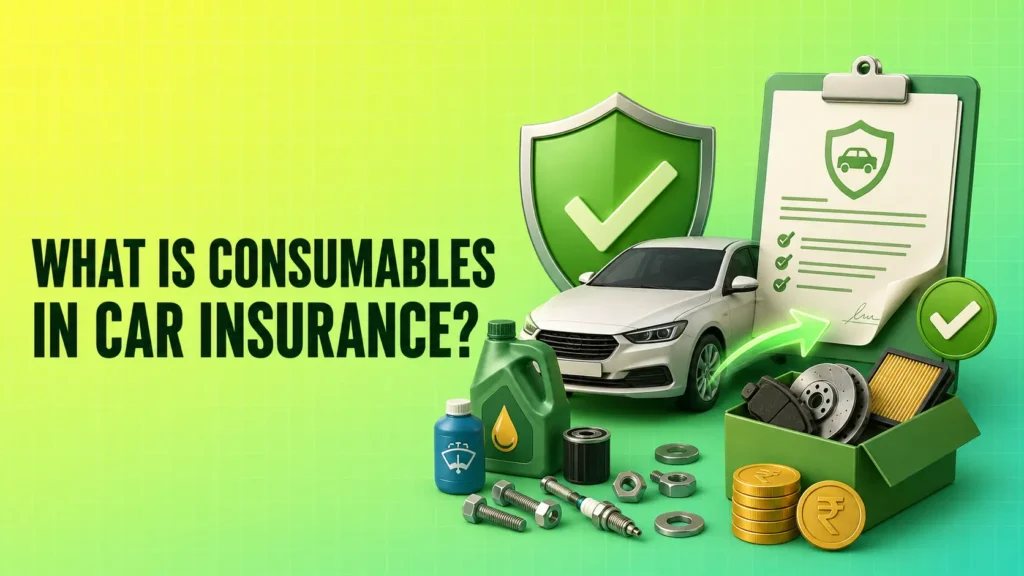
A car insurance claim does not always pay the full repair bill. Many car owners are surprised when they see small items like engine oil, coolant, nuts, bolts, screws, washers, grease, or AC gas added to the bill but not fully paid by the insurer.
These small items are called consumables in car insurance. Individually, their cost may look small, but during accident repair, they can increase your out-of-pocket expense. A consumables add-on cover helps reduce this extra cost, subject to your policy terms.
What Are Consumables in Car Insurance?

Consumables in car insurance are small vehicle parts, oils, fluids, and repair items that are used once and need to be replaced or refilled during car repair.
Common examples include:
- Engine oil
- Gearbox oil
- Brake oil
- Coolant
- Grease
- Nuts and bolts
- Screws
- Washers
- Bearings
- Oil filter
- Lubricants
- AC gas or refrigerant
ICICI Lombard also lists items such as engine oil, gearbox oil, nuts, bolts, grease, washers, oil filters, lubricants, power steering oil, AC gas oil, and radiator coolant as consumables, while specifically excluding fuel.
In simple words, consumables are the small but necessary items used during repair. Once used, they cannot usually be reused.
Why Consumables Are Not Usually Covered in Standard Car Insurance
A standard comprehensive car insurance policy covers own damage and third-party liability, but it may not cover every small repair item.
Consumables are often excluded because they are considered regular-use items that may need replacement during repair or servicing. This is why insurers offer consumables cover as an optional add-on.
ICICI Lombard explains that a comprehensive car insurance policy may not cover the cost of consumables, while a consumables add-on can pay for replacement or refilling costs due to an accident.
Important point: third-party car insurance does not cover consumables because it does not cover damage to your own car. Consumables add-on is generally available with comprehensive or own-damage car insurance.
What Does Consumables Cover Include?
Consumables cover may include repair-related items such as:
- Engine oil
- Brake oil
- Gearbox oil
- Radiator coolant
- Lubricants
- Grease
- Nuts and bolts
- Screws and washers
- Oil filter
- AC gas
- Bearings
Coverage can differ from insurer to insurer. Always check your policy wording before buying the add-on.
What Is Not Covered Under Consumables Cover?
Consumables cover does not mean every small car expense will be paid.
Usually, it does not cover:
- Fuel
- Routine servicing
- Normal wear and tear
- Mechanical or electrical breakdown without an insured accident
- Damage due to drunk driving
- Damage when driving without a valid licence
- Commercial use of a private car
- Repairs done without informing the insurer
- Items not related to the approved accident claim
- Delay in claim intimation
- Consumables used outside policy conditions
For example, if you change engine oil during normal servicing, consumables cover will usually not pay for it. But if engine oil needs replacement due to an insured accident repair, the add-on may help.
Consumables Cover Example: How Much Can You Save?
Suppose your car meets with an accident and goes to the garage for repair.
| Repair Bill Item | Amount |
|---|---|
| Approved repair cost | ₹34,000 |
| Consumables cost | ₹4,500 |
| Other non-payable items | ₹1,500 |
| Total bill | ₹40,000 |
Without consumables cover, you may need to pay the consumables cost from your pocket.
With consumables cover, the insurer may pay the eligible consumables cost, subject to policy terms. In this example, you may save around ₹4,500.
But remember, this add-on may not pay for every item. Deductibles, non-covered items, depreciation, and policy limits can still apply.
Consumables Cover vs Zero Depreciation Cover
Many car owners confuse consumables cover with zero depreciation cover. Both are useful, but they are different.
| Point | Consumables Cover | Zero Depreciation Cover |
|---|---|---|
| Main purpose | Covers oils, fluids, nuts, bolts, coolant, grease, etc. | Covers depreciation deducted on car parts |
| Useful during | Accident repair involving consumables | Replacement of damaged parts |
| Best for | Reducing small repair item costs | Getting higher claim on replaced parts |
| Available with | Own-damage/comprehensive policy | Own-damage/comprehensive policy |
| Good for | New cars, city-use cars, premium cars | New and expensive cars |
If your budget allows, zero depreciation and consumables cover together can give better claim protection than buying only one add-on.
Is Consumables Cover Worth Buying?
Consumables cover is worth considering if:
- Your car is new
- Your car is less than 5 years old
- You drive daily in traffic
- Repair cost in your city is high
- Your car has expensive parts
- You already have zero depreciation cover
- You want to reduce out-of-pocket claim expenses
It may not be very useful if:
- Your car is old
- You rarely use the car
- The add-on premium is too high
- Your insurer does not offer it for your car age
- You are comfortable paying small repair costs yourself
- You only have third-party insurance
Some insurers may restrict this add-on by car age. ICICI Lombard’s article mentions that this add-on is usually valid for cars that are not older than 5 years, but this can differ by insurer and product.
Who Should Buy Consumables Add-on Cover?
Consumables add-on cover can be useful for:
- New car owners
- First-time car buyers
- People who use their car daily
- People living in metro cities
- Owners of premium or expensive cars
- Buyers who want better accident claim protection
- People already buying zero depreciation cover
For a new car, the add-on can be more useful because repair and replacement costs are usually higher.
When Consumables Cover May Not Help Much
Consumables cover may not help much if:
- You have only third-party insurance
- The accident claim itself is not approved
- The damage is due to normal wear and tear
- The repair is done without insurer approval
- You delay informing the insurer
- The car is not eligible for the add-on
- The repair bill is very small
- The add-on premium is higher than the expected benefit
This is why you should compare the add-on cost with your car’s age, usage, and repair cost.
Claim Process for Consumables Cover

The claim process is usually similar to a normal own-damage car insurance claim.
Follow these steps:
- Inform the insurer immediately after the accident.
- Do not start major repairs before claim intimation.
- Take the car to a network garage, if possible.
- The insurer may appoint a surveyor for inspection.
- The garage will prepare a repair estimate.
- Eligible repair and consumables costs will be reviewed.
- The insurer will approve the claim as per policy terms.
- You may need to pay deductibles, non-covered items, or extra charges.
ICICI Lombard also states that repairs at a network garage are preferable and that claims may be denied if the car is repaired at a non-network garage or the insurer is not informed beforehand.
Things to Check Before Buying Consumables Cover
Before adding consumables cover to your car insurance policy, check:
- Is your car age eligible?
- Is the add-on available with your policy type?
- What exact consumables are covered?
- Is fuel excluded?
- Is there any claim limit?
- Does it work only for accident claims?
- Is it valid at non-network garages?
- Is it better with zero depreciation cover?
- How much extra premium is charged?
- What is the claim intimation deadline?
- Are there any conditions for repair approval?
Do not buy the add-on only because it sounds useful. Buy it only if the cost and benefit make sense for your car.
Conclusion
Consumables in car insurance are small repair-related items like engine oil, coolant, nuts, bolts, grease, washers, screws, lubricants, and oil filters. Standard car insurance may not cover these costs, so you may need to pay them during a claim.
A consumables add-on cover can reduce this extra expense when your car is repaired after an insured accident. It is especially useful for new cars, daily-use cars, premium cars, and buyers who already have zero depreciation cover.
However, it does not cover routine servicing, fuel, wear and tear, or repairs done outside policy conditions. Before buying, check the policy wording, exclusions, car age limit, claim process, and add-on premium.
The best decision is not to buy every add-on blindly, but to choose the ones that actually reduce your real claim expenses.