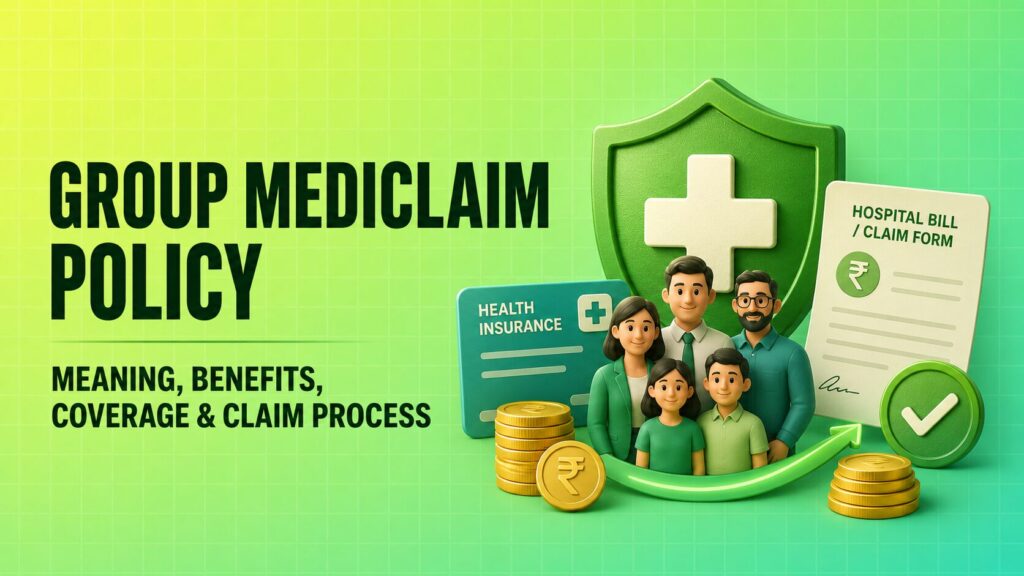
A group mediclaim policy is a health insurance cover offered by an employer that protects employees, and sometimes their family members, against hospitalisation expenses. It is one of the most common employee benefits in India, but the exact coverage, claim rules, and limits depend on the employer’s master policy document.
For many salaried people, this cover is the first line of protection during a medical emergency. It is useful, but it is not always enough on its own. Knowing how it works can help you avoid claim surprises, especially when you need cashless treatment or reimbursement.
What is a Group Mediclaim Policy?

A group mediclaim policy is a health insurance policy purchased by an organisation for a defined group of people, usually employees. In many cases, the plan also extends to dependents such as spouse, children, and sometimes parents, depending on the company’s rules.
Legally and practically, the policy is a contract between the insurer and the employer, not between the insurer and the employee individually. That is why the final coverage, exclusions, waiting period waivers, and claim process are governed by the employer’s policy document and the insurer’s terms.
In simple words, a group health insurance policy is company-sponsored health cover. It can be a valuable benefit, but it is tied to employment and may change when you change jobs, resign, or when the employer updates the plan.
Key Benefits of Group Mediclaim Insurance
A well-designed group medical insurance policy can offer several advantages, especially for employees who want immediate coverage without long waiting periods.
- No waiting period for many benefits: Unlike many individual policies, group plans often start coverage from day one for covered members.
- Pre-existing diseases may be covered from day one: Many employer plans provide this benefit, though the exact scope depends on the policy wording.
- Maternity benefit may be included: Some company policies cover maternity expenses, newborn care, or related hospitalisation, subject to limits and waiting conditions if any.
- Lower or no medical check-up: Employees are often enrolled without the kind of health screening required in many individual plans.
- Useful family protection: Some employers allow spouse, children, and in some cases parents to be added under the cover.
- Easy payroll-linked enrolment: Premium is usually managed by the employer, so employees do not need to handle a separate policy premium payment process.
These benefits make group cover helpful, but it should be viewed as a workplace benefit, not a complete replacement for personal health insurance.
Understanding Your Policy Coverage
Before relying on your group mediclaim policy, it helps to understand the core terms inside the policy document. The most important ones are sum insured, co-payment, and room rent limits.
Sum insured is the maximum amount the insurer will pay in a policy year for covered claims. For example, if your employer provides a cover of ₹5 lakh, expenses above that amount are usually your responsibility unless a top-up or super top-up is available.
Co-payment means you pay a fixed part of the claim yourself. Not every policy has co-payment, but if it exists, it can increase your out-of-pocket cost. Read this clause carefully, especially for senior dependents or non-network hospital treatment.
Room rent limits can restrict the kind of hospital room you can choose. If the room charge goes beyond the allowed limit, other hospital expenses may also be proportionately affected in some policies. This is a common point of confusion during claims.
If you are not sure about any of these terms, check the employee benefits booklet, the insurer’s policy wording, or ask your HR team for the exact master policy document. That is the safest way to understand what is actually covered.
Group Mediclaim vs. Individual Health Insurance: A Comparison
Group cover is helpful, but it is tied to your job. Individual health insurance gives you more control and continues even if you switch employers. The table below shows a simple comparison.
This table provides a general comparison; always check your specific company policy document for exact terms.
| Feature | Group Mediclaim | Individual Policy | Why It Matters |
|---|---|---|---|
| Policy holder | Employer buys the policy for employees | You buy it in your own name | Group cover is linked to employment; individual cover stays with you |
| Coverage start | Often from day one | May have waiting periods for some benefits | Group plans are easy to use for new joiners |
| Pre-existing diseases | Often covered from day one, as per policy | Usually subject to waiting period | This can be a major benefit of a company plan |
| Family inclusion | Sometimes spouse, children, and parents can be added | You can choose family floater or separate policies | Group family cover depends on employer rules |
| Portability | Generally not portable like an individual policy | Can usually be ported as per insurer rules | Changing jobs can affect group cover continuity |
| Coverage amount | Fixed by employer | You choose the sum insured | Employer cover may not be enough for major hospitalisation |
| Customisation | Limited | Better flexibility with add-ons and sum insured | Individual plans let you build stronger long-term protection |
In many cases, the smartest approach is to use the company cover as a base benefit and maintain a separate personal policy for long-term security. A top-up or super top-up can also help bridge the coverage gap if your employer cover is small.
How the Claim Process Works

The claim process under a group mediclaim policy usually works in two ways: cashless claim and reimbursement claim. In both cases, the third party administrator, or TPA, may play an important role in verification and settlement.
A TPA (Third Party Administrator) is the intermediary that helps process health insurance claims on behalf of the insurer. Your health card, policy details, and hospital network status often determine how smoothly the claim moves.
Filing a Cashless Claim
A cashless claim means the insurer settles approved hospital bills directly with the hospital network, subject to group mediclaim policy terms. You may still need to pay non-covered expenses, deductions, or any amount above the approved limit.
- Check whether the hospital is in the insurer’s network. Cashless treatment usually works better at network hospitals.
- Inform the TPA or insurer as early as possible. For planned hospitalisation, this is usually done before admission. For emergencies, it should be done as soon as possible after admission.
- Show your health card and ID proof. The hospital insurance desk uses these details to initiate the pre-authorisation request.
- Hospital sends pre-authorisation to the TPA. The hospital shares diagnosis, estimated cost, and treatment details for approval.
- Wait for approval or additional queries. The insurer or TPA may ask for more medical details before approving the claim.
- Pay any uncovered charges at discharge. Items outside the policy, such as certain consumables or excess room charges, may need to be paid by you.
Cashless claims are convenient, but they are not automatic. Approval still depends on policy coverage, hospital documents, and the insurer’s assessment.
Filing a Reimbursement Claim
If you choose a non-network hospital, miss the cashless window, or face an emergency situation where cashless is not available, you may need to file a reimbursement claim. In this case, you pay the hospital first and later request the insurer to reimburse eligible expenses.
- Collect all original documents. Keep hospital bills, pharmacy bills, discharge summary, prescriptions, diagnostic reports, and payment receipts.
- Get the claim form. Your HR team, insurer portal, or TPA typically provides the form.
- Fill in the details carefully. Match the hospital records, dates, treatment type, and bank details exactly.
- Submit within the deadline. Every policy has a time limit for claim submission, so do not delay.
- Track the claim status. The insurer or TPA may ask for additional documents or clarification.
- Receive reimbursement for eligible expenses. The payout will depend on policy coverage, exclusions, and deductions.
Reimbursement claims need more paperwork than cashless claims. A common mistake is missing a bill, prescription, or discharge summary. That can delay settlement or lead to partial rejection.
Common Limitations and Risks
Even a good group mediclaim policy has limits. Knowing these in advance helps you avoid the shock of discovering them during a hospital bill.
- Coverage ends when employment ends: In many cases, group health insurance stops when you leave the company, unless the policy has a continuation option.
- Fixed sum insured: The employer decides the cover amount, and it may not match your actual family needs.
- Employer can modify the plan: The company may revise benefits, add exclusions, or change family coverage terms at renewal.
- Portability is limited: Group plans generally do not offer the same portability benefits as individual health insurance.
- Dependents may have restrictions: Parents may not be included in every plan, and family floater limits can vary.
- Not all expenses are covered: Room rent caps, exclusions, consumables, and non-medical items can reduce the final payout.
This is why many financial planners suggest having a personal base policy in addition to employer-provided cover. If your job changes or the company policy changes, your individual policy can continue without depending on employment status.
A practical setup for many salaried families is to treat the company policy as the first layer and use a personal policy or top-up as the second layer. That way, a change in job does not leave you uninsured.
FAQs
Can I add my parents to my Group Mediclaim policy?
It depends on your employer’s policy. Some companies allow parents to be added, while others cover only the employee, spouse, and children. Check the employee benefits document or ask HR for the exact rule.
What happens to my coverage if I quit my job?
In most cases, your group mediclaim coverage ends when your employment ends. Some employers may offer a short continuation window or conversion option, but that is not guaranteed. It is wise to keep an individual policy for continuity.
Do I need an individual policy if I have a company health cover?
Yes, having a personal policy is usually sensible because group cover is tied to your job and may change with employer decisions. An individual policy gives you portability and long-term security.
What is a TPA in health insurance?
A TPA, or Third Party Administrator, is the agency that helps process health insurance claims, especially cashless claims. It coordinates between the hospital and the insurer and checks documents, eligibility, and claim details.
Are pre-existing diseases covered in group insurance?
Usually yes, many group insurance policies cover pre-existing diseases from day one. However, this depends on the master policy document, so do not assume it automatically applies to every employer plan.
Can I claim for maternity expenses under my group policy?
Some group mediclaim policy include maternity benefits, but not all do. If maternity cover is available, it may have a waiting period, sub-limit, or specific conditions. Always verify the exact policy wording before relying on it.