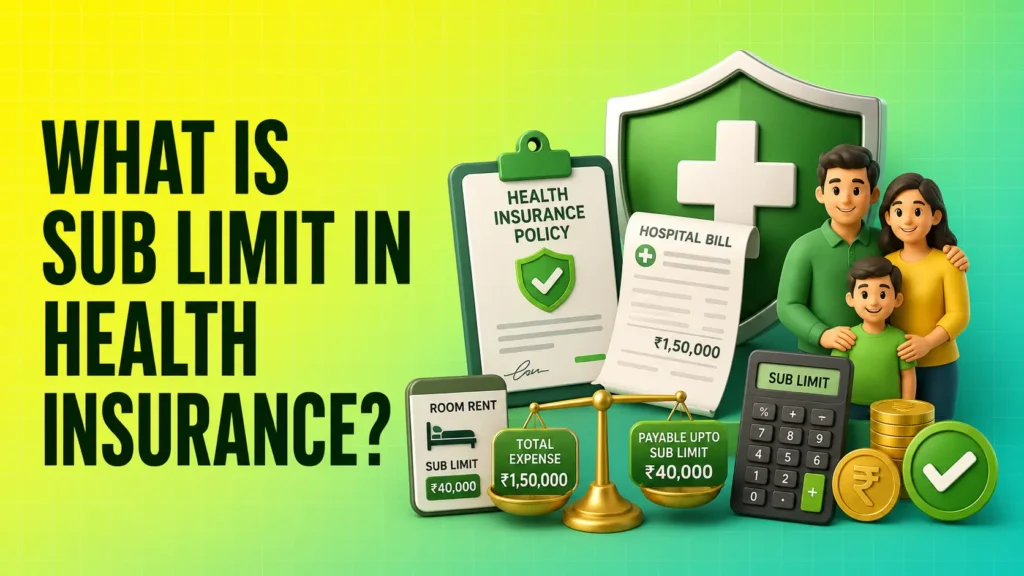
A ₹10 lakh health insurance policy does not always mean the insurer will pay up to ₹10 lakh for every hospital expense. Your policy may contain smaller caps for room rent, cataract surgery, maternity treatment, ambulance charges or other medical expenses.
These caps are called sub-limits. Ignoring them can lead to a partially paid claim even when most of your total sum insured is still available.
Understanding the sub limit in health insurance helps you estimate the insurer’s actual liability and the amount you may need to pay from your own pocket during treatment.
What Is Sub Limit in Health Insurance?

A sub-limit is a predefined cap on the amount an insurance company will pay for a specific expense, treatment or benefit covered by a health insurance policy.
It operates within the total sum insured.
For example, suppose your policy has:
- Total sum insured: ₹10 lakh
- Cataract surgery sub-limit: ₹50,000 per eye
- Actual cataract surgery cost: ₹80,000
Even though you have ₹10 lakh coverage, the insurer may pay only up to ₹50,000 for that surgery. You would have to pay the remaining ₹30,000, along with any non-payable expenses.
A sub-limit may be expressed as:
- A fixed amount, such as ₹50,000 for a specific surgery
- A percentage of the sum insured
- A fixed amount per day
- A specified room category
- A per-claim or per-policy-year cap
This is why the total sum insured alone does not show the full quality of a health insurance plan.
How Does a Sub-Limit Affect a Health Insurance Claim?
A sub-limit does not necessarily reduce your total sum insured. Instead, it restricts the maximum payout for the expense on which it applies.
Consider this example:
| Claim detail | Amount |
|---|---|
| Total sum insured | ₹10,00,000 |
| Knee surgery bill | ₹3,00,000 |
| Treatment-wise cap | ₹2,00,000 |
| Maximum insurer payout for treatment | ₹2,00,000 |
| Amount paid by policyholder | ₹1,00,000 |
The insurer may approve the treatment but still restrict the payment to ₹2 lakh because of the disease-wise sub-limit.
The unused portion of the sum insured may remain available for other eligible claims, subject to the policy terms. However, it cannot be used to exceed the specific cap applied to that treatment.
Types of Sub-Limits in Health Insurance
Sub-limits can apply to several parts of a hospital bill. Their format and amount vary between policies.
Room Rent Sub-Limit
A room rent sub-limit restricts the hospital room charges payable per day or limits the insured person to a particular room category.
It may be written as:
- ₹5,000 per day
- 1% of the sum insured per day
- Single private room
- Twin-sharing room
- General ward
Suppose your policy allows room rent of ₹5,000 per day, but you choose a room costing ₹8,000. At a minimum, you may have to pay the difference in room charges.
Depending on the policy wording, selecting a room above the allowed category may also affect associated expenses through a proportionate deduction. This can include eligible costs linked to the room category, such as nursing charges, doctor visits, operation theatre charges or surgeon fees.
Not every health policy applies proportionate deduction in the same way. You should therefore check the exact room-rent and proportionate-deduction clauses instead of assuming that only the room charge will be reduced.
Disease-Wise or Treatment-Wise Sub-Limit
A disease-wise sub-limit restricts how much the insurer will pay for a listed disease, surgery or medical procedure.
It may apply to treatments such as:
- Cataract surgery
- Knee replacement
- Hernia treatment
- Gall bladder surgery
- Maternity care
- Dental treatment
- Certain cancer treatments
- Specific modern procedures
For instance, a policy may have a ₹40,000 cataract limit per eye. If the hospital charges ₹70,000, the policyholder may need to pay the balance.
Always check whether the limit applies:
- Per person
- Per eye or knee
- Per claim
- Per policy year
- For the entire policy term
ICU Sub-Limit
Some policies separately restrict ICU charges. The cap may be a percentage of the sum insured per day or a fixed daily amount.
ICU bills can be significantly higher than normal room charges. A low ICU cap may therefore create a major out-of-pocket expense during serious hospitalisation.
Ambulance Sub-Limit
The policy may cover ambulance expenses only up to a fixed amount per hospitalisation or policy year.
For example, even if the actual ambulance charge is ₹5,000, a policy with a ₹2,000 ambulance cap may pay only ₹2,000.
Check whether the cover includes:
- Road ambulance
- Emergency ambulance
- Air ambulance
- Inter-hospital transfer
These benefits can have separate limits and conditions.
Maternity Sub-Limit
Health policies that include maternity benefits usually apply a specific cap for normal delivery and caesarean delivery.
A policy with a ₹10 lakh sum insured may still restrict maternity expenses to ₹50,000 or another specified amount. Newborn care, vaccination and pre- or post-natal expenses may have separate conditions.
Maternity coverage can also have a waiting period, so both the waiting period and sub-limit should be checked.
Post-Hospitalisation Sub-Limit
A policy may promise coverage for post-hospitalisation expenses for a stated number of days but still restrict the payable amount.
The cap may apply to:
- Follow-up consultations
- Diagnostic tests
- Medicines
- Physiotherapy
- Scans and laboratory tests
The number of covered days and the maximum payable amount are separate conditions. Both should be reviewed.
How Can a Room Rent Limit Reduce Your Claim?
Room-rent limits deserve special attention because hospital charges are sometimes linked to the selected room category.
Assume your policy allows ₹4,000 per day, but you choose a room costing ₹8,000 per day. The eligible room rate is 50% of the actual room rate.
If the policy contains a proportionate-deduction clause, some associated expenses may also be settled in the same proportion, subject to the wording.
A simplified example:
| Hospital expense | Actual bill | Illustrative eligible amount |
|---|---|---|
| Room rent | ₹40,000 | ₹20,000 |
| Surgeon fee | ₹1,00,000 | ₹50,000 |
| Nursing and related charges | ₹30,000 | ₹15,000 |
| Total | ₹1,70,000 | ₹85,000 |
This is an illustration only. Actual deductions depend on the policy wording, room category, admissible expenses and insurer’s claim assessment.
Before planned hospitalisation, ask the insurer or third-party administrator to confirm the eligible room category in writing. In an emergency, the family should inform the hospital insurance desk about the room entitlement as early as possible.
Sub-Limit vs Co-Pay vs Deductible
These terms can all increase your out-of-pocket cost, but they work differently.
| Term | Meaning | Example |
|---|---|---|
| Sub-limit | Maximum amount payable for a specific expense or treatment | Cataract covered up to ₹50,000 |
| Co-payment | Percentage of the admissible claim paid by the policyholder | You pay 20% of the approved claim |
| Deductible | Fixed amount paid before the insurer’s liability begins | You pay the first ₹50,000 |
| Sum insured | Overall maximum coverage under the policy | Total annual cover of ₹10 lakh |
A single policy may contain more than one of these conditions.
For example, a senior citizen health policy may have:
- A ₹1 lakh treatment sub-limit
- A 20% co-pay
- A room-category restriction
In such a case, the final insurer payout can be considerably lower than the total hospital bill.
Why Do Health Insurance Policies Have Sub-Limits?

Insurers use sub-limits to control their maximum liability for specific expenses. Policies with sub-limits may therefore have a lower premium than plans offering broader coverage without such caps.
Sub-limits may help make basic health coverage more affordable, but they transfer part of the claim risk to the policyholder.
A policy with limits may be reasonable when:
- The premium budget is limited
- The permitted room category is adequate
- The treatment caps match local hospital costs
- The insured understands the possible out-of-pocket expense
- Additional savings are available for uncovered costs
However, low premiums should not be the only reason to select a plan. A large treatment gap can cost much more than the premium saved.
What Are the Disadvantages of Sub-Limits?
The main disadvantages include:
- Higher out-of-pocket hospital expenses
- Restricted room choice
- Partial claim settlement despite sufficient sum insured
- Lower coverage for expensive surgeries
- Complicated claim calculations
- Proportionate-deduction risk
- Limited maternity, ambulance or post-treatment support
- Need to compare several clauses before hospital admission
Sub-limits can be particularly restrictive for senior citizens and people with planned procedures because their likelihood of hospitalisation may be higher.
How to Check Sub-Limits in Your Policy
Do not rely only on the brochure or sales summary. Download and read the complete policy wording and policy schedule.
Check the following sections:
Policy Schedule
This contains your sum insured, chosen variant, room eligibility, optional covers and member details.
Schedule of Benefits
Look for fixed caps or percentage-based limits against specific benefits.
Room Rent and ICU Clause
Check:
- Daily room-rent limit
- Eligible room category
- ICU cap
- Proportionate-deduction wording
- Expenses excluded from proportional deductions, if specified
Disease-Wise Limit Table
Search for terms such as:
- Sub-limit
- Defined limit
- Disease-wise cap
- Procedure-wise cap
- Benefit limit
- Maximum payable amount
Maternity and Ambulance Sections
These benefits often have separate caps, waiting periods and eligibility conditions.
Add-On or Rider Wording
Some insurers offer a sub-limit waiver or room-rent modification add-on. Confirm exactly which limits it removes and whether other treatment caps remain.
Before buying, ask the insurer these questions:
- Is there any room rent sub-limit?
- Can choosing a higher room reduce other claim expenses?
- Are there disease-wise or procedure-wise limits?
- Is the cap per claim, per person or per policy year?
- Can I remove the limit through an add-on?
- Will these limits apply to cashless as well as reimbursement claims?
Ask for the answers in writing.
Should You Buy Health Insurance With or Without Sub-Limits?

A no sub-limit health insurance plan generally offers better flexibility because it reduces restrictions on room rent and selected treatments. However, the premium may be higher.
A plan without sub-limits may be more suitable when:
- You live in a city with expensive hospital rooms
- You want greater freedom to select a hospital room
- You are buying cover for parents or senior citizens
- You expect planned surgery or maternity treatment
- You want to reduce partial-claim risk
- You can afford the higher premium
A policy with sub-limits may still be considered if its caps are realistic and the premium fits your budget.
Do not assume that “no sub-limit” means every hospital expense will be paid. Waiting periods, exclusions, non-medical items, co-payments, deductibles and reasonable-and-customary-charge conditions may still apply.
How to Reduce the Impact of Sub-Limits
You can reduce the risk of an unexpected claim deduction by taking these steps:
- Select a policy without room-rent capping where affordable
- Compare disease-wise limits before buying
- Choose a room within the permitted category
- Consider a sub-limit waiver or room-rent add-on
- Check local hospital charges before selecting coverage
- Keep an emergency fund for non-payable expenses
- Confirm benefit limits before planned treatment
- Review the policy again at every renewal
- Port to a more suitable plan if existing limits are restrictive, subject to applicable rules
Increasing the total sum insured does not always increase every sub-limit. A fixed ₹50,000 surgery cap may remain unchanged even after upgrading the policy unless the product terms say otherwise.
Conclusion
A sub limit in health insurance is a smaller cap placed within your overall sum insured. It may restrict room rent, ICU costs, ambulance charges, maternity benefits, post-hospitalisation expenses or specific treatments.
These limits can make the premium more affordable, but they can also result in a partially paid claim and higher out-of-pocket costs.
Before purchasing or renewing a policy, check the room-rent clause, disease-wise sub-limits, proportionate-deduction rules and available waiver add-ons. A policy should not only offer a high sum insured; it should also provide practical coverage when you actually need treatment.
FAQs
Does a sub-limit reduce the total sum insured?
A sub-limit generally restricts the amount payable for a specific expense rather than automatically reducing the overall sum insured. The remaining sum insured may still be available for other eligible claims, subject to policy terms.
Do sub-limits apply to cashless health insurance claims?
Yes. A cashless claim changes the payment process, not the policy conditions. Room-rent caps, treatment-wise limits, co-payments and other applicable clauses can still reduce the approved cashless amount.
Can I remove a sub-limit from an existing health policy?
Some insurers offer add-ons that increase or remove selected limits, such as room-rent restrictions. Availability depends on the product and may be offered only at purchase or renewal after paying an additional premium.
Will increasing my sum insured remove disease-wise limits?
Not necessarily. Percentage-based limits may rise when the sum insured increases, but fixed treatment caps may remain unchanged. Check the benefit schedule of the upgraded plan.
Is health insurance without sub-limits always better?
It generally offers greater flexibility and lowers the risk of treatment-specific deductions, but it may cost more. You must still check co-payments, deductibles, waiting periods, exclusions and non-payable expenses before deciding.