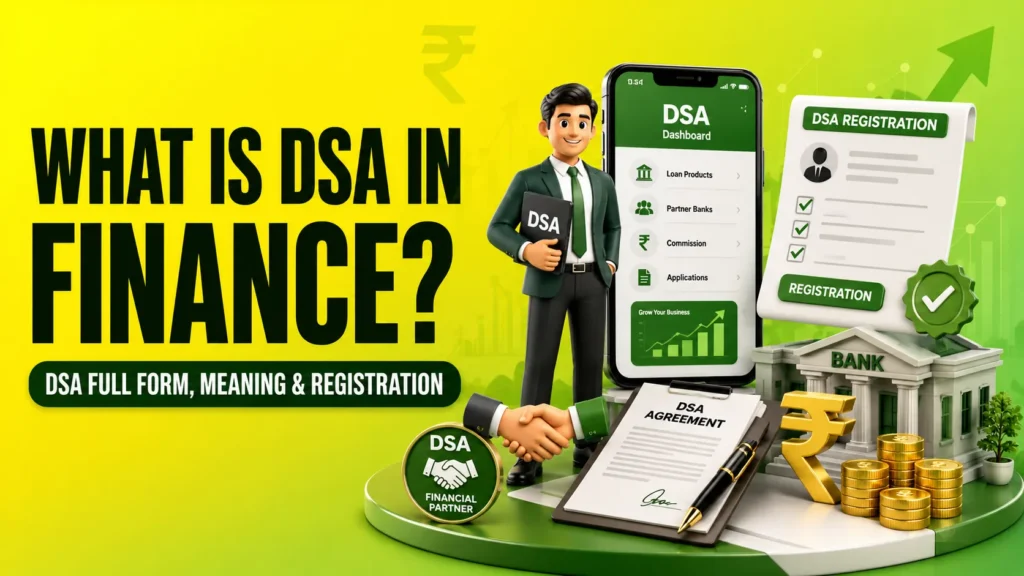
In India’s growing lending market, many people get loans without walking into a bank branch. Behind a large number of these loans stands a DSA — a Direct Selling Agent.
This guide explains the DSA full form in finance, what a DSA actually does, how the registration process works, and what both borrowers and aspiring agents should know in 2026.
DSA Full Form in Finance
DSA stands for Direct Selling Agent.
In banking and finance, a DSA is an authorised individual or firm that sources loan applications for banks and Non-Banking Financial Companies (NBFCs). The DSA does not lend money. Instead, the agent identifies potential borrowers, helps them with the application process, and earns a commission only when the loan is successfully disbursed.
Think of a DSA as a bridge between the borrower and the lender.
Who is a DSA?
A DSA is formally registered (empanelled) with one or more financial institutions under a written agreement. The agent works independently or through a distribution platform and is paid on a performance basis.
Unlike bank staff, DSAs are not on the lender’s payroll. They operate on commission and often have the flexibility to offer products from multiple banks and NBFCs.
How DSAs Differ from Regular Bank Staff and Loan Agents
| Aspect | Bank/NBFC Employee | Registered DSA | Informal Loan Agent |
|---|---|---|---|
| Employment Status | Salaried | Independent / Contractual | No formal link |
| Products | Only one institution’s | One or multiple lenders | Varies, often unregulated |
| Accountability | High (employer rules) | Bound by DSA agreement + lender code | Low or none |
| Income | Fixed salary + incentives | Commission only | Commission or fees |
| Compliance | Strict internal rules | Must follow lender’s code of conduct | Often none |
Roles and Responsibilities of a DSA
For the Borrower
- Explains loan products, interest rates, tenure, and eligibility
- Helps collect and organise required documents
- Compares suitable options based on the borrower’s profile
- Follows up on application status till disbursement
For the Lender
- Sources quality leads in areas where the lender has limited branch presence
- Conducts basic eligibility screening before submission
- Reduces the lender’s customer acquisition cost
- Maintains service standards during the process
A good DSA makes the loan journey smoother for both sides.
Types of DSA
- Independent DSAs – Empanelled with multiple banks and NBFCs. They can show borrowers several options.
- Bank-Associated / Exclusive DSAs – Work mainly or only with one lender and receive focused product training.
- Platform / Corporate DSAs – Register once with a distribution company that has tie-ups with dozens of lenders. This model has grown rapidly.
- NBFC-Focused DSAs – Specialise in personal loans, business loans, gold loans, and other NBFC products, often with faster digital processes.
How the DSA Process Works (Step-by-Step)
- Lead Identification – Through referrals, local networks, digital marketing, or existing contacts.
- Needs Assessment – Understanding the borrower’s requirement, income, credit profile, and suitable product.
- Document Collection – Gathering KYC, income proofs, bank statements, and other papers.
- Application Submission – Filing the complete application with the chosen lender using the DSA’s unique code.
- Follow-up Till Disbursement – Coordinating with both the borrower and the lender until the loan is approved and funds are released.
Commission is paid only after successful disbursement.
How to Become a DSA – Eligibility & Registration Process
Basic Eligibility (typical requirements in 2026)
- Indian citizen
- Minimum age usually 18–25 years (varies by lender/platform)
- Valid PAN and Aadhaar
- Basic understanding of loan products (formal degree not mandatory)
- Clean background; some lenders prefer a reasonable credit score
- GST registration if operating as a firm and turnover crosses the threshold
Registration Process (General Steps)
- Decide whether to register directly with individual banks/NBFCs or through a multi-lender DSA platform.
- Fill the online application form on the lender’s or platform’s website/app.
- Complete KYC verification and upload documents (PAN, Aadhaar, cancelled cheque, photos, address proof).
- Undergo background checks if required.
- Sign the DSA agreement that covers commission structure, code of conduct, and compliance rules.
- Receive your unique DSA code and start sourcing leads.
Direct registration with multiple banks takes more time. Partnering with a established distribution platform often gives access to many lenders under one registration.
DSA Commission Structure (Indicative 2026 Ranges)
Commissions are calculated as a percentage of the disbursed loan amount and vary by product, lender, ticket size, and volume:
- Personal Loan: Typically 1% – 2.5%
- Business Loan / Unsecured Business Credit: 1% – 3%
- Home Loan: 0.25% – 1%
- Loan Against Property (LAP): 0.5% – 1.5%
- Other products (Gold Loan, Education Loan, Car Loan, etc.): Usually lower percentages
Actual rates depend on the specific agreement. High-volume DSAs often move to better slabs. Income can range from a few thousand rupees to several lakhs per month depending on activity and product mix.
Benefits of the DSA Model
For the DSA
- Flexible working hours
- No upper limit on earnings
- Opportunity to build a network-based recurring income
- Product training and support from lenders/platforms
For the Lender
- Wider reach without opening new branches
- Lower customer acquisition cost
- Access to local and semi-urban markets
Challenges and Risks
- Product bias risk (recommending higher-commission products)
- Income inconsistency if lead flow is weak
- Strict compliance requirements — violation can lead to de-empanelment
- Need to stay updated with RBI guidelines and lender policies
- Borrowers should always verify that the DSA is formally registered and never pay any advance fee to the agent
RBI holds the bank or NBFC responsible for the conduct of their DSAs. Lenders must maintain a code of conduct, ensure transparency, and prevent mis-selling or unauthorised charges.
Tips for Borrowers
- Ask for the DSA’s unique code and verify it with the lender if possible
- Never share original documents permanently or pay any fee to the DSA
- Compare the final offer carefully (interest rate, processing fee, prepayment charges)
- Prefer registered DSAs over informal agents
Tips for Aspiring DSAs
- Start with strong product knowledge and basic credit assessment skills
- Build a genuine referral network
- Maintain clean documentation and ethical practices
- Track applications and follow up systematically
- Stay updated on RBI norms related to fair practices and digital lending
Conclusion
A Direct Selling Agent (DSA) plays an important role in expanding access to credit across India. For borrowers, a registered DSA can simplify the loan process. For individuals looking for flexible income, becoming a DSA offers a low-entry, performance-based opportunity.
The key is transparency and compliance — both for the agent and the borrower. Always work with formally registered DSAs and understand the terms before proceeding.
Frequently Asked Questions
Q1. What is the full form of DSA in finance?
DSA stands for Direct Selling Agent.
Q2. What is the difference between a DSA and a loan agent?
A DSA is formally registered with a lender under a signed agreement and follows compliance rules. A generic loan agent may operate without any formal authorisation.
Q3. Can one DSA work with multiple banks?
Yes. Independent DSAs and those registered through multi-lender platforms commonly work with several banks and NBFCs.
Q4. Is any educational qualification required to become a DSA?
No formal degree is mandatory. Knowledge of loan products and documentation significantly improves success rates.
Q5. How can I verify if a DSA is genuine?
Ask for the DSA code and, if needed, confirm with the lender. Genuine DSAs do not demand any fee from the borrower.