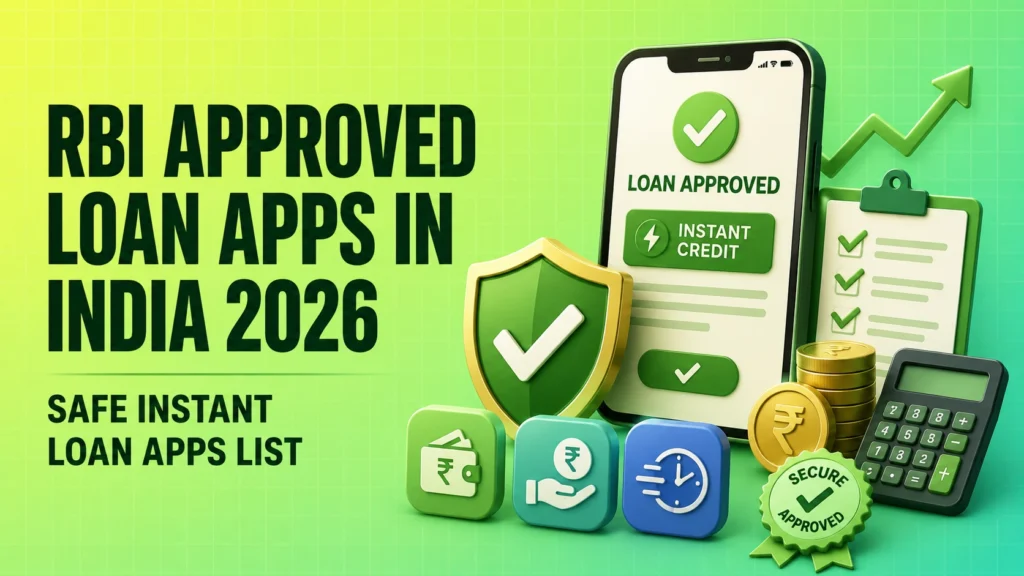
Imagine you need money urgently for a medical bill, rent, school fees, or a sudden personal expense. A loan app can approve and disburse money quickly, but the bigger question is: is the app safe to use?
That is why many people search for RBI approved loan apps in India before applying. They want instant money, but they also want safety, transparent charges, and proper repayment rules.
Before checking the list, understand one important point: RBI usually does not directly approve every mobile loan app. RBI registers and regulates banks and NBFCs. A loan app is considered safer when it works through an RBI-regulated bank or NBFC and clearly shows lender details, charges, Key Fact Statement, and grievance support.
This article explains the safe instant loan apps list for 2026, how to verify a loan app, what documents are required, and what charges you should check before applying.
What Are RBI Approved Loan Apps?
“RBI approved loan apps” is a common search term, but the practical meaning is slightly different.
In simple words, these are loan apps that provide loans through RBI-regulated banks or NBFCs. The app may be a fintech platform, but the actual lender behind the loan is usually a bank or NBFC.
Instant loan apps are generally part of the broader retail loan category, where individuals borrow money for personal, emergency, education, travel, or other household needs.
A safe loan app should clearly show:
- Lender or NBFC name
- Loan amount and tenure
- Interest rate
- Annual Percentage Rate
- Processing fee
- Repayment schedule
- Key Fact Statement
- Customer support details
- Grievance officer details
Before applying, always check who is actually giving the loan. Do not trust an app only because it says “RBI approved” on its website or advertisement.
RBI Approved vs RBI Registered Loan Apps

This difference is important for every borrower.
RBI does not usually approve each loan app one by one like a product approval. Instead, RBI regulates banks and NBFCs that provide loans.
So, when people say “RBI approved loan apps,” they usually mean apps that are connected with RBI-registered banks or NBFCs.
For example:
- A fintech app may collect your application.
- The lending partner may be an RBI-registered NBFC or bank.
- The loan agreement should mention the actual lender.
- The borrower should get proper loan documents and repayment details.
This is why you should not only check the app name. You should also check the lender or NBFC partner name before accepting the loan.
List of RBI Approved Loan Apps in India 2026
Below is a list of popular instant loan apps used in India. These apps may work through banks, NBFCs, or lending partners. Loan amount, interest rate, tenure, and eligibility can change, so always verify the latest details from the official app or website before applying.
| Loan App | Loan Type | Best For | Loan Amount |
|---|---|---|---|
| KreditBee | Personal loan | Young professionals | As per app terms |
| Fibe | Personal loan | Salaried users | As per app terms |
| Moneyview | Personal loan | Higher loan needs | As per app terms |
| Navi | Personal loan | Digital loan users | As per app terms |
| CASHe | Personal loan | Salaried professionals | As per app terms |
| mPokket | Small instant loan | Students and first-time borrowers | As per app terms |
| Bajaj Finserv | Personal loan | Larger loan requirements | As per lender terms |
| Tata Capital | Personal loan | Trusted brand users | As per lender terms |
| PaySense | Personal loan | Digital borrowers | As per app terms |
| Stashfin | Credit line or personal loan | Flexible borrowing | As per app terms |
This list is for educational purposes. Always check the lender name, charges, and loan agreement before accepting any loan.
Top RBI-Linked Instant Loan Apps in India
1. KreditBee
KreditBee is a popular digital lending platform for personal loans. It is commonly used by young professionals and salaried borrowers who need quick access to credit.
The application process is usually online, and users may need to complete digital KYC before approval. Loan approval depends on income, repayment history, credit profile, and lender rules.
Best For
- Young professionals
- Salaried users
- Small to medium personal loan needs
- Short-term financial requirements
What to Check
Before accepting the loan, check the interest rate, processing fee, tenure, late payment fee, and total repayment amount.
2. Fibe
Fibe, earlier known as EarlySalary, is commonly used by salaried people for short-term personal loans. It focuses on quick digital loan processing and app-based application.
It may be useful when you need money for an urgent expense and can repay it comfortably through EMIs.
Best For
- Salaried employees
- Short-term personal needs
- Salary gap situations
- Digital loan users
What to Check
Check the repayment date, EMI amount, late payment charges, and total cost of borrowing before using the app.
3. Moneyview
Moneyview is another popular personal loan app in India. It is often used by borrowers who need a personal loan with EMI-based repayment.
The app may check your income, credit profile, bank statement, and repayment capacity before approval.
Best For
- Personal loan users
- Higher loan amount needs
- EMI-based repayment
- Borrowers with regular income
What to Check
Before applying, check your EMI affordability. Taking a loan without repayment planning can affect your credit score. If your score is near 700, read our guide on whether a CIBIL score of 700 is good or bad before applying.
4. Navi
Navi is a digital financial services platform that offers personal loans through app-based processing. It is suitable for users who prefer a fully digital experience.
The approval depends on eligibility, income, credit score, and internal risk checks.
Best For
- Digital loan users
- Personal loan needs
- App-based borrowing
- Users who prefer online processing
What to Check
Check the loan agreement, interest rate, repayment schedule, and processing fee before accepting the offer.
5. CASHe
CASHe is commonly used by salaried professionals for short-term personal loans. The platform focuses on digital loan processing and quick application review.
It can be useful for urgent expenses, but borrowers should avoid using it repeatedly for non-essential spending.
Best For
- Salaried professionals
- Short-term borrowing
- Emergency expenses
- Digital loan users
What to Check
Check the total repayment amount, processing fee, repayment tenure, and late payment charges.
6. mPokket
mPokket is known for small instant loans and is often used by students and first-time borrowers. It may offer small-ticket loans depending on eligibility.
Since small loans can also become expensive if repaid late, users should borrow carefully. For very short borrowing needs, you can also read about 7 days loan apps to understand the risks before applying.
Best For
- Students
- First-time borrowers
- Small emergency needs
- Short-term loan requirements
What to Check
Check the repayment date, charges, and total repayment amount. Avoid taking repeated small loans for regular expenses.
7. Bajaj Finserv
Bajaj Finserv is a well-known NBFC-backed lending platform in India. It offers personal loans and other financial products to eligible users.
It may be suitable for borrowers who need a larger loan amount and prefer an established financial brand.
Best For
- Larger personal loan needs
- Salaried and self-employed users
- Existing customers
- EMI-based repayment
What to Check
Check interest rate, processing fee, foreclosure charges, prepayment rules, and EMI amount before applying. If you are comparing loan options, our guide on Gold Loan vs Personal Loan can help you understand which borrowing option may be better.
8. Tata Capital
Tata Capital is a trusted financial services brand that offers personal loans and other credit products. It is suitable for users who prefer borrowing from an established NBFC.
The loan process may be online or assisted, depending on the product and eligibility.
Best For
- Trusted brand users
- Personal loan borrowers
- Salaried and self-employed users
- Medium to higher loan needs
What to Check
Check loan eligibility, documentation, interest rate, processing fee, and repayment tenure.
9. PaySense
PaySense is a digital personal loan platform used by borrowers looking for small to medium personal loans. The application process is usually online.
Approval depends on your income, credit profile, and lending partner rules.
Best For
- Digital borrowers
- Small to medium personal loans
- EMI-based repayment
- Urgent personal needs
What to Check
Check APR, processing fee, repayment period, and late payment charges before accepting the loan.
10. Stashfin
Stashfin offers credit line or personal loan-type products depending on eligibility. It may be useful for users who want flexible access to credit.
However, flexible borrowing should be used carefully because repeated withdrawals can increase repayment pressure.
Best For
- Flexible borrowing needs
- Short-term credit users
- Digital borrowers
- Emergency cash flow needs
What to Check
Check how the credit line works, when interest is charged, repayment rules, total cost, and penalty charges.
How to Check If a Loan App Is Safe or RBI-Linked

Before applying through any loan app, follow these steps:
- Open the app or official website.
- Check the name of the lending partner, bank, or NBFC.
- Read the loan agreement carefully.
- Check whether a Key Fact Statement is provided before loan acceptance.
- Review the APR, interest rate, processing fee, and total repayment amount.
- Check customer support and grievance officer details.
- Download the app only from official app stores.
- Do not install APK files from unknown links.
- Confirm that loan disbursal happens directly to your bank account.
- Avoid accepting a loan if lender details and charges are not clearly shown.
A safe borrower does not apply only because approval is fast. A safe borrower first checks the lender, loan cost, and repayment terms.
Features of Safe Instant Loan Apps
A good loan app should be simple, transparent, and easy to understand.
Important features include:
- Clear lender or NBFC name
- Digital KYC process
- Key Fact Statement before loan approval
- Interest rate and APR disclosure
- Processing fee details
- EMI schedule
- Direct bank account disbursal
- Customer support
- Grievance officer details
- Privacy policy
- Secure app experience
If an app hides important details, it is better to avoid borrowing from it.
Documents Required for Instant Loan Apps
Most instant loan apps ask for basic documents and KYC details. The exact requirement can change based on the lender and loan amount.
Common documents include:
- PAN card
- Aadhaar card
- Bank account details
- Mobile number
- Email ID
- Selfie or video KYC
- Salary slip, if required
- Bank statement, if required
- Employment proof, if required
- Address proof, if required
For KYC-based borrowing, you can also read our detailed guide on Aadhar card loan eligibility and documents before applying online.
Keep your documents ready before applying. This can make the application process faster.
Eligibility for Instant Loan Apps in India
Eligibility rules differ from app to app, but most lenders check a few common points.
You may need:
- Indian citizenship or residency
- Minimum age, usually 18 or 21 years and above
- Valid PAN and Aadhaar
- Active bank account
- Regular income source
- Stable mobile number
- Acceptable credit score
- Good repayment history
- Completed KYC verification
Some apps may approve loans for users with limited credit history, but the loan amount may be small and the charges may be higher. Always compare before applying.
Charges to Check Before Taking a Loan from an App
Instant loans are convenient, but the cost can be high if you do not check charges properly.
Before accepting any loan, check:
- Interest rate
- Annual Percentage Rate
- Processing fee
- GST on fees
- Late payment fee
- EMI bounce charges
- Penal charges
- Prepayment charges
- Foreclosure charges
- Total repayment amount
- EMI due date
- Any subscription or platform fee
Do not look only at the monthly EMI. Check the total amount you will repay. Loan interest and EMI cost are also affected by broader lending conditions, so understanding the repo rate and its impact on loans can help you make better borrowing decisions.
When Should You Use Instant Loan Apps?
Instant loan apps can be useful when you need money quickly and have a clear repayment plan.
You may consider them for:
- Medical emergency
- Salary delay
- Urgent bill payment
- Short-term cash flow gap
- Education-related urgent payment
- Genuine personal emergency
You should avoid using instant loan apps for unnecessary shopping, risky trading, gambling, lifestyle expenses, or paying one loan with another loan.
Borrowing should solve a problem, not create a bigger one.
Tips Before Applying for an Instant Loan
Follow these tips before taking a loan from any app:
- Borrow only what you can repay.
- Compare at least 2–3 loan options.
- Check APR, not only interest rate.
- Read the Key Fact Statement.
- Understand EMI due date.
- Check late payment charges.
- Avoid multiple applications at the same time.
- Pay EMIs on time.
- Do not share OTP, PIN, or password.
- Use only official app stores.
- Keep loan documents saved.
A quick loan can be helpful, but only when used responsibly.
What to Do If You Face an Issue With a Loan App
If you face a problem with a loan app, do not ignore it.
You can take these steps:
- Contact the app’s customer support.
- Raise a complaint with the grievance officer.
- Keep screenshots, emails, call records, and payment receipts.
- Contact the actual lender or NBFC mentioned in the loan agreement.
- Use official complaint channels if the issue is not resolved.
- Inform your bank if you notice any unauthorised transaction.
Keeping proper records can help you resolve disputes faster.
Conclusion
RBI approved loan apps in India are commonly understood as apps that provide loans through RBI-regulated banks or NBFCs. RBI usually does not directly approve every loan app, so borrowers should always verify the lender behind the app.
Before applying, check the lender name, Key Fact Statement, APR, processing fee, EMI schedule, and grievance support. Do not borrow only because the app promises fast approval.
Instant loan apps can be useful during emergencies, but they should be used carefully. Borrow only what you need, compare charges, repay on time, and always keep your financial safety first.
FAQs
Which are the RBI approved loan apps in India 2026?
Some popular loan apps in India include KreditBee, Fibe, Moneyview, Navi, CASHe, mPokket, Bajaj Finserv, Tata Capital, PaySense, and Stashfin. Before applying, verify the lender or NBFC partner and read all loan terms.
Does RBI directly approve loan apps?
RBI generally regulates banks and NBFCs. It does not usually approve every loan app directly. A loan app is safer when it works through an RBI-regulated bank or NBFC and provides proper loan documents.
How can I check if a loan app is RBI registered?
Check the lender or NBFC name shown in the app. Then verify that lender from official RBI resources or the lender’s official website. Also check the Key Fact Statement and grievance details before accepting the loan.
Which instant loan app is safe in India?
A safe instant loan app should clearly show lender name, interest rate, APR, charges, repayment schedule, customer support, and grievance officer details. Safety depends on the app’s lending partner and transparency.
Are loan apps safe for personal loans?
Loan apps can be safe if they are linked with regulated lenders, disclose charges clearly, and follow proper digital lending rules. Borrowers should still compare costs and avoid borrowing more than they can repay.
What is the difference between RBI approved and RBI registered loan apps?
“RBI approved loan app” is a common user term, but technically RBI registers and regulates banks and NBFCs. A loan app may work with an RBI-registered lender, but the app itself may not be directly approved by RBI.
What documents are required for instant loan apps?
Common documents include PAN card, Aadhaar card, bank account details, mobile number, email ID, selfie or video KYC, salary slip, bank statement, and income proof if required.
Should I pay upfront fees before loan approval?
Be careful with any app or lender that asks for money before loan disbursal. Genuine lenders usually disclose charges in the loan documents and deduct applicable fees as per policy.
What should I check before accepting a loan from an app?
Check lender name, APR, interest rate, processing fee, EMI amount, tenure, late payment charges, total repayment amount, and grievance officer details before accepting the loan.
Can I get an instant loan without a credit score?
Some apps may offer small loans to users with limited credit history, but approval, loan amount, and charges depend on the lender’s policy. Always check the total cost before borrowing.