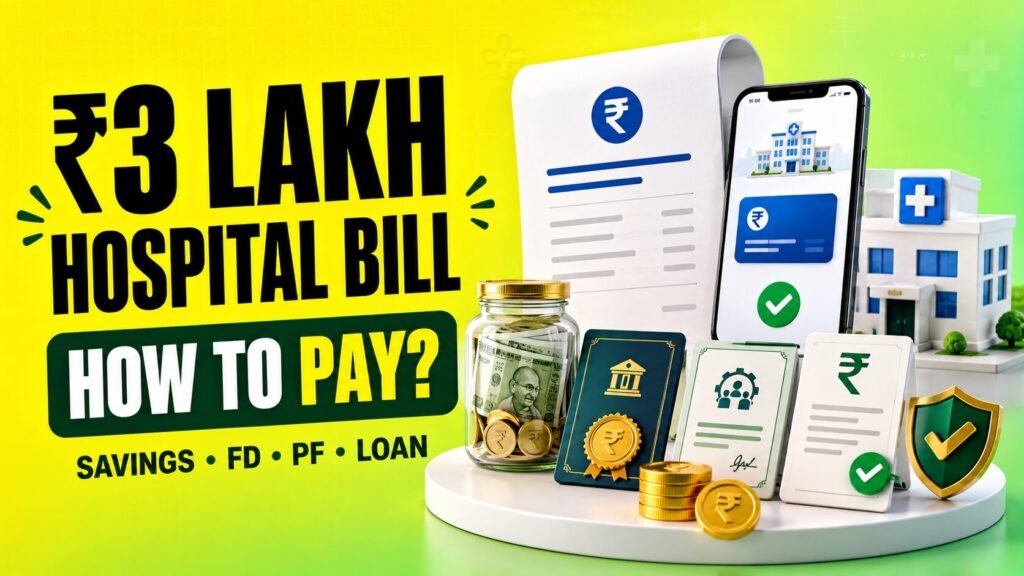
A medical emergency can put significant pressure on your finances, especially when a hospital bill reaches ₹3 lakh and your health insurance does not cover the full amount. You may need to decide whether to use your savings, break a fixed deposit (FD), withdraw money from your Provident Fund (PF), or borrow from a bank.
The right choice depends on how urgently you need the money, how much cash you have available, the interest you could lose or pay, and whether you need to protect your emergency fund for future expenses.
Before taking a loan or withdrawing long-term savings, check your health insurance coverage and ask the hospital about payment options. Here is how to compare the available choices and decide which may work best for your situation.
1. Check Your Health Insurance Coverage First
Before arranging ₹3 lakh from your own pocket, find out how much of the hospital bill your health insurance policy can cover.
Your final out-of-pocket expense may depend on your sum insured, eligible treatment expenses, room rent limits, deductibles, co-payments, waiting periods and policy exclusions. These conditions vary by policy. The Insurance Regulatory and Development Authority of India (IRDAI) advises policyholders to understand these terms before relying on insurance coverage.
Take these steps:
- Contact your insurer or TPA: Ask whether the treatment is covered and how much of the bill is eligible for reimbursement.
- Check cashless treatment: If the hospital and policy allow it, ask whether the insurer can settle eligible expenses directly with the hospital.
- Request a detailed bill: Review the estimated treatment costs, medicines, room charges and other expenses.
- Ask about the shortfall: Confirm the amount you must pay yourself after insurance.
For example, if the total hospital bill is ₹3 lakh and the insurer approves ₹2 lakh, your immediate funding gap may be ₹1 lakh, subject to any additional expenses or adjustments.
You should arrange money for the actual shortfall rather than automatically borrowing the full ₹3 lakh.
Before arranging the remaining amount, understand the health insurance claim process and check whether cashless treatment or reimbursement can cover the eligible expenses.
2. Should You Use Your Savings to Pay Hospital Bills?
Using savings is often a sensible first option because you do not have to pay loan interest or break an investment. However, withdrawing all your savings can leave you financially vulnerable after the medical emergency.
Consider using the portion of your savings that is available for emergencies while keeping enough money for essential household expenses, rent, loan EMIs and other immediate commitments.
Advantages of using savings
- No borrowing cost or loan EMI.
- Immediate access to funds if the money is in an accessible bank account.
- No need to sell investments or complete a withdrawal process.
Disadvantages of using savings
- Your emergency fund may become smaller or disappear.
- You may struggle to manage another unexpected expense.
- Rebuilding your savings can take time.
For example, suppose you have ₹4 lakh in savings and need to pay a ₹3 lakh hospital bill. Paying the entire amount from savings would leave only ₹1 lakh.
If that remaining amount is insufficient for your regular expenses and future emergencies, consider combining savings with another suitable funding source instead of exhausting your cash reserves.
The goal is to pay the hospital bill without creating a second financial emergency.
If paying the hospital bill reduces your savings significantly, learn how to build an emergency fund to rebuild your financial safety net after the emergency.
3. Should You Break Your Fixed Deposit (FD)?
Breaking a fixed deposit can be an option when your savings are insufficient but you have money invested in an FD.
An FD may offer a better alternative to borrowing at a high interest rate. However, withdrawing it before maturity may reduce the interest you earn or result in a premature withdrawal penalty, depending on the bank and deposit terms.
Before breaking your FD, ask the bank to calculate the amount you will receive and the interest adjustment, if any.
Advantages of breaking an FD
- You can access your own money without taking a conventional personal loan.
- You avoid future loan EMIs and borrowing interest.
- It may be useful when you need funds quickly and have a suitable deposit.
Disadvantages of breaking an FD
- You may lose some expected interest.
- You could reduce the funds available for future needs.
- You may give up a deposit that was intended for a specific financial goal.
Can you take a loan against an FD instead?
Some banks offer loans or overdrafts against eligible fixed deposits. This allows you to borrow against the deposit rather than close it immediately.
However, the bank may charge interest, impose limits on the amount available and place a lien on the deposit. Compare the borrowing cost with the interest you would lose by breaking the FD.
If you can comfortably repay the loan, borrowing against an FD may be worth considering. If repayment would strain your monthly budget, withdrawing the deposit may be more practical.
4. Can You Withdraw PF for Medical Expenses?
Employees who contribute to the Employees’ Provident Fund (EPF) may be eligible for an advance for certain medical expenses, subject to the applicable EPFO rules.
This is different from taking a personal loan. An eligible EPF advance does not create a conventional monthly loan EMI, but withdrawing retirement savings reduces the money available for your future.
EPFO provides a facility for illness-related advances. Members should check the current eligibility conditions, applicable limits and claim procedure before relying on this money to pay a hospital bill.
Before applying:
- Check whether you and the family member receiving treatment meet the applicable eligibility conditions.
- Review the permitted withdrawal amount and requirements.
- Ensure your UAN and other required account details are in order.
- Check the current claim process through the official EPFO member services.
Advantages of an eligible EPF advance
- It may help you access retirement savings during a genuine medical emergency.
- It avoids the interest cost of a conventional personal loan.
- It may reduce the need to liquidate other investments.
Disadvantages of an EPF advance
- Your retirement savings will decrease.
- You may not be eligible for the full amount you need.
- Claim processing and eligibility requirements may affect when you receive the money.
Do not assume that your entire EPF balance is available for medical withdrawal. Check the applicable rules and the amount you can actually claim before making a payment plan.
Also read: How to Transfer EPF Online?
5. Should You Take a Personal Loan for Hospital Bills?
A personal loan can help cover a medical expense when you do not have sufficient savings or accessible investments. It may be particularly relevant when the hospital requires payment urgently and other funding sources are unavailable.
However, a personal loan creates a repayment obligation. You should consider the interest rate, processing fees, EMI and total repayment amount before accepting an offer.
Advantages of a personal loan
- It can provide funding without selling investments.
- Repayment can be spread across a selected loan tenure.
- It may help cover a shortfall that cannot be met through other sources.
Disadvantages of a personal loan
- Interest and fees increase the overall cost of treatment.
- Monthly EMIs reduce the money available for household expenses.
- Late payments can lead to additional charges and affect your credit profile.
Before borrowing, compare offers from lenders and check the annual interest rate, processing fee, repayment tenure and total amount payable. Do not choose a loan solely because the advertised EMI looks affordable.
You can also ask the hospital whether it offers a payment plan or instalment arrangement. Check the full terms before agreeing to any financing option.
A personal loan is generally more suitable when you have a realistic repayment plan and the alternatives would cause greater financial difficulty. If your income is already committed to existing EMIs and essential expenses, borrowing more may increase your financial stress.
6. Savings vs FD vs PF vs Loan: Which Is Better?
There is no single option that is best for every family. Compare how quickly you can access the money, the cost of using it and the effect on your future finances.
| Funding option | Main benefit | Main drawback |
|---|---|---|
| Savings | No loan interest or EMI | Can deplete your emergency fund |
| Fixed deposit | Uses money you already own | May reduce interest earnings |
| Loan against FD | May avoid closing the deposit | Interest is payable and the FD is encumbered |
| EPF advance | May avoid conventional loan interest | Eligibility limits and reduced retirement savings |
| Personal loan | Can cover a funding gap | Interest, fees and monthly EMI |
A practical order of consideration is:
- Use insurance first: Confirm the eligible claim amount and the remaining bill.
- Use available savings carefully: Keep enough cash for essential expenses and immediate emergencies.
- Compare FD options: Check the cost of premature withdrawal against the cost of borrowing against the deposit.
- Check EPF eligibility: Consider an advance if the treatment qualifies and the withdrawal is permitted.
- Borrow only for the remaining gap: Choose a loan only after checking its full cost and your repayment capacity.
This is a starting point, not a rigid rule. If an FD withdrawal would cause a substantial loss, or an eligible EPF advance cannot arrive in time, another option may be more appropriate.
7. How to Pay a ₹3 Lakh Hospital Bill: Example
Suppose your family receives a hospital bill of ₹3 lakh, and health insurance covers ₹2 lakh. You need to arrange the remaining ₹1 lakh.
Here is one possible way to manage the shortfall without taking a large personal loan.
| Source | Amount |
|---|---|
| Total hospital bill | ₹3,00,000 |
| Insurance claim approved | ₹2,00,000 |
| Remaining amount to pay | ₹1,00,000 |
| Available savings used | ₹40,000 |
| FD withdrawal | ₹40,000 |
| Eligible EPF advance or other available funds | ₹20,000 |
| Total amount arranged | ₹1,00,000 |
This is only an illustrative example. Insurance approval, FD withdrawal costs and EPF eligibility depend on your individual circumstances.
The key idea is to identify the actual funding gap and combine suitable sources if doing so reduces your financial burden. You do not necessarily need to take a personal loan for the entire amount.
If your emergency savings are already low, you could use a smaller amount from savings and explore other available options. If you cannot access the required funds in time, discuss a payment arrangement with the hospital.
8. Mistakes to Avoid During a Medical Emergency
When a large hospital bill arrives unexpectedly, making a quick financial decision without checking the details can create further problems.
Avoid these common mistakes:
- Borrowing before checking insurance: Confirm the approved claim and your actual out-of-pocket expense first.
- Using all your savings: Keep sufficient money for essential living costs and future emergencies where possible.
- Breaking an FD without comparing costs: Ask your bank about premature withdrawal penalties and loans against eligible deposits.
- Assuming your entire PF balance is withdrawable: Verify the applicable EPFO rules and permitted advance amount.
- Choosing a loan based only on EMI: Compare the interest rate, fees, tenure and total repayment.
- Ignoring repayment capacity: Consider your existing EMIs, household expenses and income stability before borrowing.
- Failing to keep hospital documents: Retain bills, receipts, prescriptions, discharge summaries and insurance correspondence for claims and records.
A medical emergency can be stressful, but taking a few minutes to understand the available options may help you avoid unnecessary financial costs.
Conclusion
Paying a ₹3 lakh hospital bill does not automatically mean you need to take a personal loan or exhaust your savings. Start by checking your insurance coverage, calculating the actual shortfall and comparing the cost of using your savings, breaking an FD, withdrawing eligible PF money or borrowing.
The most suitable approach is the one that covers the immediate medical expense while keeping future financial obligations manageable. Whenever possible, preserve some emergency savings and avoid taking on debt that you cannot comfortably repay.
Frequently Asked Questions
Q1. Can I withdraw EPF money for medical treatment?
Eligible EPF members may apply for an advance for illness-related expenses, subject to the applicable EPFO rules and limits. Check your eligibility and the latest claim procedure through the official EPFO website before relying on the money.
Q2. Is it better to break an FD or take a personal loan?
Breaking an FD may be preferable if the lost interest and any premature withdrawal penalty are lower than the total cost of a personal loan. A loan against an eligible FD may also be worth comparing. The better choice depends on the deposit terms, loan rate and repayment capacity.
Q3. Should I use my emergency fund for hospital bills?
Yes, using part of your emergency fund can be reasonable during a genuine medical emergency. However, avoid exhausting it if possible. Consider insurance, available deposits and other eligible funding options to protect your ability to manage future expenses.
Q4. Can I get a loan for hospital expenses?
You may be able to use a personal loan or another eligible financing facility to pay hospital expenses. Approval, interest rates and loan amounts depend on the lender’s eligibility criteria and your financial profile. Compare the full borrowing cost before applying.
Q5. What should I do if health insurance does not cover the full hospital bill?
Ask your insurer to explain the uncovered amount and review your policy terms. Then assess your savings, FD options, eligible EPF advance and borrowing alternatives. If necessary, discuss a payment arrangement with the hospital.