Table of Contents
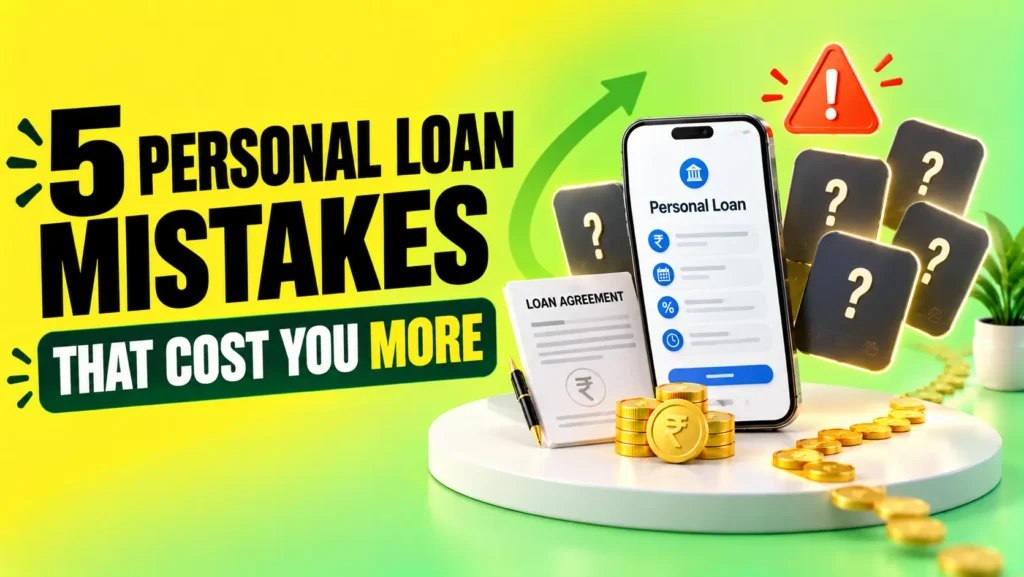
A personal loan may solve an immediate cash problem, but the wrong borrowing decision can increase your repayment burden. Before applying, avoid these five common personal loan mistakes.
1. Choosing a Loan Only Because of a Low Interest Rate
A low advertised interest rate does not always mean a cheaper personal loan. Processing fees and other applicable charges can increase the total cost.
Before applying, compare the interest rate, processing fee, APR, and total repayment amount. Read the lender’s Key Facts Statement (KFS) to understand the loan’s costs and key terms.
What to do: Compare the complete cost of the loan, not just the interest rate shown in an advertisement.
2. Borrowing More Than You Actually Need
A bank may offer you a pre-approved personal loan of ₹8 lakh, but that does not mean you should borrow the entire amount.
For example, if you need only ₹3 lakh, borrowing ₹8 lakh means paying interest on an additional ₹5 lakh that you may not need. A larger loan can also increase your EMI or total interest cost.
What to do: Calculate your actual expenses and borrow only what you need and can comfortably repay from your monthly income.
3. Choosing a Longer Tenure Just to Reduce Your EMI
A longer loan tenure usually lowers your monthly EMI but increases the total interest you pay.
For example, a three-year loan may have a higher EMI than a five-year loan, but the shorter tenure can reduce the total interest cost, assuming the same loan amount and interest rate.
What to do: Compare EMIs and total interest for different tenures. Choose the shortest tenure you can comfortably afford without compromising essential expenses.
4. Ignoring Prepayment and Foreclosure Rules
You may want to repay your personal loan early after receiving a bonus or extra income. However, the loan’s terms can affect whether you can make a part-payment or close the loan early and whether any charges apply.
Do not assume that every lender charges a 2% to 5% foreclosure fee or that every loan has a lock-in period. The rules depend on the loan terms and applicable regulations. For example, RBI directions effective from January 1, 2026, prohibit prepayment charges on specified floating-rate loans to individuals taken for purposes other than business.
What to do: Before signing, check the part-payment and foreclosure clauses, understand the applicable foreclosure charges, and review any lock-in period and other charges associated with your specific loan.
5. Applying to Too Many Banks and Loan Apps at Once
Submitting several personal loan applications in a short period can lead to multiple hard enquiries on your credit report. These enquiries may affect your credit score, although the impact varies by credit profile.
Applying everywhere also does not guarantee approval or a better interest rate.
What to do: Compare lenders’ eligibility criteria, interest rates, and fees before submitting a formal application. Ask whether checking eligibility will involve a hard enquiry.
What Should You Check Before Taking a Personal Loan?
Before accepting an offer, confirm these five things:
- Total cost: Interest rate, APR, processing fee, and other applicable charges.
- Loan amount: Borrow only what you need.
- EMI: Make sure it fits your monthly budget and existing repayments.
- Tenure: Compare total interest across different repayment periods.
- Early repayment: Understand the part-payment and foreclosure rules.
Conclusion
The biggest personal loan mistakes are focusing only on the advertised interest rate, borrowing more than necessary, choosing a long tenure just for a lower EMI, overlooking early repayment conditions, and applying to too many lenders.
Before accepting a personal loan, compare its total cost and check whether you can comfortably afford the EMI. A loan offer is useful only when its terms suit your financial situation.
If you are concerned about how multiple credit enquiries may affect your credit profile, learn how to improve your CIBIL score from 600 to 750.