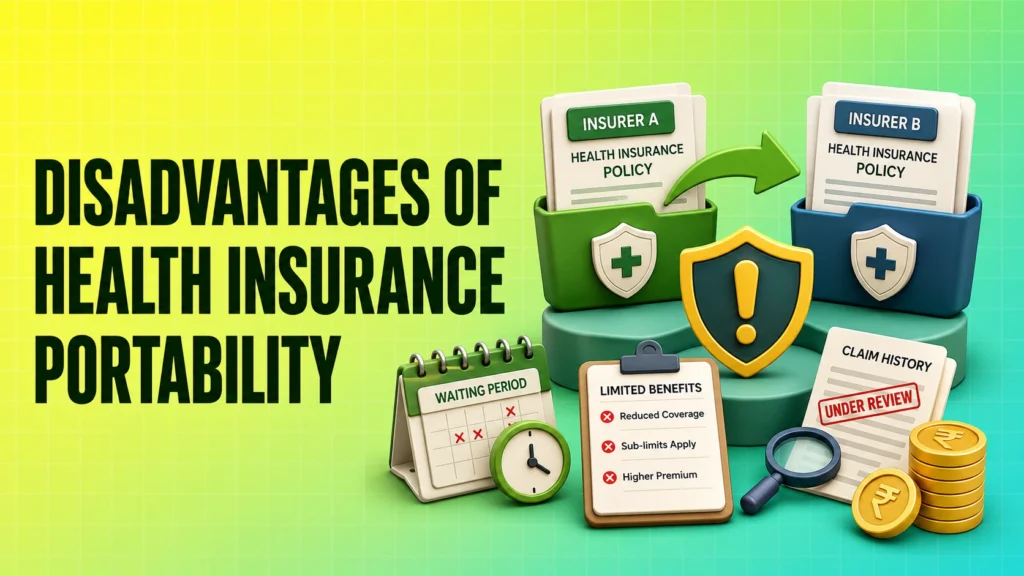
Health insurance portability allows you to move your existing policy to another insurer without losing all the continuity benefits you have already earned. It can be useful when you are unhappy with the premium, coverage, hospital network or claim service of your current insurer.
However, switching is not always beneficial. The new insurer may charge a higher premium, change important policy conditions or reject the application after underwriting. Understanding the disadvantages of health insurance portability can help you avoid an unsuitable switch.
What Is Health Insurance Portability?

Health insurance portability is the process of transferring an indemnity health insurance policy from one insurer to another at renewal.
Eligible credits for completed waiting periods, the existing sum insured and other continuity benefits may move to the new policy. However, the new insurer can assess your age, medical history, previous claims and requested coverage before accepting the application.
Portability means moving to another insurer. Moving to another plan offered by the same insurer is called migration.
What Are the Disadvantages of Health Insurance Portability?
1. Portability Is Usually Allowed Only at Renewal
You normally cannot port a health policy in the middle of its policy term. The switch takes place around the renewal date of the existing policy.
A portability request should generally be submitted between 30 and 60 days before renewal. Starting late can leave less time to submit documents, complete medical tests and compare the new insurer’s final offer.
2. Approval Is Not Guaranteed
The new insurer is allowed to evaluate your application under its underwriting rules.
It may consider:
- Your age
- Medical history
- Existing diseases
- Previous claims
- Current sum insured
- Requested increase in coverage
- Information given in the proposal form
The insurer may accept the application, request medical tests, offer different conditions or reject the portability request. Previous claims do not automatically cause rejection, but they may be considered during risk assessment.
3. The New Premium May Be Higher
Portability does not guarantee a lower premium. The initial online quote may change after the insurer reviews your age, medical history and required coverage.
The final premium may also be affected by your city, selected sum insured, co-payment, deductible and policy benefits. Compare the final accepted premium instead of relying only on the first quote shown online.
4. Additional Sum Insured May Have a Fresh Waiting Period
Continuity credit generally applies to the eligible coverage carried from the old policy. A waiting period may apply to the additional amount when you increase the sum insured during portability.
For example, if you move from a ₹5 lakh policy to a ₹10 lakh policy, the completed waiting-period credit may apply to the eligible ₹5 lakh. The additional ₹5 lakh may be subject to the new policy’s conditions.
This does not mean that every waiting period starts again for the entire policy.
5. Policy Benefits and Conditions May Change
Portability transfers eligible continuity credits, not every feature of the old policy.
The new policy may have different:
- Room-rent limits
- Co-payment clauses
- Disease-wise sub-limits
- Restoration conditions
- Maternity benefits
- Consumables coverage
- Modern-treatment limits
- Exclusions
A policy with more advertised benefits may still contain stricter claim conditions. Read the Customer Information Sheet and policy wording before accepting it.
6. Network Hospitals May Be Different
The new insurer may not have cashless arrangements with the hospitals you normally use.
Do not choose an insurer only because it advertises a large national hospital network. Verify your preferred hospital, nearby emergency hospital and relevant specialist facilities before switching.
Hospital-network arrangements can also change, so check the current status with both the insurer and hospital.
7. More Documents or Medical Tests May Be Required
The acquiring insurer may ask for documents before deciding on your application.
These may include:
- Previous policy documents
- Renewal notices
- Claim records
- Medical reports
- Portability form
- Proposal form
- KYC documents
- Fresh medical-test reports
Missing or inconsistent information can delay the process. You should disclose existing illnesses, medicines and previous claims accurately.
8. Delays Can Create a Coverage Gap
Portability itself does not automatically create a break in coverage. Problems may arise when the policyholder applies late, fails to submit documents or lets the existing policy expire before receiving the new policy.
Do not cancel or stop renewing the current policy merely because you have submitted a portability request. Wait until the new insurer formally accepts the proposal and issues the policy.
What Benefits Transfer During Health Insurance Portability?
Eligible continuity benefits may transfer from the existing policy to the new policy.
These may include:
- Credit for the completed pre-existing disease waiting period
- Credit for completed specific waiting periods
- Continuity on the eligible existing sum insured
- Eligible cumulative or no-claim bonus credit
- Credit towards the applicable moratorium period
However, the exact benefits available under the new plan may differ. Co-payment, room eligibility, restoration benefits, add-ons and wellness rewards do not automatically continue in the same form.
Always request written confirmation of the credits being transferred.
When Can Health Insurance Portability Be Rejected?
The acquiring insurer may reject a portability application when the applicant does not meet its underwriting or eligibility requirements.
Possible reasons include:
- Incomplete medical disclosure
- Incorrect information in the proposal form
- Missing policy or claim documents
- Unacceptable medical risk
- Requested coverage beyond the insurer’s limits
- Inconsistent policy history
- Failure to complete required medical tests
- Application submitted too close to renewal
A previous claim does not automatically disqualify you. The insurer should assess the complete application and communicate its decision.
When Should You Avoid Porting Your Health Insurance?

Porting may not be worthwhile when your current policy already provides suitable coverage and the new plan offers only a small premium saving.
You should reconsider the switch when:
- The new policy has a higher co-payment
- Your preferred hospitals are not in its network
- Important benefits will be reduced
- Additional coverage has a long waiting period
- Disease-wise sub-limits are stricter
- The final premium is unaffordable
- The application remains uncertain near renewal
When your main problem is the current product rather than the insurer, migration to another plan with the same insurer may also be worth checking.
Checklist Before Porting Health Insurance
| What to check | What you should compare |
|---|---|
| Premium | Final accepted premium, not only the online estimate |
| Waiting periods | Credit transferred and conditions on additional cover |
| Room eligibility | Private room, shared room or capped room rent |
| Co-payment | Percentage of the claim you must pay |
| Sub-limits | Limits on diseases, treatments and procedures |
| Hospitals | Current cashless hospitals in your city |
| Restoration | When and how restored cover can be used |
| Exclusions | Differences between the old and new policies |
| Claim process | Cashless and reimbursement procedures |
| Continuity | Written details of transferred credits |
Compare policies with the same sum insured, deductible and major benefits. Otherwise, a cheaper quote may not represent better value.
Is Health Insurance Portability Worth It?
Health insurance portability may be worthwhile when the new policy provides a meaningful improvement in coverage, hospital access, room eligibility, co-payment or long-term affordability.
It may not be worth switching when the only advantage is a small premium reduction but the new policy has stricter limits, exclusions or waiting-period conditions.
Base your decision on the final policy offer and written terms, not only on advertisements or estimated premiums.
Conclusion
Health insurance portability gives you the option to change insurers without losing all your accumulated continuity benefits. However, approval is not guaranteed, and every feature of the old policy will not transfer automatically.
The new premium, hospital network, co-payment, room-rent conditions and waiting periods may be different. Additional coverage may also face fresh conditions.
Compare the final offer carefully and obtain written confirmation of continuity credits. Most importantly, do not allow your existing health policy to lapse while the portability request is being processed.