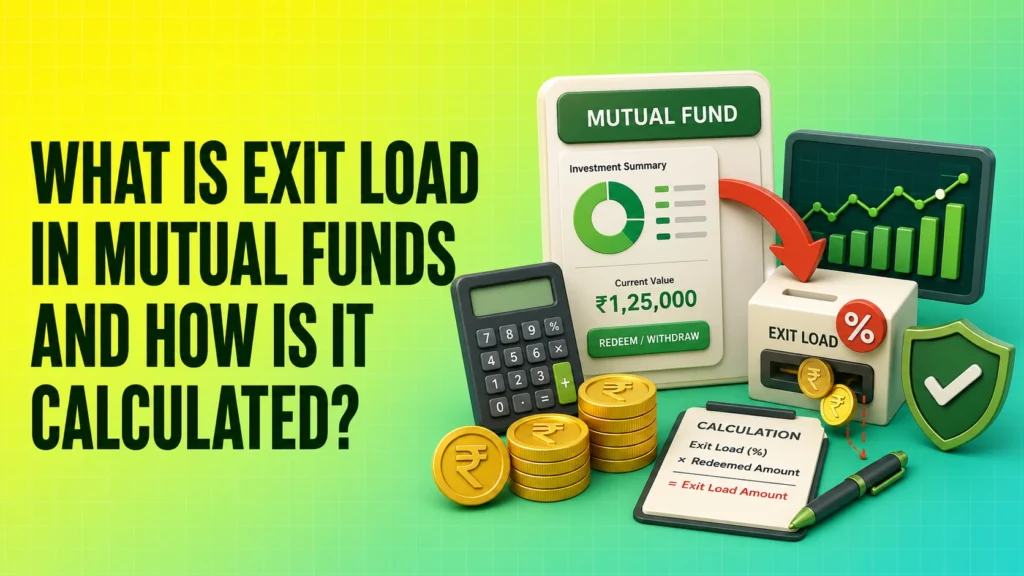
You submit a redemption request for ₹1 lakh, but the amount credited to your bank account is lower. The difference may come from an exit load, even when the investment has earned a profit.
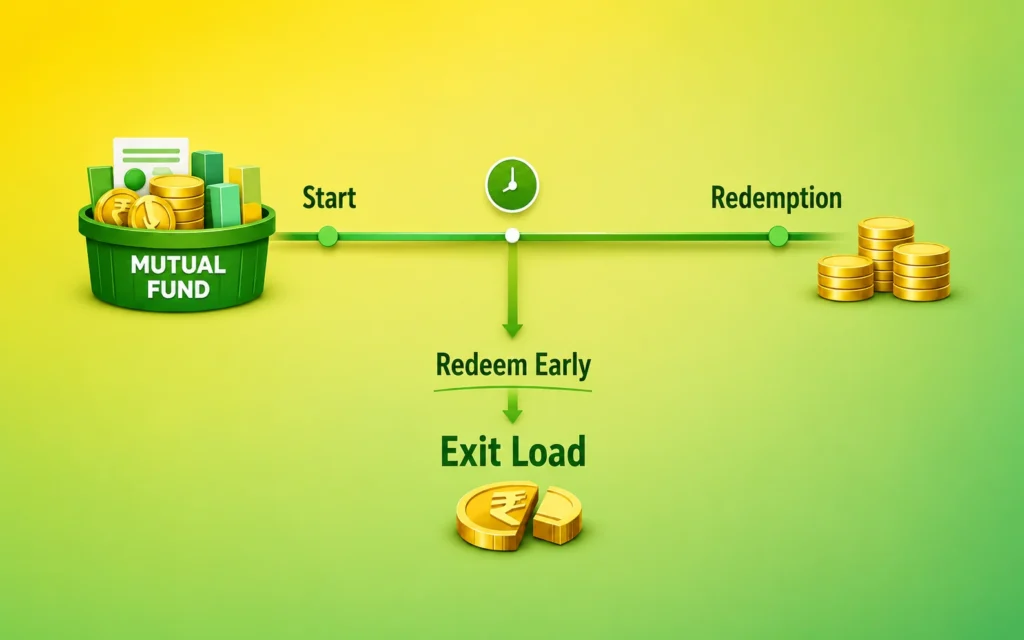
An exit load in mutual fund is charged when units are redeemed before the period specified by the scheme. The rate, holding period and calculation method depend on the scheme’s terms.
The calculation becomes more important when you invest through SIPs, redeem only part of your units, start an SWP or switch money between schemes. Each transaction can have a different exit-load impact.
What Is Exit Load in Mutual Fund?
Exit load is a percentage deducted from the redemption value when an investor withdraws eligible units within a specified period.
Fund houses use it to discourage frequent redemptions and manage sudden outflows from the scheme. It is not a standard charge across all mutual funds.
A scheme may have:
- No exit load
- A fixed exit load for a specified period
- A reducing or graded exit load
- A free-redemption limit followed by an exit load
- Different rules for different transaction types
For example, a scheme may charge 1% when units are redeemed within 12 months and no load after that. Another scheme may reduce the rate gradually as the holding period increases.
The applicable rule must be checked in the Scheme Information Document, Key Information Memorandum, latest factsheet or AMC addendum.
How Is Exit Load Calculated?
The basic formula is:
Exit Load = Units Redeemed × Applicable NAV × Exit Load Rate
The net redemption amount is:
Net Redemption Amount = Redemption Value − Exit Load
Where:
- Units redeemed means the number of units withdrawn.
- Applicable NAV is the NAV used to process the redemption.
- Exit load rate is the percentage applicable to those units.
Exit load calculation example
Suppose you redeem 1,000 units from a mutual fund.
- Applicable NAV: ₹50
- Redemption value: 1,000 × ₹50 = ₹50,000
- Exit load: 1%
- Exit load amount: ₹50,000 × 1% = ₹500
- Net redemption amount: ₹50,000 − ₹500 = ₹49,500
You receive ₹49,500 before considering any applicable tax or securities transaction tax.
What happens when the investment is in profit?
Assume you invested ₹40,000 and the current redemption value is ₹50,000.
If the exit load is 1%, it is calculated on ₹50,000, not on the original ₹40,000 investment.
The exit load will be:
₹50,000 × 1% = ₹500
What happens when the investment is in loss?
Assume you invested ₹50,000, but the current redemption value has fallen to ₹45,000.
If a 1% exit load applies:
₹45,000 × 1% = ₹450
Your net redemption amount will be ₹44,550.
An investment loss does not automatically remove the exit load. The scheme’s holding-period condition still applies.
How Exit Load Works for SIP Investments
Every SIP instalment is treated as a separate purchase. Each instalment receives units on its own allotment date and has an independent holding period.
This means stopping a SIP after 1 year does not make every unit exit-load-free. Recent instalments may still fall within the scheme’s exit-load period.
Redemptions generally follow the First In, First Out method. Under FIFO, the oldest available units are treated as redeemed first.
SIP exit load example
Assume a mutual fund charges 1% on units redeemed within 12 months.
You invest through 3 SIP instalments:
| SIP date | Investment | Purchase NAV | Units allotted |
|---|---|---|---|
| January 2025 | ₹10,000 | ₹20 | 500 |
| February 2025 | ₹10,000 | ₹22 | 454.55 |
| March 2025 | ₹10,000 | ₹25 | 400 |
In February 2026, you redeem 600 units at an NAV of ₹30.
Under FIFO:
- The first 500 units come from the January 2025 instalment.
- The next 100 units come from the February 2025 instalment.
Assume the January instalment has completed the required period, while the February instalment has not.
Exit load applies only to the 100 units from February:
- Redemption value subject to exit load: 100 × ₹30 = ₹3,000
- Exit load: ₹3,000 × 1% = ₹30
- Total redemption value: 600 × ₹30 = ₹18,000
- Net amount: ₹18,000 − ₹30 = ₹17,970
The exact eligibility depends on the unit allotment date and the redemption processing date.
Also Read: What Are the Benefits of SIP Investment?
Exit Load on Partial Redemption
A partial redemption does not trigger exit load on your entire investment. It applies only to the units being redeemed that fall within the exit-load conditions.
Suppose you hold 5,000 units and redeem 1,000 units. The remaining 4,000 units stay invested.
If all 1,000 redeemed units carry a 1% exit load and the applicable NAV is ₹25:
- Redemption value: 1,000 × ₹25 = ₹25,000
- Exit load: ₹25,000 × 1% = ₹250
- Net redemption amount: ₹24,750
Partial redemption with a free-unit limit
Some schemes allow a specified percentage of units to be redeemed without an exit load.
Assume:
- Total holding: 10,000 units
- Units allowed without exit load: 10%, or 1,000 units
- Units redeemed: 2,000
- Units subject to exit load: 1,000
- Applicable NAV: ₹20
- Exit load: 1%
The exit load will be:
1,000 × ₹20 × 1% = ₹200
Such free-redemption limits are scheme-specific. The policy may also define how the free units are calculated and whether earlier redemptions reduce the available limit.
Exit Load on SWP, STP and Mutual Fund Switches
Systematic transactions can trigger exit load because they may involve redemption of units.
Systematic Withdrawal Plan
Each SWP instalment is processed by redeeming enough units to pay the selected withdrawal amount.
If the redeemed units have not completed the required holding period, the scheme may deduct exit load from that instalment.
Example:
- Monthly SWP amount: ₹10,000
- Applicable exit load: 1%
- All redeemed units fall within the load period
The load may reduce the amount received or increase the number of units redeemed, depending on how the scheme processes the transaction.
Investors planning an SWP should check whether the oldest units will complete the exit-load period before the first withdrawal begins.
Also Read: What Is SWP in Mutual Fund?
Systematic Transfer Plan
An STP moves money from one mutual fund scheme to another. The transfer is normally processed as:
- Redemption from the source scheme
- Fresh investment into the destination scheme
Exit load may apply to the units redeemed from the source scheme. The destination scheme starts a new holding period for the newly allotted units.
Also Read: What Is a Systematic Transfer Plan?
Switching between schemes or plans
A switch-out is generally treated as redemption from the existing scheme. A switch-in is treated as a new purchase in the destination scheme.
Exit load may apply when switching:
- From one scheme to another
- From a regular plan to a direct plan
- From a direct plan to a regular plan
- Between growth and income-distribution options
- From one asset category to another
The transaction may also have tax consequences because a switch can be treated as a transfer for tax purposes.
Investors considering a plan switch should first compare direct vs regular mutual funds, including their costs, support model and tax implications.
Exit Load Across Mutual Fund Categories
There is no universal exit-load rate for an entire mutual fund category.
| Fund category | Common structure investors may find | What to verify |
|---|---|---|
| Equity funds | Load for redemption within an initial period | Rate, period and free-unit limit |
| Hybrid funds | Load linked to an early redemption period | Whether the rate changes over time |
| Debt funds | Nil, fixed or graded load depending on the scheme | Holding period and reducing rate |
| Liquid funds | Graded load may apply to very early redemption | Day-wise load structure |
| Overnight funds | Commonly structured without exit load | Current scheme terms |
| Index funds | Depends on the individual scheme | Direct AMC redemption rules |
| Fund of Funds | Scheme-specific load period | Costs at both scheme levels |
| ELSS | Units cannot be redeemed during the lock-in | Lock-in completion for each instalment |
These are common structures, not fixed rules. Two funds within the same category can have different exit loads.
ELSS follows a separate withdrawal structure because each investment remains locked for 3 years. This also applies separately to every SIP instalment.
Also Read: What Is ELSS Fund in India?
Exit Load vs Expense Ratio, Tax and Lock-In
Investors often combine these costs and restrictions, though each affects an investment differently.
| Cost or restriction | When it applies | Effect |
|---|---|---|
| Exit load | Eligible units are redeemed early | Deducted from redemption value |
| Expense ratio | During the investment period | Reflected in the scheme’s NAV |
| Capital gains tax | Taxable gains arise on redemption or transfer | Creates a tax liability |
| Stamp duty | Units are purchased | Slightly reduces the units allotted |
| Lock-in period | Withdrawal is restricted | Redemption is not permitted |
Exit load and lock-in period
Exit load permits redemption after deducting the applicable charge. A lock-in prevents redemption during the stated period.
A mutual fund can have no lock-in and still charge an exit load.
ELSS units have a 3-year lock-in. For SIP investments in ELSS, every instalment completes its own 3-year period.
Exit load and capital gains tax
Waiting until the exit-load period ends does not automatically remove tax.
For example, a scheme may stop charging exit load after 12 months, while the tax treatment depends on the fund category, purchase date, holding period and tax rules applicable at redemption.
Both amounts should be checked separately before withdrawing.
Exit load and expense ratio
The mutual fund expense ratio is deducted through the NAV while you remain invested. Exit load is deducted when eligible units are redeemed.
A scheme with no exit load may still have a higher expense ratio than another scheme. Compare both costs before selecting a fund.
Where to Check Exit Load Before Investing or Redeeming
Do not depend only on the brief information shown on an investment app.
Check the latest:
- Scheme Information Document
- Key Information Memorandum
- AMC website
- Scheme factsheet
- Statement of Additional Information
- AMC addendums
- Investment platform’s detailed scheme page
Verify these points:
- Exit-load percentage
- Applicable holding period
- Free-redemption allowance
- Graded or reducing load
- SIP instalment treatment
- SWP and STP rules
- Switch-out conditions
- Effective date of any change
- Treatment of units purchased on different dates
Changes announced by an AMC may apply prospectively. Units purchased before and after a change can carry different load structures, depending on the terms of the announcement.
Should Exit Load Affect Your Mutual Fund Choice?
Exit load should be considered alongside the investment goal, expected holding period, risk level, performance consistency and expense ratio.
A fund with no exit load is not automatically suitable. A fund charging an exit load is not automatically expensive.
Pay closer attention to exit load when:
- You may need the money within a few months
- You are investing an emergency fund
- You plan to start an SWP soon
- You regularly switch funds
- You are moving from a regular plan to a direct plan
- Your SIP contains recent instalments
- You may need partial withdrawals
Equity funds should generally be selected for goals that allow enough time to manage market volatility. Short-term money may require a lower-volatility option with suitable redemption rules.
A liquid mutual fund may be considered for short-term money parking, but investors must still check its graded exit load, credit risk, expense ratio and redemption timeline.
How to Reduce or Avoid Exit Load
You can reduce avoidable exit load by planning the redemption date and checking which units have completed the required period.
Useful steps include:
- Hold units beyond the stated exit-load period where practical.
- Check the allotment date of each SIP instalment.
- Use FIFO calculations before submitting a partial redemption.
- Review free-redemption limits.
- Start an SWP only after checking the age of available units.
- Check the source scheme before beginning an STP.
- Calculate the cost before switching plans.
- Keep emergency money separate from long-term investments.
Delaying a necessary withdrawal may expose the investment to further market movement. Compare the likely exit load with the risk of remaining invested for longer.
Conclusion
Exit load is calculated on the current value of the units being redeemed, using the rate and holding period stated by the mutual fund scheme.
For lump-sum investments, the calculation is usually direct. SIPs, partial withdrawals, SWPs, STPs and switches require unit-level checking because different purchases can have different holding periods.
Before redeeming, confirm the applicable NAV, eligible units, exit-load rate and tax treatment. Checking the SID, KIM or AMC website can prevent an unexpected deduction.
FAQs