A profitable business can still result in a weak term-insurance application when the owner’s income records are incomplete or inconsistent. Insurers assess the income available to the applicant, not simply the revenue earned by the business.
People comparing term insurance for self employed applicants should prepare their financial records before choosing a large sum assured. Recent income tax returns, business accounts, bank statements and accurate disclosures can directly affect the cover, premium and underwriting decision.
Can self-employed people buy term insurance?

Self-employed people can buy term insurance in India, subject to the insurer’s eligibility and underwriting rules.
This includes:
- Business owners
- Freelancers
- Consultants
- Doctors, architects and other professionals
- Partners in a firm
- Traders
- Independent contractors
- Gig workers
The insurer checks whether the requested cover is reasonable compared with the applicant’s income, liabilities, occupation, age and health profile.
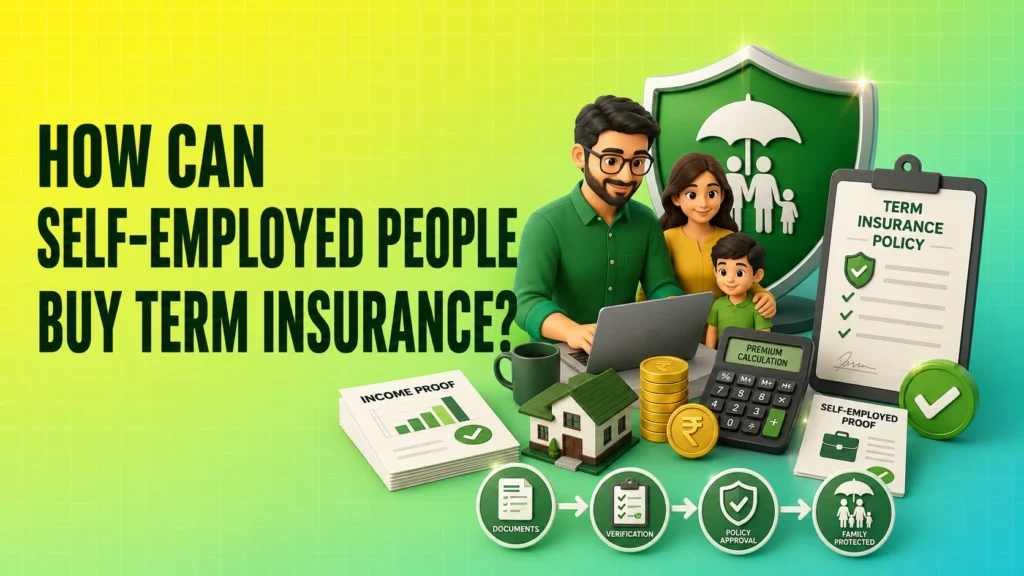
A salaried applicant usually proves income through salary slips and Form 16. A self-employed applicant may need income tax returns, computation of income, audited financial statements or other accepted financial records.
How insurers assess self-employed applicants
The insurance company conducts financial and medical underwriting before approving the policy. The assessment usually covers the following areas.
Declared personal income
The insurer needs to estimate the financial loss that the family may face after the applicant’s death. Personal income shown in tax returns and financial statements carries more weight than business sales or turnover.
For example, a business may report annual revenue of ₹1 crore, but the owner’s taxable income may be ₹15 lakh. The requested sum assured will usually be assessed against the owner’s income and financial interest.
Income consistency
A single high-income year may not support a large term cover when the previous years show much lower earnings.
Insurers may check recent income records to understand:
- Whether income is stable
- Whether profits are rising or falling
- Whether the latest income is sustainable
- Whether there are unexplained changes in reported earnings
Applicants with seasonal or irregular income should provide consistent records across multiple financial years.
Age of the business
A recently started business has a limited financial history. The insurer may ask for more records, approve a smaller cover or postpone the application until the business has completed a reasonable operating period.
An established business with regular tax filings and audited accounts is easier to assess.
Nature of occupation
Some occupations carry higher physical, travel or workplace risks. The insurer may ask additional questions when an applicant works in mining, construction, offshore operations, hazardous manufacturing or another high-risk field.
The occupation can affect the premium, available cover and underwriting terms.
Existing insurance and liabilities
The insurer may consider:
- Current life insurance policies
- Home and personal loans
- Business loans carrying a personal guarantee
- Family responsibilities
- The total cover requested across insurers
Every existing or pending life insurance application should be disclosed in the proposal form.
Health and lifestyle
Age, medical history, tobacco use, alcohol consumption, body measurements and family medical history may affect underwriting.
The insurer decides whether medical tests are required. Applicants with a suitable age, health and financial profile may explore whether they can buy term insurance without a medical test, though approval still depends on the insurer’s underwriting rules.
Documents required for term insurance for self employed applicants
Document requirements differ between insurers, cover amounts and applicant profiles. A self-employed person may be asked for the following records.
| Document category | Commonly requested documents | Purpose |
|---|---|---|
| Income proof | Recent ITRs, computation of income, audited profit and loss account | Confirms personal earning capacity |
| Financial records | Balance sheet, capital account, bank statements | Shows financial position and income flow |
| Business proof | GST registration, business registration, partnership deed | Confirms the nature and ownership of the business |
| Identity proof | PAN, Aadhaar, passport or driving licence | Completes KYC verification |
| Address proof | Aadhaar, passport, utility bill or accepted bank record | Confirms residential address |
| Medical information | Health declaration and medical reports | Supports medical underwriting |
| Existing insurance details | Policy numbers and sum assured | Checks total life cover |
Insurers commonly ask for recent 2 or 3 years of financial records, though the exact period varies.
What if you do not have salary slips?
Salary slips are generally not required for self-employed applicants because they do not receive a fixed salary from an employer.
You may be able to provide:
- Income tax returns
- Computation of income
- Audited business accounts
- Personal or business bank statements
- A chartered accountant-certified financial statement
- GST or business registration records
Some insurers may consider approved financial surrogates when standard income records are unavailable. These can include bank statements or investment records, depending on the insurer’s underwriting policy.
Acceptance of alternative documents does not guarantee approval. The insurer may restrict the sum assured, request further records or decline the application when income cannot be assessed reliably.
How much term insurance should a self-employed person buy?

A fixed income multiple gives only a rough estimate. Self-employed applicants should calculate cover using family expenses, personal debt, future goals and business liabilities that may affect their dependants.
A practical formula is:
Required term cover = Family income corpus + outstanding personal loans + future goals + personally linked business liabilities − existing life cover and usable financial assets
You can also use a term insurance calculator to estimate the cover required for income replacement, outstanding debts and major family goals.
Include these financial needs
Family income replacement
Estimate the annual amount your family would need after your death. Account for household costs, healthcare, education expenses and inflation.
Use sustainable personal income for this calculation. Do not use gross business turnover.
Outstanding personal loans
Include the unpaid balance on:
- Home loans
- Personal loans
- Vehicle loans
- Education loans
- Credit card debt
If a home loan forms a large part of your liabilities, compare term cover with dedicated home loan insurance plans before deciding how the outstanding debt should be protected.
Future family goals
Estimate the money required for children’s education, dependent parents and other essential goals.
Avoid adding optional goals that would make the premium difficult to maintain.
Business liabilities affecting the family
A business loan does not always need to be included in personal term cover. Include it when:
- You have given a personal guarantee
- Family assets are pledged
- Your spouse or family may become responsible for repayment
- The business depends heavily on your involvement
- Your death could force the family to settle the debt
Business liabilities that remain entirely within a separate legal entity need a different assessment.
Existing assets and life insurance
Deduct financial assets that your family can use without disrupting essential goals. These may include liquid investments, deposits and existing life cover.
Do not deduct the family home when dependants will continue living in it.
Example of cover calculation
Consider a 36-year-old business owner with these financial responsibilities:
- Family income corpus: ₹1.35 crore
- Home loan: ₹45 lakh
- Children’s education: ₹35 lakh
- Parent-care fund: ₹15 lakh
- Personally guaranteed business loan: ₹20 lakh
Total requirement: ₹2.50 crore
The applicant already has:
- Existing life cover: ₹25 lakh
- Usable financial investments: ₹35 lakh
Estimated cover gap:
₹2.50 crore − ₹60 lakh = ₹1.90 crore
The applicant may consider cover near ₹1.9 crore, subject to affordability and the insurer’s financial underwriting.
How to buy term insurance with irregular income

Self-employed income may rise or fall with business conditions. The policy should remain affordable during lower-income periods.
Use sustainable income
Calculate affordability using an average of recent earnings rather than the most profitable month or year.
A premium that looks manageable during a strong business period may become difficult during a slowdown.
Keep personal and business finances clear
Maintain separate bank accounts where possible. Clear records make it easier to show:
- Business receipts
- Business expenses
- Owner withdrawals
- Personal income
- Loan repayments
Mixing personal spending with business transactions may make the financial assessment harder.
File tax returns consistently
Regular tax filings give insurers a clearer income history. Large unexplained differences between bank credits, business accounts and declared income may lead to further questions.
Choose a suitable premium-payment schedule
Annual payments may suit applicants who receive income seasonally, provided the premium is set aside in advance.
Monthly payments spread the cost across the year, but the applicant must maintain enough cash flow for every due date.
Set aside the annual premium as part of the business and personal cash-flow plan.
Steps to apply for self-employed term insurance
1. Calculate the cover requirement
List household expenses, outstanding debt, future family goals and business liabilities carrying personal exposure.
Deduct existing life cover and assets that dependants can use.
2. Check your financial eligibility
Review recent ITRs, computation of income and business financial statements. The requested sum assured should have a reasonable connection with your documented income.
3. Collect the required documents
Keep clear copies of:
- PAN and identity proof
- Address proof
- Recent income tax returns
- Computation of income
- Bank statements
- Business registration records
- Audited accounts, where applicable
- Existing insurance details
Submitting complete records can reduce avoidable follow-up requests.
4. Compare plans based on eligibility
A low advertised premium has limited value when the insurer may not approve the desired cover for your financial profile.
Compare:
- Maximum cover available for your income
- Policy term
- Premium payment term
- Payout choices
- Medical requirements
- Rider conditions
- Exclusions
- Claim support process
Check the latest policy brochure and benefit illustration before applying.
5. Complete the proposal form accurately
Enter the correct occupation, annual income, health history, tobacco use and existing insurance details.
Do not allow an intermediary to enter estimated or incorrect information merely to complete the application faster. Read every declaration before submitting it.
6. Complete financial and medical underwriting
The insurer may request extra records or medical tests after reviewing the proposal.
Respond within the specified time and submit documents that match the information already declared.
7. Review the underwriting decision
The insurer may:
- Accept the application on standard terms
- Increase the premium
- Approve a lower sum assured
- Add specific terms
- Postpone the decision
- Decline the application
Review any revised cover or premium before accepting the policy.
8. Check the issued policy
After issuance, verify:
- Name and date of birth
- Sum assured
- Policy and premium-payment terms
- Nominee details
- Smoking status
- Rider details
- Exclusions
- Premium due date
Business owners should also include insurance records, nominee details, major liabilities and important asset documents in their estate planning for the family.
How to compare term plans as a self-employed applicant
Financial eligibility
Check whether your documented income supports the required cover. Premium comparison should come after this step.
Policy term
Choose a term that covers the period during which your family depends on your income or remains exposed to major liabilities.
Cover running far beyond the working and liability period may increase the premium without solving a clear financial need.
Premium payment term
Common choices include regular pay, limited pay and single pay.
| Payment option | May suit | Main concern |
|---|---|---|
| Regular pay | Applicants seeking lower periodic premiums | Payments continue for a longer period |
| Limited pay | Applicants with strong current cash flow | Premiums are higher during payment years |
| Single pay | Applicants with a large available surplus | High upfront outflow and limited payment flexibility |
Compare the total premium payable and cash-flow impact. Do not choose limited pay only to finish premiums early.
Death-benefit payout
A lump-sum payout gives the nominee immediate access to the full benefit. An income or instalment option distributes the benefit over a set period.
The payout structure should match the nominee’s ability to manage a large amount and the family’s immediate debt obligations.
Riders
A waiver of premium, accidental death, disability or critical illness rider may cover a specific risk. Read the trigger, exclusions and payout conditions before paying the additional premium.
A rider should address an identified need. It should not replace separate health or disability cover where broader protection is required.
Insurer information
Review the insurer’s current:
- Claim settlement disclosures
- Solvency information
- Complaint data
- Product documents
- Service channels
Use the same measurement period when comparing insurers. One ratio should not decide the purchase.
Reasons an application may be delayed, reduced or declined
Income proof does not support the cover
A large gap between declared income and requested cover can lead to a lower offer or rejection.
Apply for a sum assured supported by your current financial records.
The business has a short operating history
A new business may not have enough tax returns or audited records. The insurer may request alternative evidence or ask the applicant to apply later.
Records show unexplained income changes
Sharp changes between tax returns, bank records and financial statements may trigger further verification.
Provide an explanation and supporting documents where the change has a genuine business reason.
Existing insurance was not disclosed
Insurers may check existing and pending applications. Missing details can affect underwriting and may create problems during a future claim review.
Health or tobacco information is incomplete
Declare current and past medical conditions, medication, surgery, tobacco use and relevant tests as asked in the proposal form.
Complete disclosure matters because incorrect income, health or occupation details are among the common term insurance claim rejection reasons.
The occupation carries higher risk
Some occupations may attract an extra premium, restricted cover or stricter underwriting.
Describe the actual work performed. A broad job title may not give the insurer enough information to assess the risk.
Mistakes self-employed applicants should avoid
Using business turnover as personal income
Turnover measures business receipts. It does not show how much income the owner earns after expenses and taxes.
Use personal taxable income and the relevant share of business profits.
Applying for an unsupported sum assured
Requesting a very large cover without matching income records can delay the application.
Calculate the need first, then check whether it fits the insurer’s financial eligibility rules.
Hiding existing policies or applications
Disclose active policies, pending proposals and recently declined or postponed applications when asked.
Choosing an unaffordable payment option
The policy must remain active during weak business periods. Compare the premium with normal cash flow, not peak earnings.
Ignoring personally guaranteed business debt
A personal guarantee can expose family assets after the owner’s death. Include this exposure when calculating cover.
Allowing inconsistent information
Income, occupation and health information should match across the proposal form and supporting records. Correct errors before submitting the application.
Final checklist before submitting the application
Confirm that:
- The sum assured matches your documented income and financial need
- Personal income has not been confused with business turnover
- Recent ITRs and financial records are ready
- Personal guarantees and family liabilities are included
- Existing policies and pending applications are disclosed
- Health and tobacco information is complete
- The premium remains affordable in a low-income year
- Nominee details are correct
- Every proposal declaration has been reviewed
Conclusion
Buying term insurance for self employed people requires stronger financial preparation than simply comparing premiums online.
Start with the amount your family would need. Match that amount with documented personal income, prepare recent tax and business records, and disclose all health and insurance details correctly.
The right self-employed term insurance plan is one that provides enough approved cover and carries a premium you can continue paying through changing business conditions.