Fixed Deposits (FDs) and Recurring Deposits (RDs) are two of the safest and most familiar savings options in India. Both are offered by banks and also by many post offices, and both give you a fixed return based on the deposit terms. If you are trying to decide fd vs rd which is better, the short answer is: it depends on how you save money. An FD is better when you already have a lump sum, while an RD works well when you want to build savings little by little every month.
These are not high-risk investments. They are simple, low-risk, fixed-income products meant for capital safety and disciplined saving. That said, the return is also usually modest, and both products can be affected by inflation over time. So the right choice is not about chasing the highest returns. It is about matching the product with your cash flow, goal, and comfort with locking money away.
Understanding FD vs RD: Key Differences
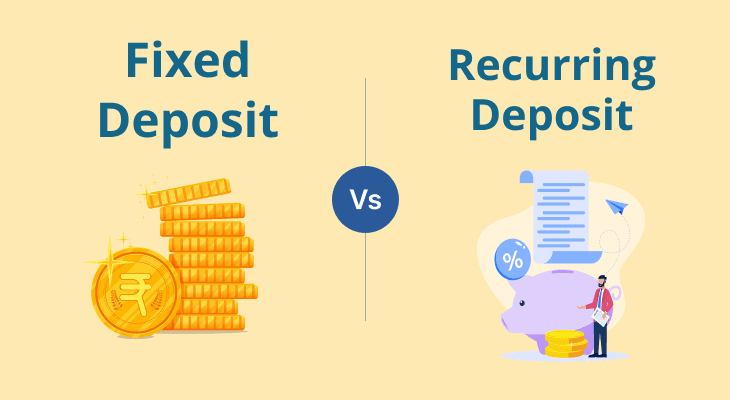 The main difference between an FD and an RD is how you put in money. A fixed deposit requires one one-time lump sum deposit. A recurring deposit lets you deposit a fixed amount every month for a chosen tenure. In both cases, the bank or post office pays interest according to the deposit terms.
Think of an FD as a “park one amount and let it grow” product. Think of an RD as a “save monthly with discipline” product. That basic difference affects everything else, including interest calculation, flexibility, and how suitable each product is for your situation.
How Fixed Deposit (FD) Works
In an FD, you deposit a lump sum amount for a fixed period such as 7 days, 1 year, 3 years, or more, depending on what the bank offers. The money stays locked for the chosen tenure unless you choose to break it early, which may attract a penalty. At maturity, you receive your principal plus interest.
FDs also give more choice in how you receive interest. Many banks offer cumulative FDs, where interest is added to the principal and paid at maturity. Some banks also offer non-cumulative options, where interest is paid monthly, quarterly, half-yearly, or yearly. This choice matters if you want regular income from your deposit.
Example: If you receive a festival bonus or a maturity amount from another savings plan, you may put that amount into an FD instead of letting it sit idle in your savings account. This can help you earn a fixed return for a period you are comfortable with.
How Recurring Deposit (RD) Works
An RD is designed for monthly saving discipline. You deposit a fixed amount every month for a selected tenure, such as 6 months, 1 year, or 5 years. The monthly instalment is usually easy to plan if you have a regular salary or steady income.
RDs are often called a form of forced savings because you commit to saving a fixed amount regularly. If you miss an instalment, the bank may charge a penalty or adjust the interest according to its rules. The interest is generally calculated on the reducing balance, which means the amount earning interest grows as your monthly deposits accumulate.
Example: If you want to save ₹3,000 or ₹5,000 every month for a future goal like an emergency fund, exam fees, travel, or a small purchase, an RD can help you stay disciplined without needing a large starting amount.
FD vs RD: A Comparative Overview
The table below gives a simple side-by-side view of FD and RD. Since bank terms can change, always check the latest rates, minimum amount, and penalty rules on the official website of your bank or post office before investing.
| Feature | Fixed Deposit (FD) | Recurring Deposit (RD) | What to Consider |
|---|---|---|---|
| Investment mode | One-time lump sum deposit | Monthly instalments | Choose based on how you receive money |
| Best for | People with spare funds or windfall amounts | People who want monthly saving discipline | Match the product to your cash flow |
| Tenure | Flexible, from short to medium/long terms | Flexible, usually with fixed monthly commitment | Longer tenure may offer different rates |
| Interest rates | Usually similar to RD, but bank-specific | Usually similar to FD, but bank-specific | Compare the exact rate before booking |
| Interest calculation | On the deposited lump sum | On monthly deposits, often on reducing balance | FD may suit those with larger capital upfront |
| Interest payout | Cumulative or periodic payout options | Usually paid at maturity | Choose payout style based on income needs |
| Liquidity | Can be broken early, usually with penalty | Can be closed or discontinued early, usually with penalty | Both are less liquid than savings accounts |
| Minimum amount | Varies by bank | Varies by bank | Check account-specific rules |
| TDS | May apply if interest crosses the threshold | May apply if interest crosses the threshold | Interest is taxable as per your slab |
| Safety | Low-risk deposit product | Low-risk deposit product | DICGC deposit insurance applies up to ₹5 lakh per depositor per bank, subject to rules |
Which One is Better for You?
The better option depends on your money pattern, not just the headline rate. Both are safe, but they serve different habits and needs.
Choose FD if:
- You already have a lump sum amount, such as a bonus, inheritance, maturity proceeds, or savings you do not need immediately.
- You want to keep money parked for a fixed period without adding money every month.
- You prefer a simpler, one-time setup rather than following a monthly deposit schedule.
- You may want periodic interest payouts for regular cash flow.
Choose RD if:
- You are a salaried professional, student, or self-employed person with regular monthly income.
- You want to build a corpus through small monthly savings.
- You struggle to save unless money is automatically committed each month.
- You are saving for a short- to medium-term goal and want a disciplined habit.
A practical way to think about it is this: if the money is already with you, FD may be easier. If the money will arrive in small monthly amounts, RD may suit you better.
Important Factors to Consider Before Investing

Before you open either product, look beyond the advertised interest rate. A few details can materially affect your actual return and convenience.
1) TDS on interest
Interest from FD and RD is taxable. Banks may deduct Tax Deducted at Source, or TDS, if the interest paid in a financial year crosses the threshold set by tax rules. For regular individuals, the threshold is commonly ₹40,000 in a financial year. For senior citizens, it is commonly ₹50,000 in a financial year. These limits can change, so verify the latest rule on the Income Tax Department website or with your bank.
TDS is not extra tax by itself. It is a deduction at source. Even if TDS is deducted, you may still owe more or less tax depending on your total income and tax slab. Interest income from deposits is generally added to your income and taxed accordingly.
2) Premature withdrawal penalties
Both FD and RD may allow early closure, but that usually comes with a penalty and lower interest. The exact penalty is bank-specific and often falls in the range of 0.5% to 1%, though the rule can differ by bank, tenure, and product type. Some banks also revise the interest payable on broken deposits. If you think you may need money soon, do not lock the entire amount into a long tenure.
3) Interest rate differences by bank and tenure
FD and RD rates are not fixed across all banks. Private banks and public sector banks may offer different rates, and even the same bank may offer different rates for different tenures. Senior citizen rates may also be higher in many banks. Before investing, compare the exact rate, compounding pattern, payout frequency, and penalty rules.
4) Cumulative vs non-cumulative interest
This is one of the most misunderstood parts of FD and RD planning. In a cumulative FD, interest is added to the principal and compounded over the tenure, and you receive the total at maturity. In a non-cumulative FD, interest is paid out at regular intervals. If you need income now, non-cumulative may be useful. If you do not need the cash flow immediately, cumulative deposits may suit long-term parking better.
For RDs, interest is generally credited at maturity. The important point is to check whether the deposit suits your savings goal: growth at maturity or regular cash flow.
5) Safety and deposit insurance
FDs and RDs are considered low-risk because they are bank deposit products, not market-linked products. In India, deposits are covered by DICGC deposit insurance up to ₹5 lakh per depositor per bank, subject to the scheme rules. If you keep large sums in deposits, it is sensible to understand this coverage and how your money is spread across banks.
6) Inflation matters
FDs and RDs are useful for safety and short-term goals, but they are not designed to beat inflation aggressively. If your goal is long-term wealth creation, these products may not be enough on their own. They are better viewed as safe savings tools, not high-growth investments.
FD vs RD Decision Matrix
Use this quick guide if you want a simple answer based on your situation. This is a general comparison, so your bank’s terms, current interest rates, and personal financial goals should always come first.
| Your Situation | Better Choice | Why |
|---|---|---|
| You have a lump sum amount already | FD | You can lock in one amount and earn fixed interest on it |
| You want to save from your monthly salary | RD | Small monthly deposits make saving easier |
| You want regular interest income | FD | Some FDs offer monthly or quarterly payout options |
| You want a disciplined saving habit | RD | Monthly instalments create saving discipline |
| You may need money soon | Neither is ideal | Both have low liquidity and may attract penalties if broken early |
| You want a simple, one-time setup | FD | One deposit is easier to manage than monthly payments |
| You are saving for a short-term goal | Either, depending on cash flow | Choose based on how you can fund the goal |
If you want the shortest practical answer: choose FD for a lump sum, choose RD for monthly savings. That rule works for most beginners.
FAQs
Which offers higher interest rates, FD or RD?
In many banks, FD and RD interest rates are similar, but the exact rate depends on the bank, tenure, and customer category. Always compare the current rate before opening either deposit.
Can I withdraw my money early from an FD or RD?
Yes, both FD and RD can usually be closed early, but banks may charge a penalty and pay lower interest than originally promised. Check your bank’s premature withdrawal rules first.
Is interest earned on FD and RD taxable?
Yes. Interest from FD and RD is taxable and is added to your income. It is taxed as per your applicable income tax slab.
Is it better to open an RD or a SIP in a mutual fund?
If your priority is safety and fixed returns, RD is the safer choice because it is a bank deposit. A SIP in a mutual fund is market-linked, so it carries risk and may suit long-term wealth creation instead of capital safety.
What happens if I miss an RD installment?
If you miss an RD installment, the bank may charge a penalty, reduce the interest, or treat the account according to its product rules. The exact treatment depends on the bank, so read the RD terms carefully.