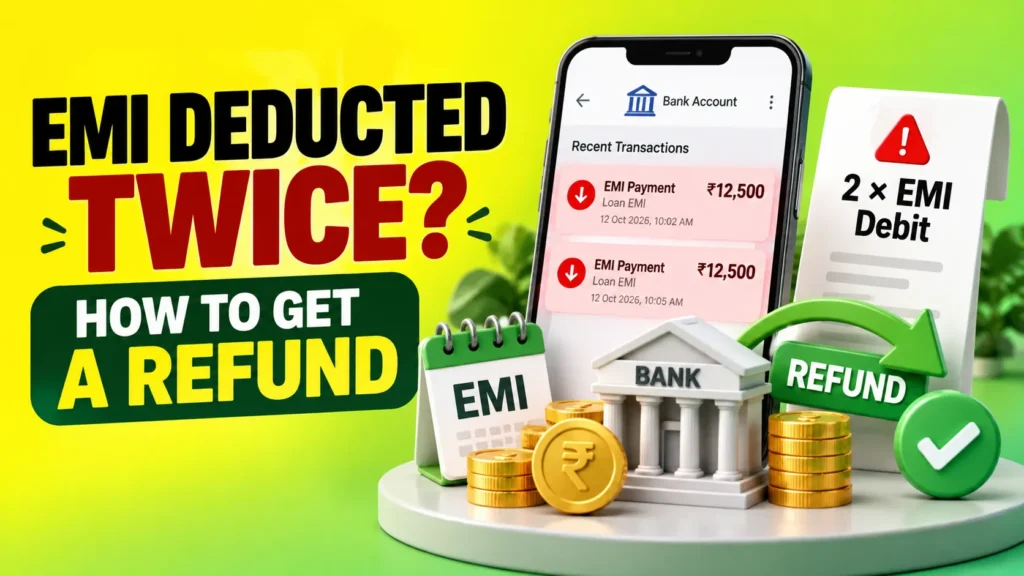
If your EMI is deducted twice, check that both payments are completed debits for the same loan instalment. Then raise a written complaint with your lender, attach both transaction references and your bank statement, and request a refund of the excess amount. Inform your bank too if a debit is unexplained or the lender cannot trace it. Do not skip your next EMI unless the lender confirms an adjustment in writing.
A double deduction can upset your monthly budget, especially when rent, bills and other payments are due. However, two debit alerts do not always mean you have paid the same EMI twice. One entry could be pending, a separate overdue instalment, or a charge that needs explanation.
This guide explains how to identify the problem, what to include in your refund request and how to follow up without creating another repayment issue.
What Does “EMI Deducted Twice” Mean?
It means two payments have been collected against what you expected to be one loan instalment. For example, a scheduled auto-debit and a separate manual payment may both reach your loan account.
An EMI or equated monthly instalment, is your scheduled loan repayment. To confirm an excess collection, compare your bank statement with the lender’s loan statement and repayment schedule.
Illustrative example: Your monthly EMI is ₹8,000. You pay ₹8,000 through the lender’s app on 4 September, and an automatic debit collects another ₹8,000 on 5 September. If both payments settled against the same loan and no other amount was due, ask the lender to explain and refund the extra ₹8,000.
Why Can an EMI Be Deducted Twice?
The following are possible causes to investigate. Your lender and bank must confirm what happened in your case.
| Possible reason | What may have happened | What to check |
|---|---|---|
| Manual payment plus auto-debit | You paid manually after the automatic collection instruction had already been submitted. | Manual receipt, debit date and the lender’s collection cut-off. |
| Payment status updated late | The first payment appeared pending, so you paid again; both later completed. | Final status and reference number for each payment. |
| Duplicate collection instruction | A collection instruction may have been submitted or processed twice. | Both debit references and the lender’s reconciliation. |
| More than one active repayment instruction | An old instruction may still be active after a repayment arrangement changed. | Mandate details and the accounts from which money was collected. |
| Current EMI plus an overdue amount | One payment may cover an earlier unpaid instalment. | Loan ledger, overdue balance and repayment schedule. |
| Separate charge or temporary entry | A fee or pending entry may look like a second EMI. | Transaction description, amount and whether the debit actually settled. |
If your repayment uses NACH, MoneyMoksh’s guide to NACH mandates and charges explains the authorisation behind automatic collections. An active mandate and a manual payment should be checked together when investigating a double debit.
What Should You Do Immediately?
- Check your bank statement. Record both amounts, dates, descriptions and references. Look for any reversal credit.
- Check your loan account. See whether the lender recorded one payment, two payments or an unapplied credit.
- Confirm the instalment involved. Make sure the payments relate to the same loan and due period.
- Save evidence. Download the relevant statement and payment receipts before raising your complaint.
- Avoid another payment based only on a pending screen. Ask the lender to trace the existing transactions first.
If you do not recognise the lender or did not authorise the transaction, report it to your bank immediately as an unrecognised debit. Do not treat it only as a routine refund request.
How to Request a Refund for a Double EMI Deduction
1. Raise a written complaint with your lender
Use the customer support or grievance channel listed on the lender’s official website, app or loan documents. Explain that two payments appear to have been taken for one instalment and ask for reconciliation of both entries.
Get a complaint reference number. A telephone conversation can help, but a written record makes follow-up easier.
2. Submit the relevant documents
- Your loan account number and registered contact details.
- The EMI amount and instalment due date.
- Both debit dates, amounts and transaction references.
- A bank statement showing the two debits and any reversal.
- The manual payment receipt, if you paid through an app or payment link.
- The loan statement and any earlier complaint acknowledgement.
Use the reference shown for each payment; not every payment system labels it a UTR. If your receipt includes one, this guide explains what a UTR number is and where to find it.
Send documents through an official channel. Never share an OTP, banking password or UPI PIN to receive a refund.
3. State the resolution you want
Ask for the excess payment to be returned to your bank account. If you would prefer an adjustment against a future instalment, request written confirmation of the amount, the instalment covered and whether the next auto-debit will still run.
Do not assume that an extra payment automatically cancels next month’s EMI or reduces principal. Ask how the lender has allocated it.
4. Contact your bank when tracing is needed
If the lender says it received only one payment, ask your bank to trace the other debit. Share the lender’s response and both references. Request confirmation of whether the payment settled, failed or was reversed.
If both parties refer you to each other, keep the complaint acknowledgements and ask each to provide its transaction findings in writing.
5. Obtain a target date and check the result
Ask when reconciliation will finish and when an approved refund should reach your account. This is the complaint’s turnaround time; our guide to TAT in banking explains the term.
Once resolved, verify the refund in your bank statement and the allocation in your loan statement. Also confirm that the correct instalment is marked paid.
EMI Deducted Twice: Refund Request Email
Replace the placeholders below and send the request through your lender’s official support channel.
Subject: Refund request for duplicate EMI payment — Loan account [number]
Dear Customer Support Team,
My EMI of ₹[amount], due on [date], appears to have been collected twice against loan account [number].
Payment 1: ₹[amount], [date], reference [reference].
Payment 2: ₹[amount], [date], reference [reference].Please reconcile these payments and explain how each has been allocated. If both were collected against the same instalment without another amount being due, please refund the excess ₹[amount] to my bank account.
I have attached the relevant bank statement and payment receipts. Please provide a complaint reference number, the expected resolution date and confirmation that the instalment is recorded correctly. Please also review any charges or adverse repayment reporting caused by this error.
Please confirm any proposed adjustment against a future EMI before treating this request as resolved.
Regards,
[Name]
[Registered contact details]
How Long Does a Double EMI Refund Take?
Do not assume that every duplicate EMI refund follows a fixed three-, seven- or ten-day timeline. The next step depends on whether both payments reached the lender, one payment failed, or a disputed mandate was used. Ask for the timeline applicable to your specific complaint.
RBI’s failed-transaction framework specifies reversal deadlines for particular payment failures. For an uncredited NACH transaction, it prescribes reversal by T+1 and ₹100 per day for delay beyond that deadline. Here, T is the transaction’s calendar date.
That is not a blanket refund or compensation rule for two successful EMI payments. If both payments reached the lender, ask it to reconcile the excess collection and confirm the applicable refund process. A failed payment and a successful duplicate collection require different checks.
What If the Lender Does Not Resolve the Complaint?
Escalate through the lender’s published grievance process, attaching your original complaint, evidence and responses. State the amount still disputed and the resolution requested.
For entities covered by RBI’s Integrated Ombudsman Scheme, the current RBI FAQs say you must first complain to the entity. You can approach the Ombudsman after an unsatisfactory reply, or after no reply within 30 days or the applicable RBI/NPCI/card-network timeline, whichever is longer.
The current FAQs specify filing within 90 days from expiry of that timeline or the entity’s last communication, whichever is later. Check eligibility and deadlines before filing through the RBI Complaint Management System. Filing is free. Not every lender is covered; check the route applicable to your institution.
Should You Skip the Next EMI or Cancel Auto-Debit?
Do not skip the next EMI just because two payments were collected this month. Until the lender confirms otherwise, treat your repayment schedule as continuing.
Similarly, cancelling auto-debit does not cancel your loan obligation. If duplicate collections are recurring, ask your lender and bank to identify the incorrect instruction and agree on a reliable payment arrangement before the next due date.
If you accept a future-EMI adjustment, obtain confirmation of whether you need to maintain funds for another automatic collection.
Can a Double EMI Deduction Affect Your Credit Record?
The key issue is how your lender records repayment. Ask it to confirm that the correct instalment is marked paid and that the dispute has not left an incorrect overdue balance.
If you later find inaccurate overdue information in your credit report, dispute it with the lender and the relevant credit bureau using your receipts and complaint history. Avoid deliberately missing another instalment while waiting for a refund.
How to Reduce the Risk of Another Double Deduction
- Check the lender’s instructions before making a manual payment close to the auto-debit date.
- Confirm a pending payment’s final status before retrying it.
- After changing your repayment bank account, obtain confirmation about the old and new mandates.
- Review your bank and loan statements after each due date.
- Keep payment receipts until the corresponding instalment is correctly recorded.
Frequently Asked Questions
Q1. Will an extra EMI payment be refunded automatically?
Do not rely on an automatic refund. A failed transaction may reverse, but two successful payments may require the lender to reconcile and return the excess. Raise a written request and track it.
Q2. I paid manually, but auto-debit also happened. Can I request a refund?
Yes. Send both payment references and ask the lender to confirm whether the second payment is an excess collection. The outcome depends on the loan ledger and any other amount due.
Q3. Should I complain to the bank or the loan company?
Contact the lender to check payment allocation and request an excess-payment refund. Contact your bank as well when the debit is unexplained, disputed or cannot be traced by the lender.
Q4. Can I ask for charges caused by the double debit to be reversed?
Yes. Identify each charge, attach evidence and explain how the error caused it. Ask for a review rather than assuming every related charge will automatically be reimbursed.
Q5. Is compensation guaranteed if the refund is delayed?
No. Compensation depends on the transaction category, applicable rules and complaint findings. The RBI failed-transaction rules should not be applied automatically to every excess loan payment.