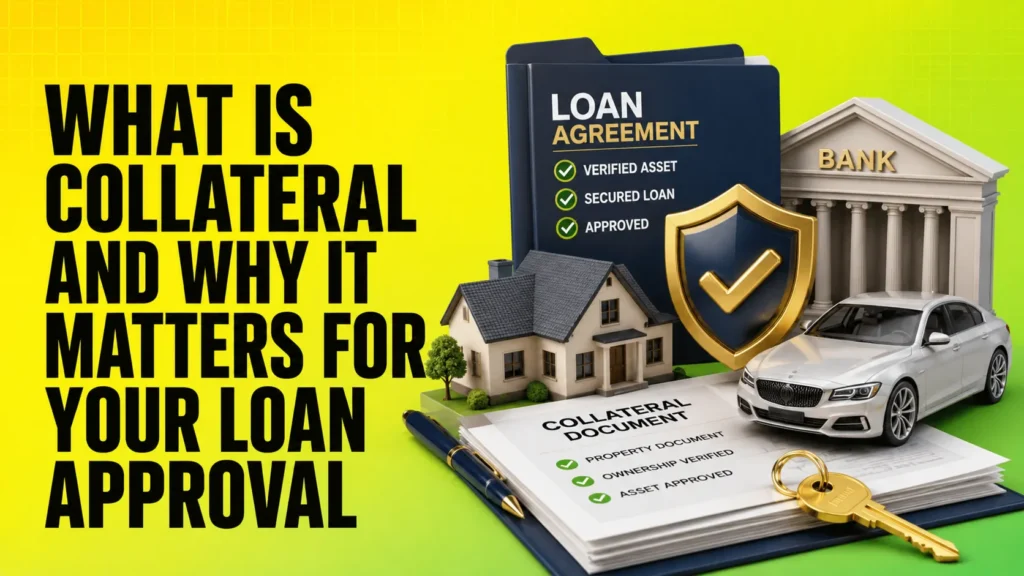
When you apply for a loan, the lender always asks one question: “How likely is it that I’ll get my money back?”
Collateral is one of the most important tools that lenders use to manage this risk.
In this guide, you will learn what collateral is, how it works, and why it can make or break your loan approval.
What Is Collateral?
Collateral is an asset pledged to a lender as security for a loan.
If you fail to repay, the lender has the legal right to take and sell the asset to recover the outstanding amount.
In simpler terms:
Collateral = Property or asset offered as a guarantee that the loan will be repaid.
Secured vs Unsecured Loans
- Secured loans
These loans require collateral.
Examples:- Home loans (property as collateral)
- Car loans (vehicle as collateral)
- Gold loans (gold ornaments as collateral)
- Unsecured loans
These loans do not require collateral.
Examples:- Most personal loans
- Credit cards
Because secured loans are backed by collateral, they usually come with better terms than unsecured loans (lower interest rates, longer tenures, and higher amounts).
Why Do Lenders Ask for Collateral?
Lenders face three major risks: default, delay, and loss. Collateral helps to reduce all three.
1. Risk Reduction
When you pledge collateral, the lender has a “backup plan”
- If you pay on time → you keep your assets and complete the loan smoothly.
- If you do not pay → the lender can sell the collateral to recover the loan.
This reduces credit risk, which is why lenders are more comfortable approving loans backed by strong collateral.
2. Better Loan Terms
Because collateral lowers the lender’s risk, you often benefit through:
- Lower interest rates
- Higher sanctioned loan amount
- Longer repayment tenure
- Higher chances of approval, especially if your credit score is moderate or limited
3. Regulatory and Internal Policies
Banks and financial institutions follow strict internal and regulatory guidelines.
Collateral helps them:
- Meet capital and risk norms
- Maintain healthier loan portfolios
- Reduce chances of non-performing assets (NPAs)
Common Types of Collateral
Different lenders accept different assets as collateral; however, these are the most common categories.
1. Property and Real Estate
- Residential houses or flats
- Plots of land (with clear title)
- Commercial properties
Property is popular as collateral because:
- It usually has high value
- It is relatively stable in price
- It is legally easier to secure with proper documentation
2. Vehicles
- Cars
- Two-wheelers
- Commercial vehicles (trucks, buses, vans)
In vehicle loans, the vehicle itself serves as collateral. If you default, the lender can repossess it.
3. Financial Assets
Lenders often accept liquid or semi-liquid financial assets such as:
- Fixed deposits (FDs)
- Government bonds
- Certain mutual funds or shares (depending on lender policy)
These assets are attractive as collateral for the following reasons:
- Easier to value
- Faster to liquidate
- Less complex legally
4. Business Assets
For business loans, collateral can include:
- Machinery and equipment
- Inventory and stock
- Accounts receivable (future payments from customers)
This helps businesses unlock capital without selling valuable assets.
5. Personal Assets (e.g., Gold)
In many markets, gold, jewelry, or other valuables may be accepted as collateral:
- Gold loans are common because gold is easy to value and sell.
- Some lenders may accept high-value items (such as artwork or rare collectibles); however, this is less common and more specialised.
4. How Collateral Affects Your Loan Approval
Collateral directly influences whether a loan is approved and on what terms.
1. Higher Loan Eligibility
When strong collateral is offered:
- Lenders are more open to sanctioning larger loan amounts.
- The value of your assets gives the lender confidence that their money is protected.
For example, if you pledge a property worth a high amount, the lender may approve a sizeable home equity or mortgage loan based on a percentage of that value.
2. Better Chances with Weak or Limited Credit History
If you:
- Have a low or moderate credit score, or
- Are new to credit (no previous loans or credit cards)
…collateral can significantly improve your approval chances.
Because the lender can fall back on the asset, they may overlook some credit limitations that would normally cause a rejection of an unsecured loan.
3. Lower Interest Rates and Flexible Terms
Secured loans often include:
- Lower interest rates than unsecured loans
- Longer tenures, making EMIs more comfortable
- Flexible repayment structures or top-up options, in some cases
In short, good collateral can translate into cheaper and more manageable borrowing.
5. How Lenders Evaluate Your Collateral
Not all collateral is equal. Lenders carefully assess collateral before approving loans.
1. Key Evaluation Factors
Typical factors include:
- Market value: Current realistic selling price of the asset
- Ownership and title: Clear legal ownership, free from disputes
- Condition: Especially for vehicles, machinery, or property
- Location: For real estate, location strongly influences value and demand
- Liquidity: How quickly and easily it can be sold
2. Loan-to-Value (LTV) Ratio
The Loan-to-Value (LTV) ratio is the percentage of an asset’s value that a lender is willing to finance.
For example:
- If your property is valued at 100,000
- And the lender offers an LTV of 70%
The maximum loan amount would be 70,000.
LTV helps lenders maintain a safety margin in case the asset’s price drops or the sale value is lower than expected.
3. Documentation and Verification
Before accepting collateral, lenders usually:
- Verify ownership documents and registration papers
- Conduct valuation through approved valuers or internal teams
- Check for existing loans, liens, or legal disputes on the asset
Only after due diligence will they approve a loan secured against your collateral.
6. Risks and Responsibilities for Borrowers
Collateral can help secure a loan, but it also comes with serious responsibilities.
1 Risk of Losing Your Asset
If you:
- Miss multiple EMIs
- Ignore repayment reminders
- Fail to settle the loan
The lender has the legal right to take possession of the collateral and sell it to recover the dues.
This could mean losing:
- Your home or land
- Your vehicle
- Your business equipment
- Your gold or savings instruments
2. Impact on Your Credit Profile
Defaulting on a secured loan may lead to the following:
- Negative entries on your credit report
- Severely reduced credit score
- Future loan rejections or tougher terms
Therefore, even though the lender has collateral, your credit reputation is still at stake.
3. Legal Consequences
In addition to repossessing collateral, lenders may
- Take legal action to recover any unpaid balance after the sale of the asset
- Charge legal and recovery fees, further increasing your liability
This is why you should pledge collateral only when you are confident about your repayment capacity.
When Should You Consider a Secured (Collateral-Backed) Loan?
Secured loans can be a smart choice in several situations.
1. You Need a Large Loan Amount
For big financial goals like:
- Buying a house
- Funding major education expenses
- Growing a business
…secured loans may be the only realistic way to borrow a large sum at a reasonable cost.
2. Your Credit Score Is Not Strong
If your credit score is average or low, collateral can:
- Offset some of the risk for the lender
- Increase your chances of approval
- Potentially reduce the interest rate compared to an unsecured option
3. You Want Lower EMIs
Secured loans can offer:
- Longer tenures, and
- More favorable rates,
…your EMIs can be more affordable, helping you to manage your monthly budget better.
8. Tips to Use Collateral Wisely
Collateral can be extremely helpful if used carefully. Here are some practical tips.
1. Borrow Only What You Can Repay
- Do not assume that you should take the maximum possible loan just because you have valuable collateral.
- Calculate realistic EMIs based on your stable income and expenses, not optimistic estimates.
2. Think About the True Value of the Asset
Ask yourself:
- “If I lose this asset, how will it affect my life or my family?”
- “Is this asset essential for my home, work, or business?”
Avoid pledging assets that are critical to your livelihood unless the loan is absolutely necessary and strategically planned for.
3. Read the Fine Print
Before signing:
- Review terms related to default and repossession
- Understand charges, penalties, and processing fees
- Clarify how the lender will handle prepayments or foreclosure
If something is unclear, ask the lender to explain it in simple language.
4. Keep Your Documents Clean and Updated
- Ensure ownership documents are in your name
- Resolve any legal or registration issues in advance
- Keep valuation reports and loan papers safely stored
This will help with loan approval and future refinancing or top-up needs.
Conclusion
Understanding what collateral is and how it works is essential before taking any secured loan.
- Collateral is an asset pledged as security, which gives the lender confidence that their money is protected.
- This can improve your chances of loan approval, lower interest rates, and increase your eligible loan amount.
- Simultaneously, it carries the serious risk of losing the pledged asset if you cannot repay.
Use collateral strategically and responsibly: borrow only what you can repay, know exactly what you are pledging, and always read your loan agreement carefully. This way, collateral becomes a powerful tool to achieve your financial goals—without putting your future at unnecessary risk.
Frequently Asked Questions
Q1. Is collateral mandatory for all loans
No. Unsecured loans, like many personal loans and credit cards, usually do not require collateral. Collateral is mainly required for secured loans, such as home loans, car loans, and many business loans.
Q2. Can I use the same collateral for multiple loans?
In most cases, no, unless:
-
The lender explicitly allows it, and
-
The asset’s value supports multiple loans with proper legal structuring
Generally, one asset is tied to one primary secured loan to avoid disputes.
Q3. Will I receive my collateral back after repayment?
Yes. Once you:
- Repay the loan in full, and
- Complete all closure formalities
…the lender will release the charge over your collateral, and you will regain full control without any loan claims on it.
Q4. What if the value of the collateral changes over time?
Asset values can increase or decrease.
- If the value increases, it usually benefits you; the lender’s position is even more secure.
- If the value decreases significantly, the lender may become cautious about new borrowing or top-ups, but existing loan terms usually remain the same unless contractually stated otherwise.