What Is EMI’s Full Form?
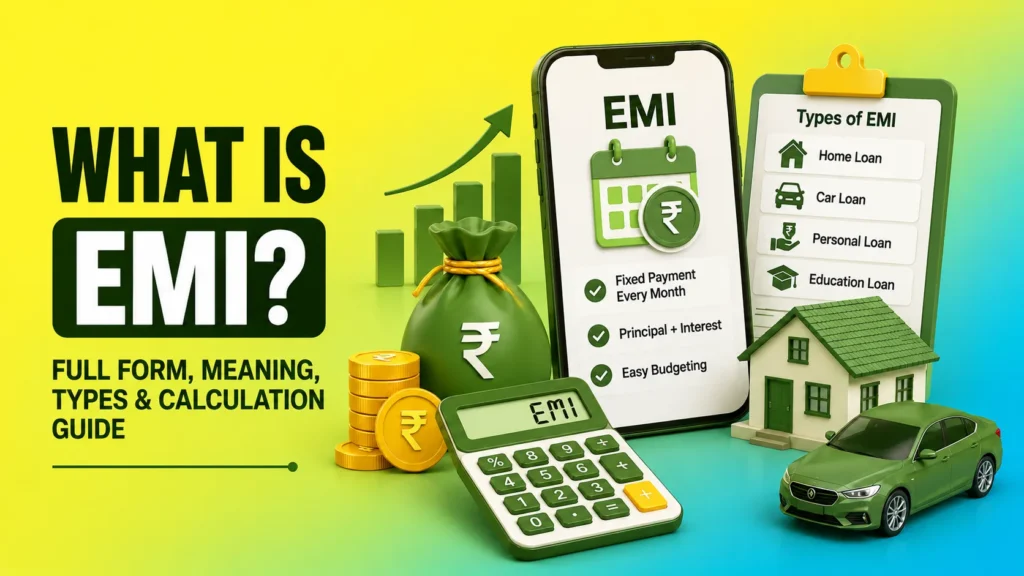
EMI stands for Equated Monthly Installment.
It is the fixed amount a borrower pays to the lender every month on a specific date until the entire loan amount, including interest, is repaid.
Read Also: what is simple interest
Meaning of EMI
An EMI is a structured way to repay a loan in equal monthly installments instead of paying the full amount at once. Each EMI consists of two main components:
- Principal: The original amount borrowed from the bank or financial institution.
- Interest – The cost charged by the lender to provide the loan.
In the early years of the loan, a larger share of the EMI goes to interest. As the outstanding principal reduces, the interest portion decreases, and the principal repayment portion increases. This gradual shift is known as amortization, which helps borrowers steadily clear their debts.
How Does EMI Work?
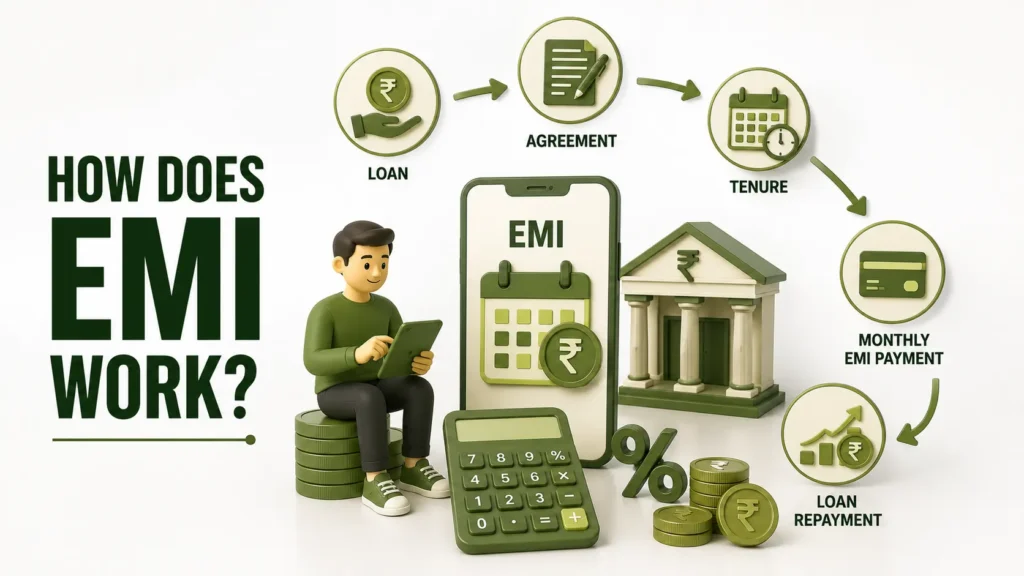
When a loan is taken, the lender calculates the total amount payable (principal + interest) and divides it into equal monthly installments over the agreed tenure. You pay the same EMI amount every month, which makes budgeting both predictable and manageable.
The EMI remains fixed in most cases when the interest rate remains fixed. However, if the loan has a floating interest rate, the EMI may change when the lender revises the interest rate. Borrowers can also reduce their EMI or loan tenure by making part-prepayments whenever they have surplus funds to do so.
Types of EMI
There are a few common types of EMI based on how interest is calculated and when payments start.
- 1. Fixed EMI The EMI amount remains the same throughout the loan tenure. This type is preferred by borrowers who want stable and predictable monthly payments.
- 2. Reducing Balance EMI (also called Diminishing Balance) Interest is calculated only on the outstanding principal every month. As the principal reduces with every payment, the interest component also decreases. This method usually results in lower total interest compared to a fixed-rate structure and is commonly used by banks and NBFCs in India for home, car, and personal loans.
- 3. EMI in Arrears is the standard form. The full loan amount (minus processing charges) is disbursed first, and EMI payments start the following month.
- 4. EMI in Advance One EMI is deducted at the time of loan disbursement, along with processing charges. The remaining amount is then credited to the borrower’s account.
- 5. Pre-EMI In home or education loans, only the interest is paid during the initial period (for example, during the construction of a house or while studying). Full EMI (principal + interest) starts later, once the property is ready or the course is completed.
EMI Calculation Formula
Read Also: calculate your EMI
Banks and financial institutions use the following standard formula to calculate EMI:
EMI=P×R×(1+R)N(1+R)N−1EMI = \frac{P \times R \times (1 + R)^N}{(1 + R)^N – 1}EMI=(1+R)N−1P×R×(1+R)N
Where:
- P = Principal loan amount
- R = Monthly interest rate (Annual interest rate ÷ 12 ÷ 100)
- N = Loan tenure in months
Example
Suppose you take a loan of ₹10,00,000 at an annual interest rate of 10% for a tenure of 10 years (i.e., 120 months).
Monthly interest rate (R) = 10 ÷ 12 ÷ 100 = 0.008333
Using this formula, the EMI is approximately ₹13,215.
Over 120 months, the total amount payable will be around ₹15,85,800. Of this, ₹10,00,000 is the principal, and the remaining ₹5,85,800 is the interest.
Online EMI calculators available on bank websites can also be used. Simply enter the loan amount, interest rate, and tenure to obtain an instant and accurate result.
Factors That Influence Your EMI
Several factors determine the amount of EMI you will pay every month:
- Loan Amount: A higher principal leads to a higher EMI.
- Interest Rate: Higher rates increase the monthly installment.
- Loan Tenure: A longer tenure reduces the EMI but increases the total interest paid. A shorter tenure raises the EMI but lowers the overall interest costs.
- Down Payment: A larger down payment reduces the loan amount and, therefore, the EMI.
- Credit Score: A good credit score often helps you get a lower interest rate, which reduces the EMI.
- Type of Interest – Fixed or floating rates affect whether the EMI remains constant or changes over time.
Benefits of EMI
- Makes large purchases affordable by breaking them into smaller monthly payments.
- It helps in better monthly budgeting because the amount is fixed and predictable.
- It encourages financial discipline through regular payments.
- Timely EMI payments positively affect your credit score.
- They allow you to own assets or fulfill important needs without waiting years to save the full amount.
Read Also: tax-saving investments under Section 80C
Conclusion
The Equated Monthly Installment (EMI) is a practical and widely used method for repaying loans in a structured manner. Knowing the full form, meaning, different types, and correct calculation method helps you choose the right loan terms and manage your finances responsibly. Before taking any loan, always calculate the EMI, check the interest rate, and ensure that the monthly payment fits comfortably within your budget.
Properly understanding EMI allows you to make informed decisions and stay in control of your financial commitments.